
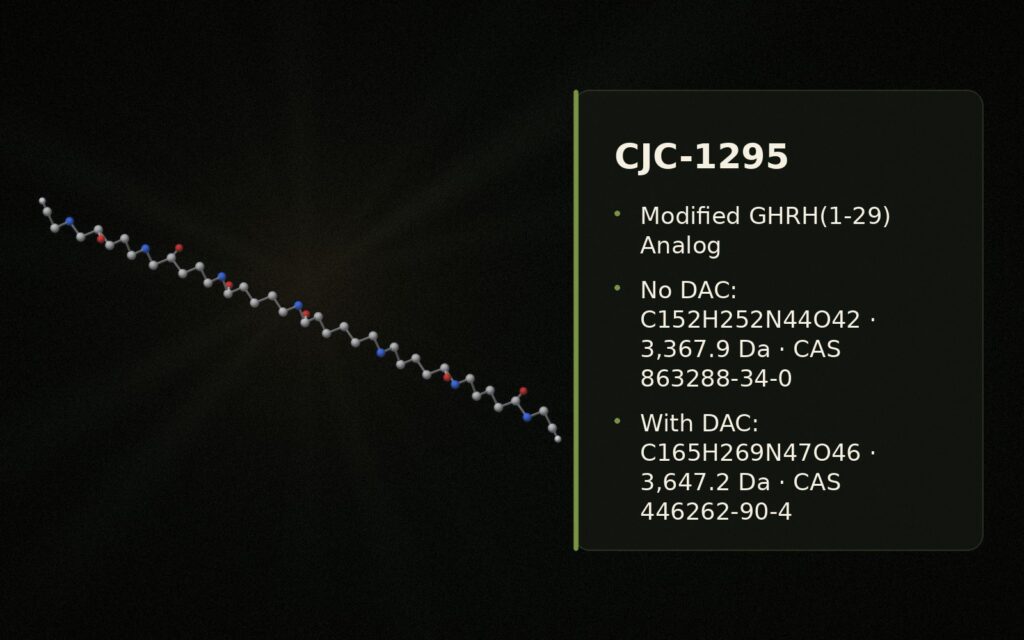
CJC-1295 is one of the more frequently searched names in the growth-hormone-releasing-hormone (GHRH) analog research space, and one of the more confusingly marketed. The name is used, often inconsistently across vendor websites, to describe two distinct research peptides: CJC-1295 without DAC (more precisely called Modified GRF 1-29, or Mod GRF 1-29) and CJC-1295 with DAC (the molecule the name originally referred to in the peer-reviewed literature). The two share the same 29-amino-acid GHRH-analog backbone but differ in one deliberately engineered chemical feature — a Drug Affinity Complex (DAC) tag — that changes the molecule’s size, half-life, and research use case considerably.
This article is written for laboratory researchers and institutional buyers evaluating these compounds for legitimate in vitro, ex vivo, or animal research. Both forms are sold by Vericor Bioscience strictly as research-use-only (RUO) laboratory chemicals. Neither form of CJC-1295 is approved by the FDA for any human use, neither is intended for human consumption or self-administration, and nothing in this article should be read as instruction, encouragement, or guidance for using either compound in or on a person. Where we describe effects on growth hormone (GH) or insulin-like growth factor 1 (IGF-1), those findings come from published preclinical and clinical-trial literature conducted by outside investigators and sponsors — not from Vericor Bioscience, and not from anecdotal consumer use. Because online marketing for this compound family is inconsistent — some vendors use “CJC-1295” to mean only the DAC-conjugated molecule, others use it loosely for either form — a central goal of this article is to make the distinction unambiguous before discussing mechanism, evidence, or regulatory status.
Featured definition: What is CJC-1295?
CJC-1295 refers to a pair of related synthetic peptide analogs of human growth-hormone-releasing hormone (GHRH), both built on the same modified 29-amino-acid GHRH(1-29) sequence. CJC-1295 without DAC (Mod GRF 1-29) is the 29-amino-acid peptide alone, with amino-acid substitutions designed to resist enzymatic breakdown; its plasma half-life is measured in minutes. CJC-1295 with DAC is the same peptide backbone with an additional C-terminal lysine bearing a maleimidopropionyl group — the Drug Affinity Complex — that forms a covalent bond with circulating serum albumin after administration, extending the molecule’s functional half-life to roughly 6–8 days. Both were developed by the Canadian biotechnology company ConjuChem Biotechnologies as long-acting GHRH-receptor agonists intended, in early drug-development research, to stimulate pulsatile GH release. Neither form has received FDA approval, and both are available in the United States only as research-use-only laboratory compounds.
What Is CJC-1295? GHRH Analog Background
Growth-hormone-releasing hormone (GHRH) is a 44-amino-acid hypothalamic hormone (its first 29 residues, GRF(1-29), retain full biological activity) that binds the GHRH receptor (GHRHR) on somatotroph cells in the anterior pituitary, triggering pulsatile secretion of growth hormone. Native GRF(1-29) — also sold as sermorelin — is degraded extremely quickly in circulation, with a reported plasma half-life under ten minutes, largely due to cleavage by the enzyme dipeptidyl peptidase-4 (DPP-IV) at the second amino acid position and general proteolytic instability.
In the early-to-mid 2000s, researchers at ConjuChem Biotechnologies pursued a structure-based strategy to extend the functional lifetime of a GRF(1-29) analog for drug-development research, combining two independent modifications:
- Point substitutions at four positions in the native GRF(1-29) sequence (including a D-alanine at position 2) designed to confer resistance to DPP-IV and other proteolytic enzymes, extending the peptide’s own intrinsic half-life from single-digit minutes to roughly 30 minutes. This modified 29-amino-acid peptide is the molecule now generally called Mod GRF 1-29, or CJC-1295 without DAC.
- A separate bioconjugation chemistry, called Drug Affinity Complex (DAC) technology, in which a maleimidopropionic acid group attached to an additional C-terminal lysine reacts with a free cysteine residue on circulating albumin, covalently tethering the peptide to the much larger and much longer-lived albumin protein. This produces the second, larger molecule that the peer-reviewed literature originally named CJC-1295 (sometimes written DAC:GRF), and which is now more commonly distinguished in the marketplace as CJC-1295 with DAC.
Both molecules act on the same receptor system and are studied for the same general question — sustained GHRH-receptor stimulation of the GH/IGF-1 axis — but they are pharmacologically distinct research tools with very different exposure profiles, and researchers should never treat published data on one form as automatically applicable to the other.
CJC-1295 Without DAC vs. With DAC: Chemical Identity and Half-Life
The table below summarizes the verified chemical identity of each form, drawn from chemical reference sources (PubChem, ChemicalBook) and the peptide-chemistry literature.
| Property | CJC-1295 Without DAC (Mod GRF 1-29) | CJC-1295 With DAC |
|---|---|---|
| CAS number | 863288-34-0 | 446262-90-4 |
| Molecular formula | C₁₅₂H₂₅₂N₄₄O₄₂ | C₁₆₅H₂₆₉N₄₇O₄₆ |
| Molecular weight | ≈ 3,367.9 g/mol | ≈ 3,647.2 g/mol |
| Amino acid count | 29 residues (modified GRF 1-29 sequence, C-terminally amidated) | Same 29-residue backbone plus a C-terminal lysine-DAC (maleimidopropionyl) extension |
| Key structural feature | D-alanine and other substitutions conferring DPP-IV/protease resistance | All of the above, plus a reactive maleimide group that forms a covalent bond with serum albumin |
| Reported plasma half-life | On the order of 30 minutes (versus under 10 minutes for unmodified GRF 1-29) | Approximately 6–8 days, attributed to covalent albumin binding |
| Typical research role | Short-acting GHRH-receptor agonist for acute-exposure or pulsatile-signaling study designs | Long-acting GHRH-receptor agonist for sustained-exposure study designs |
Why DAC extends half-life. Albumin is the most abundant protein in blood plasma and has an endogenous half-life of roughly three weeks. By forming a stable covalent linkage to a free cysteine on circulating albumin, the DAC-conjugated peptide is effectively shielded from rapid renal clearance and proteolytic degradation, and its clearance rate becomes tied to albumin’s own turnover rather than to the peptide’s intrinsic stability.
Practical implication for researchers. Because the two forms differ by roughly 8% in molecular weight and by more than two orders of magnitude in functional half-life, they are not interchangeable in a study design. A protocol modeling acute, pulsatile GHRH-receptor activation is a fundamentally different experiment from one modeling sustained receptor occupancy over days, and data generated with one form cannot be assumed to generalize to the other.
Proposed Mechanism of Action
Both forms of CJC-1295 are proposed, in the pharmacology literature, to act through the same receptor-level mechanism:
- GHRH receptor agonism. Both molecules bind the GHRH receptor (a class II G-protein-coupled receptor) on anterior pituitary somatotroph cells, activating the same downstream cyclic-AMP signaling cascade engaged by endogenous GHRH.
- Pulsatile, not continuous, GH release. Published pharmacology work emphasizes that even the long-acting DAC form is reported to preserve the pulsatile pattern of GH secretion characteristic of the intact hypothalamic-pituitary axis, rather than producing a flat, continuously elevated GH level — a distinction researchers designing endocrine studies should note carefully, since it differs from what would be expected of a receptor agonist with a simple sustained-release profile.
- Downstream GH/IGF-1 axis activity. GH released from the pituitary acts primarily on the liver (and other tissues) to stimulate production of IGF-1, the mediator of most of GH’s growth-related and metabolic signaling. Published studies of both CJC-1295 forms use IGF-1 elevation, alongside direct GH measurement, as a pharmacodynamic marker of GHRH-receptor engagement.
- DPP-IV resistance as an upstream determinant. The D-alanine substitution shared by both forms is specifically credited in the literature with protecting the peptide from DPP-IV-mediated cleavage, which is the dominant degradation pathway for native GRF(1-29) and is proposed as the reason even the non-DAC form outlasts the unmodified hormone.
Researchers should treat this as a receptor-and-axis-level working model derived from a mix of animal pharmacology and a small number of controlled human studies (below) — not as a fully characterized human pharmacological pathway with established dose-response relationships across populations.
Preclinical and Human Research Findings
Animal pharmacology. A study published in the American Journal of Physiology–Endocrinology and Metabolism examined once-daily administration of CJC-1295 (DAC form) in GHRH-knockout mice — animals that lack endogenous GHRH and consequently show impaired growth. The peptide was reported to normalize growth parameters in this model, consistent with GHRH-receptor agonist activity. The compound has also reportedly been characterized in dogs and pigs as part of its pharmacokinetic development program, in addition to the human work described below.
Human pharmacodynamics (single- and multiple-dose study). The most frequently cited human data on CJC-1295 with DAC comes from a study published in the Journal of Clinical Endocrinology & Metabolism (Teichman et al., 2006), which examined the compound in healthy adult volunteers. According to published summaries of this work, a single subcutaneous dose produced a sustained elevation of plasma GH (reported on the order of a 2- to 10-fold increase over 6 or more days) and a corresponding rise in IGF-1 (roughly 0.5- to 3-fold) lasting 9 to 11 days after a single injection. With repeated weekly dosing, IGF-1 elevation was reported to persist for as long as 28 days. This study is one of the few controlled human datasets available for either form of CJC-1295 and is the primary basis for the “long-acting GHRH analog” characterization used throughout the research literature.
Human clinical trial program and its discontinuation. CJC-1295 with DAC was carried into a Phase II, multicenter, randomized, double-blind, placebo-controlled clinical trial sponsored by ConjuChem, enrolling approximately 192 participants with HIV-associated visceral fat accumulation (lipodystrophy), using once-weekly injections. In July 2006, shortly after enrollment completed, the sponsor halted the trial following the death of one participant at a study site in Argentina, reportedly occurring some hours after that individual’s eleventh injection. Investigators attributed the death to pre-existing, asymptomatic coronary artery disease rather than the study drug, but the sponsor terminated further clinical development as a precaution. No completed New Drug Application or FDA approval has ever followed from this or any other CJC-1295 development effort, for either form.
What has not been established. There is no published, adequately powered, placebo-controlled efficacy trial demonstrating a specific clinical outcome (body composition, functional recovery, or any other endpoint) for either form of CJC-1295 in humans. The available human data is pharmacodynamic (GH/IGF-1 level changes) and safety/tolerability data from a discontinued Phase II program — not efficacy data. Essentially all detailed human pharmacokinetic and pharmacodynamic characterization in the literature concerns the DAC-conjugated form; substantially less controlled human data exists for CJC-1295 without DAC (Mod GRF 1-29) on its own.
Evidence by Research Level
| Research Level | What Has Been Studied | Applies To | Strength of Evidence |
|---|---|---|---|
| Receptor / in vitro pharmacology | GHRH-receptor binding and activation, DPP-IV resistance of modified sequence | Both forms (shared backbone) | Foundational; establishes proposed mechanism |
| Animal models | GHRH-knockout mouse growth normalization; pharmacokinetic characterization in dogs and pigs | Primarily DAC form | Preliminary-to-moderate; species-specific translation uncertain |
| Human Phase I / pharmacodynamics | Single- and multiple-dose GH and IGF-1 response in healthy adults | DAC form specifically | Documented in one key published trial; not independently replicated at scale |
| Human Phase II efficacy trial | Randomized, placebo-controlled trial in HIV-associated lipodystrophy | DAC form specifically | Conducted but discontinued after a safety-related halt; no completed efficacy readout published |
| Approved clinical use | Any FDA-approved indication, for either form | Neither form | None — no approval exists for CJC-1295 without DAC or with DAC |
U.S. Regulatory Status
The following reflects publicly available FDA and regulatory-history information as of this writing. Regulatory status for compounded and bulk substances can change, and researchers should independently verify current status through primary FDA sources before making compliance decisions.
- No FDA approval, for either form. CJC-1295 without DAC and CJC-1295 with DAC are not approved by the FDA for any human therapeutic, diagnostic, or preventive use. The only sponsor-run human clinical development effort (the DAC form’s Phase II lipodystrophy trial) was discontinued in 2006 following the safety-related halt described above, and no New Drug Application has ever been completed or approved for either molecule.
- 503A Bulks List history. CJC-1295 was included in FDA’s interim 503A bulks list Category 2 — the category FDA uses for bulk drug substances it has identified as raising significant safety risks — in the agency’s list revisions published in 2023. In FDA’s subsequent 2026 review activity, in which the agency removed a number of other research peptides from Category 2 pending formal Pharmacy Compounding Advisory Committee (PCAC) evaluation, publicly reported summaries do not list CJC-1295 among the substances removed, indicating it has continued to be treated as a Category 2 substance rather than cleared for 503A compounding. This means CJC-1295, in either form, is not lawfully positioned as an ingredient in compounded human prescription products.
- Anti-doping status. CJC-1295 (both forms) is listed by the World Anti-Doping Agency (WADA) among prohibited growth-hormone-releasing substances, reflecting its classification as a growth-hormone secretagogue rather than any assessment of general safety.
- Research-use-only status. In the United States, both forms are lawfully offered only as research-use-only laboratory chemicals for qualified personnel and institutions, not for human consumption, compounding, or clinical administration.
- General enforcement climate. FDA has taken enforcement action against companies marketing peptide products, as a category, for unapproved human use, unsubstantiated therapeutic claims, or misbranding. Researchers should treat GHRH-analog and growth-hormone-secretagogue peptides as an area of continued regulatory attention and never present RUO material as suitable for human use.
Safety Considerations and Unknown Risks
Documentation submitted in connection with FDA’s compounding-substance review process for CJC-1295 identifies several safety considerations relevant to its pharmacological class (GH secretagogues/GHRH analogs) that researchers should be aware of when designing studies or evaluating literature:
- Reported adverse findings in the discontinued Phase II program. Aside from the single death discussed above, commonly reported adverse events associated with CJC-1295 (DAC form) administration in available clinical documentation include injection-site flushing and erythema, rash, edema (fluid retention), joint and muscle pain, and fatigue — a pattern broadly consistent with what is reported for growth-hormone-axis stimulation generally.
- Theoretical mitogenic (cell-growth) considerations. Because growth hormone and IGF-1 signaling can influence cell proliferation, safety guidance associated with this compound class flags caution regarding use in any research model with pre-existing or suspected neoplastic disease, and calls for careful interpretation of proliferation-related endpoints.
- Potential effects on glucose/insulin physiology and thyroid-axis interaction. GH-axis activation is documented in the broader endocrinology literature to influence insulin sensitivity and can mask symptoms of hypothyroidism; researchers studying GHRH analogs should account for both in any metabolic or endocrine study design.
- No established safety data in specific populations. Available documentation explicitly notes that safety in pregnancy and in pediatric populations has not been established, for either form.
- No long-term human surveillance data. Because neither form has ever been approved or marketed for ongoing human use, there is no post-market surveillance dataset comparable to what exists for an approved pharmaceutical.
- Risk-profile differences between the two forms are not well separated in the literature. Because almost all detailed human safety data concerns the DAC-conjugated (long-acting) molecule, researchers should not assume the short-acting non-DAC form (Mod GRF 1-29) shares an identical risk profile, or the reverse — the two have not been directly compared head-to-head in a controlled human safety study.
- Sourcing and purity risk. As with any peptide obtained outside a validated pharmaceutical supply chain, identity, purity, and degradation state can vary substantially between sources. Research use should involve independent analytical verification (e.g., HPLC, mass spectrometry) rather than reliance on vendor claims alone.
Neither CJC-1295 without DAC nor CJC-1295 with DAC is intended for human use of any kind. Both should be handled only by qualified personnel in appropriate laboratory settings, following institutional biosafety and chemical-handling protocols and all applicable research-use regulations.
Research Evaluation Checklist
Researchers evaluating either form of CJC-1295 — or any RUO GHRH-analog peptide — should consider working through the following steps before drawing conclusions from vendor or third-party materials:
- Confirm which form is being discussed. Verify whether a source, product listing, or dataset refers to CJC-1295 without DAC (Mod GRF 1-29) or CJC-1295 with DAC — the two are not interchangeable, and much marketing language blurs the distinction.
- Verify chemical identity independently. Confirm molecular formula, molecular weight, CAS number, and sequence against a primary chemical database (e.g., PubChem, ChemicalBook) rather than a vendor product page alone.
- Trace pharmacodynamic claims to primary literature. Identify whether a GH/IGF-1 elevation claim originates from the peer-reviewed Teichman et al. (2006) human study, an animal pharmacology paper, or unsourced marketing copy.
- Review the discontinued clinical trial history. The DAC form’s only sponsor-run human efficacy trial was halted following a participant death and never resumed; no efficacy data from that program has been published.
- Confirm current 503A bulks list and FDA status directly. Check FDA sources rather than a supplier’s characterization of legality, and re-verify periodically given the pace of 2026 bulks-list revisions.
- Demand analytical documentation. Request a current, lot-specific Certificate of Analysis (COA) confirming identity, purity, and which form of CJC-1295 it covers.
- Design studies around the correct half-life profile. Match study duration and dosing-interval assumptions to the pharmacokinetics of the specific form used (minutes for non-DAC; days for DAC).
- Confirm RUO labeling and handling practices. Ensure the product is labeled and distributed strictly for laboratory research use, with no suggestion of human dosing or therapeutic outcomes.
People Also Ask About CJC-1295
They share the same modified 29-amino-acid GHRH-analog backbone, but CJC-1295 with DAC carries an additional C-terminal lysine-based Drug Affinity Complex tag that covalently binds circulating albumin, extending its functional half-life from roughly 30 minutes (without DAC) to approximately 6–8 days (with DAC). They are different molecules with different molecular weights (≈3,368 g/mol vs. ≈3,647 g/mol) and are used to model different exposure durations in research.
No. Neither CJC-1295 without DAC nor CJC-1295 with DAC has received FDA approval for any indication. The only sponsor-run human clinical trial program (a Phase II study of the DAC form) was discontinued in 2006 and was never resumed or completed.
Mod GRF 1-29 and “CJC-1295 without DAC” refer to the same molecule — a modified, protease-resistant 29-amino-acid GHRH(1-29) analog without the albumin-binding DAC modification. It is chemically distinct from CJC-1295 with DAC, which is the larger, longer-lived, DAC-conjugated molecule.
A Phase II, placebo-controlled trial of CJC-1295 with DAC in approximately 192 participants with HIV-associated lipodystrophy was halted in July 2006 after a participant died at a study site in Argentina. Investigators reported the death was attributed to pre-existing coronary artery disease, but the sponsor discontinued further development of the compound as a precaution.
CJC-1295, in either form, can be lawfully purchased in the United States only as a research-use-only chemical intended strictly for laboratory research by qualified personnel or institutions — not for human consumption, compounding into prescriptions, or clinical administration.
No controlled human efficacy trial has established that either form of CJC-1295 produces any specific outcome in a person, including changes in muscle mass or markers of aging. Available human data is limited to pharmacodynamic measurements (GH and IGF-1 levels) from a small number of studies and safety data from a discontinued trial — not efficacy data supporting outcome-based claims. Framing either compound as an anti-aging or body-composition product is not supported by its research record.
Expert CJC-1295 Q&A
From a chemistry standpoint, why does adding a DAC tag change the half-life so dramatically?
The DAC modification hijacks a much larger, longer-lived carrier — serum albumin, which has a half-life of roughly three weeks — by forming a covalent bond to one of its free cysteine residues. Once conjugated, the peptide’s clearance is effectively governed by albumin’s turnover rather than its own susceptibility to proteolysis, which is why the functional half-life jumps from around 30 minutes to roughly 6–8 days despite the peptide backbone itself being nearly identical.
Why does published human data concentrate so heavily on the DAC form rather than Mod GRF 1-29?
The DAC-conjugated molecule was the version ConjuChem carried furthest into drug-development research, including the Phase I/II human program, because its extended half-life was the scientifically and commercially relevant property for a once-weekly injectable candidate. Mod GRF 1-29 has a much shorter pedigree as a standalone human-studied compound — an important caveat for anyone assuming the two forms are equally characterized.
Does the pulsatile GH release reported for the DAC form mean it behaves differently from a typical long-acting drug?
That is the mechanistic claim in the pharmacology literature — that despite a multi-day half-life, the DAC-conjugated molecule was reported to preserve pulsatile GH secretion rather than flat, continuously elevated GH. Researchers should treat this as a specific, testable pharmacodynamic claim from a limited dataset, not an established universal property.
What should a researcher take away from the 2006 trial halt when designing new studies?
The halt is a reminder that even an event ultimately assessed as unrelated to a study drug can and should stop a program pending investigation — appropriate clinical-trial safety practice, not evidence of a specific causal mechanism. The more durable lesson is that efficacy in the lipodystrophy indication was never established, because the trial did not reach a completed efficacy readout before being discontinued.
How should a lab decide which form of CJC-1295 to use in a study?
The decision should be driven by the exposure duration the study is designed to model — acute, transient GHRH-receptor activation favors the non-DAC form; sustained, multi-day receptor engagement favors the DAC form. Given how much more human pharmacodynamic data exists for the DAC form specifically, researchers working with the non-DAC form should be especially careful not to extrapolate DAC-form findings without independent verification.
Conclusion
CJC-1295 is really two related research compounds wearing one popular name. CJC-1295 without DAC (Mod GRF 1-29) is a protease-resistant, short-acting 29-amino-acid GHRH analog; CJC-1295 with DAC is the same backbone extended with an albumin-binding Drug Affinity Complex that stretches its functional half-life from roughly 30 minutes to roughly a week. Both are proposed to work through GHRH-receptor agonism on the pituitary GH/IGF-1 axis, and the DAC form in particular has a genuine, published human pharmacodynamic dataset and a discontinued Phase II clinical trial history behind it — a history that includes a real safety-related trial halt researchers should understand rather than gloss over. Neither form has ever been approved by the FDA for any use, and CJC-1295 has continued to be treated as a Category 2 substance on FDA’s interim 503A bulks list rather than cleared for compounding, distinguishing its current regulatory posture from several other research peptides.
CJC-1295, in either form, is not intended for human use, self-administration, or any diagnostic or therapeutic purpose, and nothing in this article should be construed as such. Qualified researchers who want to review current specifications and analytical documentation for CJC-1295 without DAC or CJC-1295 with DAC as laboratory research compounds can visit Vericor Bioscience’s research product pages for each form.