
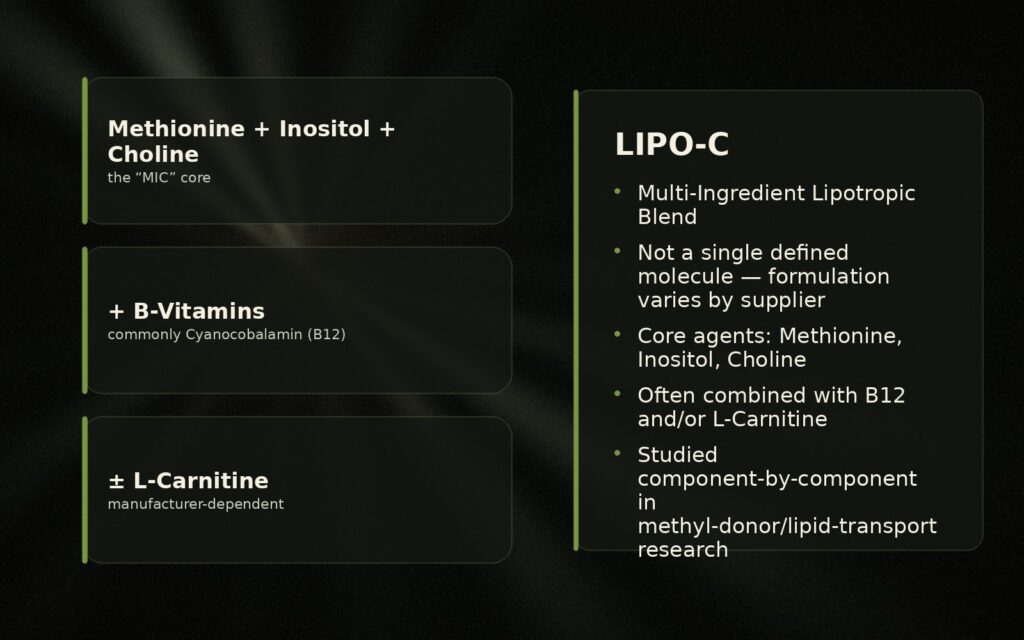
LIPO-C is a blend name used across the compounding and research-chemical marketplace for a combination of nutritional and biochemical agents — most commonly methionine, inositol, and choline (the “MIC” core), frequently combined with B-vitamins such as cyanocobalamin (B12) and sometimes L-carnitine. It is not a single defined molecule, and it is not a weight-loss or fat-burning product as offered by Vericor Bioscience. The material referenced on this site is sold strictly for laboratory research use only (RUO) — not for human use, not as a weight-management or body-composition product, and not as an FDA-approved drug of any kind.
Featured definition: LIPO-C refers to a multi-ingredient “lipotropic” blend — typically methionine, inositol, and choline plus B-vitamins and/or L-carnitine — historically marketed as an injectable for fat metabolism support; as a research compound it is studied component-by-component for its role in methyl-donor and hepatic lipid-transport biochemistry, not administered to humans or evaluated as a weight-loss intervention.
What Is LIPO-C?
Unlike a single-molecule research peptide, “LIPO-C” is a category name for a blend, and its exact formulation is not standardized across the marketplace. Compounding pharmacies and research suppliers that use the name generally build it around what is historically called the “MIC” combination — methionine, inositol, and choline — with additional ingredients layered in depending on the manufacturer. Publicly available formulation sheets from compounding sources describe per-milliliter concentrations along these lines (illustrative of typical industry formulations, not a fixed universal standard):
- Methionine — commonly in the range of roughly 10–25 mg/mL
- Inositol — commonly in the range of roughly 25–50 mg/mL
- Choline (typically as choline chloride) — commonly in the range of roughly 25–50 mg/mL
- L-Carnitine — often included, roughly 25–50 mg/mL, in blends that add it
- B-vitamins — cyanocobalamin (B12) is very frequently paired with or included in MIC/LIPO-C formulations; pyridoxine (B6), thiamine (B1), and dexpanthenol (B5) also appear in some manufacturers’ versions
Because there is no single regulatory monograph that fixes “LIPO-C” as a defined article, researchers should treat any specific product’s composition as manufacturer-specific and always verify the actual certificate of analysis (COA) for the exact lot in question rather than assuming a standardized recipe. This is a meaningful distinction from a single well-characterized molecule, and it is one reason this guide addresses each component’s chemistry individually rather than presenting a single fabricated “LIPO-C molecular formula” — no such single formula exists, because LIPO-C is a blend, not a compound.
Historically, blends of this type have been marketed in medical spa and wellness-clinic settings as “lipotropic” or “fat-burning” injections, frequently alongside vitamin B12 shots, as part of consumer weight-management programs. Vericor Bioscience does not offer, market, or position its LIPO-C research material in that way. The product described on this site exists strictly for in vitro, analytical, and non-clinical laboratory research into the individual and combined biochemistry of methyl-donor nutrients and B-vitamin cofactors — not as a weight-loss product, not as a consumer wellness injection, and not for any form of human or animal administration outside an authorized research protocol.
Chemical Identity of Each Component
Rather than inventing a single “LIPO-C” structure, the chemistry of each real, individually well-characterized ingredient is summarized below.
L-Methionine An essential, sulfur-containing amino acid. Molecular formula C₅H₁₁NO₂S, molecular weight approximately 149.21 g/mol, CAS number 63-68-3. Methionine is a proteinogenic amino acid obtained from diet (mammals cannot synthesize it de novo) and is the metabolic precursor to S-adenosylmethionine (SAMe), the principal methyl-group donor used throughout cellular biochemistry, including in the choline/betaine-homocysteine remethylation cycle.
Choline (commonly supplied as choline chloride) Choline itself is a quaternary ammonium cation, C₅H₁₄NO⁺; choline chloride, the salt form typically used in injectable formulations, has CAS number 67-48-1. Choline is classified as an essential nutrient (the U.S. National Academy of Medicine set a formal Adequate Intake level for choline in 1998) and is required for synthesis of phosphatidylcholine (a major structural phospholipid) and acetylcholine, as well as serving — via its oxidized metabolite betaine — as a methyl donor.
Myo-inositol A naturally occurring cyclitol (a cyclic sugar alcohol), molecular formula C₆H₁₂O₆, molecular weight approximately 180.16 g/mol, CAS number 87-89-8. Myo-inositol is the precursor for phosphatidylinositol and its phosphorylated derivatives, which function as membrane signaling lipids and second-messenger precursors in cellular research.
Cyanocobalamin (Vitamin B12) A cobalt-containing corrinoid compound, molecular formula C₆₃H₈₈CoN₁₄O₁₄P, molecular weight approximately 1355.4 g/mol, CAS number 68-19-9. Cyanocobalamin is a synthetic, stable form of vitamin B12 used in injectable and supplement formulations; in vivo it is converted to the active coenzyme forms (methylcobalamin and adenosylcobalamin) required for methionine synthase and methylmalonyl-CoA mutase activity.
L-Carnitine (in formulations that include it) A quaternary ammonium compound derived from lysine and methionine, molecular formula C₇H₁₅NO₃, molecular weight approximately 161.20 g/mol, CAS number 541-15-1. L-carnitine’s well-established biochemical role is shuttling long-chain fatty acids across the inner mitochondrial membrane for beta-oxidation.
Each of these substances is independently well characterized in the pharmacological and nutritional-biochemistry literature. What is not independently characterized — because it does not exist as a single defined chemical entity — is a unified “LIPO-C molecule.” Any research protocol involving a LIPO-C blend should document and verify each individual constituent and its concentration rather than treating the blend as a single active pharmaceutical ingredient.
Proposed Mechanism: Lipotropic Biochemistry
The term “lipotropic,” which predates modern injectable marketing by decades, originates in basic nutritional biochemistry research on how the liver processes and exports fat. The core mechanistic threads researchers associate with the LIPO-C constituents are:
- Methyl-donor metabolism. Methionine, via conversion to S-adenosylmethionine (SAM), and choline, via its oxidation to betaine, both feed into the one-carbon/methyl-donor metabolic network. This network is studied for its role in synthesizing phosphatidylcholine — a phospholipid required to package triglycerides into very-low-density lipoprotein (VLDL) particles for export from hepatocytes. In classic animal-model research (dating back to early-to-mid 20th century studies establishing the “lipotropic factor” concept), diets deficient in methionine and choline were shown to produce hepatic steatosis (fatty liver), which could be prevented or reversed by supplementing these lipotropic factors — a finding still referenced in modern methionine-choline-deficient (MCD) diet models used to study non-alcoholic fatty liver disease (NAFLD) in rodents.
- Phosphatidylinositol signaling. Inositol’s role as a precursor to phosphatidylinositol and inositol phosphates situates it within cell-signaling research (including insulin-signaling pathways), which is a separate line of basic-science interest from, and should not be conflated with, any claim about fat loss in intact organisms.
- B12 as an essential cofactor for methionine regeneration. Vitamin B12 (as methylcobalamin) is the essential cofactor for methionine synthase, the enzyme that remethylates homocysteine back to methionine. This connects B12 status directly to the methyl-donor pool described above, and is why B12 is so frequently included alongside MIC — a mechanistic rationale grounded in one-carbon metabolism, not in an independent “energy” or “metabolism-boosting” effect.
- Carnitine and mitochondrial fatty-acid oxidation. Where included, L-carnitine’s transport function is studied in the context of how fatty acids are shuttled into mitochondria for oxidation — a distinct, well-established biochemical role from the methyl-donor pathways above.
It is important to be precise about what this research literature does and does not show. The classic lipotropic-factor experiments were conducted primarily in animal models under conditions of frank dietary deficiency, establishing that methionine/choline deficiency causes hepatic fat accumulation and that repletion reverses it. This is scientifically distinct from — and should never be presented as equivalent to — a claim that injecting these nutrients into a non-deficient human will produce fat loss, reduced body fat, or any weight-management outcome. Vericor Bioscience does not make, and does not authorize any reader to infer, such a claim from the material on this site.
Research Findings
The individual components of LIPO-C blends each have a genuine, if uneven, evidence base rooted in nutritional biochemistry — separate from the much thinner and largely uncontrolled literature on injectable lipotropic blends as marketed for weight loss.
- Methionine and choline deficiency / hepatic steatosis models. Well-established rodent research using methionine-choline-deficient (MCD) diets reliably produces hepatic steatosis, inflammation, and fibrosis, and is one of the most widely used experimental models for studying NAFLD/NASH pathophysiology. This is basic-science model literature, not evidence that supplementing an already-sufficient organism accelerates fat loss.
- Choline as an essential nutrient. The U.S. National Academy of Medicine (Institute of Medicine) formally recognized choline as an essential nutrient in 1998, with an Adequate Intake level set specifically because human studies demonstrated that choline-deficient diets produce liver and muscle damage, reversible with choline repletion. This is a genuine, well-replicated clinical nutrition finding.
- Inositol in insulin-signaling and reproductive-endocrine research. Myo-inositol (and its stereoisomer D-chiro-inositol) has a substantial clinical-trial literature specifically in polycystic ovary syndrome (PCOS) research, examining effects on insulin sensitivity and ovulatory function — a legitimate, actively studied area, but one focused on metabolic/endocrine signaling rather than fat-loss outcomes.
- Vitamin B12 deficiency research. B12’s role in preventing megaloblastic anemia and neurological damage from deficiency is extensively documented (NIH Office of Dietary Supplements). Correcting a true B12 deficiency reliably improves associated symptoms; there is no comparable evidence base that supplemental B12 in non-deficient individuals produces weight or fat-related effects.
- L-carnitine and exercise/fat-oxidation research. Carnitine supplementation has been studied in exercise physiology for its role in fatty-acid transport, with a mixed literature — some studies report modest effects on fat oxidation markers under specific exercise conditions, while systematic reviews generally describe the evidence for meaningful body-composition change as weak and inconsistent.
- Combined MIC/lipotropic injection blends specifically. This is the weakest link in the chain. Controlled clinical trials evaluating the combined MIC (or MIC+B12) injectable blend itself — as opposed to its individual ingredients — are sparse, small, and largely absent from the peer-reviewed literature; most claims made for these blends in commercial wellness settings rely on the individual-ingredient mechanistic rationale above rather than on trials of the finished blend.
Evidence by Research Level
| Component / Topic | Study Type | Evidence Strength | Summary |
|---|---|---|---|
| Methionine/choline deficiency → hepatic steatosis | Animal models (rodent) | Strong, well-replicated | Long-standing, widely used experimental model for NAFLD/NASH research |
| Choline as essential nutrient | Human clinical/nutrition studies | Strong for deficiency-repletion | Basis for formal Adequate Intake designation by the National Academy of Medicine |
| Myo-inositol in PCOS/insulin signaling | Human RCTs | Moderate, active research area | Multiple trials studying ovulatory and insulin-sensitivity endpoints, not fat loss |
| Vitamin B12 deficiency correction | Human clinical studies | Strong for deficiency states | Well-documented reversal of anemia/neurological symptoms with repletion |
| L-carnitine and fat oxidation markers | Human exercise-physiology studies | Weak to mixed | Some biochemical marker effects reported; body-composition evidence inconsistent |
| Combined MIC/B12 injectable blend efficacy | Human trials of the finished blend | Very limited / largely absent | Little controlled trial data on the combined product itself, as opposed to its ingredients |
U.S. Regulatory Status
Regulatory status must be evaluated at two separate levels: the individual ingredients, and the blend as marketed.
- Individual components are generally recognized nutritional/vitamin substances, not novel drugs. Methionine, choline, inositol, cyanocobalamin (B12), and L-carnitine are all substances with long histories of use as dietary ingredients, and several (methionine, several B-vitamins including cyanocobalamin, and others) also appear as components in FDA-regulated pharmaceutical products or compounding contexts in specific forms and concentrations. This does not mean every injectable formulation or concentration of these ingredients is itself FDA-approved — approval status attaches to specific drug products, not to a nutrient category in the abstract.
- The LIPO-C blend, as such, is not an FDA-approved drug product. Because it combines multiple active ingredients rather than constituting a single defined compound, it does not appear on FDA’s list of bulk drug substances eligible for compounding under Section 503A, and no finished “LIPO-C” combination product carries FDA marketing approval. Compounded versions sold through pharmacies operate under the separate compounding regulatory framework, which is distinct from, and should not be confused with, FDA drug approval.
- Industry scrutiny of lipotropic/MIC injection marketing. Lipotropic and MIC/B12 injection blends sold commercially for weight loss have drawn documented FDA and FTC scrutiny industry-wide for unsubstantiated fat-loss and weight-management marketing claims — the FTC’s health-products advertising guidance specifically requires “competent and reliable scientific evidence,” generally meaning well-controlled human clinical trials, before any product may be marketed with a health or weight-loss benefit claim, and has taken enforcement action against sellers of weight-loss products whose claims outrun their evidence. Vericor Bioscience’s LIPO-C research material is sold strictly as a laboratory research compound blend — not as a weight-management, fat-loss, or body-composition product — precisely to avoid this exact pattern of unsubstantiated marketing that has drawn regulatory attention elsewhere in the lipotropic-injection industry.
- No claim of FDA approval is made or implied. Nothing in this article or in Vericor’s product listing should be read as a representation that LIPO-C, or any of its components in the concentrations or combinations sold, is an FDA-approved drug for any indication, including weight loss, fat metabolism, or any disease or condition.
Researchers should independently verify current regulatory status for their jurisdiction and intended use before designing any protocol, and should never treat RUO material as equivalent to a compounding-pharmacy or pharmaceutical-grade product intended for human administration.
Safety Profile & Unknown Risks
- This is a laboratory research compound blend, not a product for human or animal administration outside an authorized protocol. Vericor Bioscience does not provide human dosing information, injection instructions, or administration guidance of any kind, and none should be inferred from this article.
- Blend composition varies by manufacturer and lot. Because “LIPO-C” is not a standardized single article, any research use requires verifying the specific certificate of analysis for the exact material in hand — assumptions about concentration or ratio should never be carried over from one supplier’s product to another’s.
- Component-level interactions are incompletely characterized. While each ingredient individually has a nutritional-biochemistry literature, the combined pharmacokinetics and potential interactions of the multi-ingredient blend as a research material are not comprehensively studied in controlled trials.
- Sterility and sourcing matter for any parenteral-route research material. As with any compound intended for injectable-route research applications, purity, endotoxin status, and sterile manufacturing documentation should be verified through the supplier’s COA before any laboratory use involving living systems.
- Long-term effects of the combined blend are not well studied. The literature reviewed above supports mechanistic and deficiency-repletion research on individual ingredients far more robustly than it supports any claim about long-term outcomes of the combined blend.
- Not evaluated for, and not marketed toward, any disease treatment, metabolic disorder treatment, or weight-management outcome.
Research Evaluation Checklist
- Identify every individual ingredient and its exact concentration in the specific LIPO-C formulation under review — never assume a standardized recipe.
- Separate ingredient-level evidence from blend-level evidence. A citation about choline deficiency in rodents, for example, does not constitute evidence about the finished multi-ingredient blend.
- Confirm the certificate of analysis (COA) for the specific lot, including purity and sterility documentation appropriate to the intended research use.
- Check the study population and endpoint of any cited research — deficiency-repletion studies, insulin-signaling trials, and exercise-physiology marker studies each answer different questions and should not be generalized to fat-loss claims.
- Distinguish nutrient/dietary-ingredient regulatory status from finished-product drug-approval status — recognizing an ingredient as a vitamin or generally recognized nutrient does not equate to FDA approval of an injectable blend containing it.
- Verify the supplier’s RUO labeling and intended-use statement match the research protocol under IRB/IACUC or institutional oversight, as applicable.
- Treat any marketing language emphasizing “fat burning” or weight-loss outcomes as a red flag inconsistent with the actual state of the controlled-trial evidence on combined lipotropic blends.
People Also Ask About LIPO-C
No. LIPO-C, as offered by Vericor Bioscience, is a research-use-only compound blend intended for laboratory and non-clinical research into methyl-donor and lipotropic biochemistry. It is not sold, labeled, or marketed as a weight-loss, fat-burning, or body-composition product, and no such outcome is claimed or implied.
In nutritional biochemistry, “lipotropic” describes a substance studied for its role in facilitating hepatic lipid transport and preventing fatty-liver accumulation, historically established through animal-model research on methionine/choline deficiency. It is a specific biochemical research term, not a synonym for “fat-burning” as used in consumer marketing.
No. LIPO-C is not an FDA-approved drug product. Its individual components are generally recognized nutritional substances, but the combined blend itself has not received FDA drug approval for any indication.
Formulations vary by manufacturer, but commonly include methionine, inositol, and choline (the “MIC” core), frequently combined with vitamin B12 (cyanocobalamin) and sometimes L-carnitine and other B-vitamins. There is no single fixed universal formula.
Vitamin B12 is the essential cofactor for methionine synthase, the enzyme that regenerates methionine from homocysteine — mechanistically linking B12 status to the same one-carbon/methyl-donor pathway that methionine and choline participate in.
Vericor Bioscience does not sell LIPO-C for that purpose. This material is offered strictly for laboratory research use by qualified researchers and institutions, and this article does not provide, and should not be interpreted as, guidance for human self-administration or personal use of any kind.
Expert LIPO-C Q&A
From a biochemistry standpoint, is there a legitimate mechanistic rationale behind the MIC/LIPO-C combination, or is it purely a marketing construct?
There is a legitimate, decades-old mechanistic rationale connecting methionine, choline, and B12 through one-carbon/methyl-donor metabolism and its role in hepatic phosphatidylcholine synthesis — this is real, citable biochemistry. What is not established by that mechanism is a downstream claim about fat loss or weight change in supplemented, non-deficient humans; that inferential leap is where the evidence base becomes thin.
What is the strongest evidence in this space, and what is the weakest?
The strongest evidence is at the level of individual-nutrient deficiency and repletion — choline’s essential-nutrient status and B12 deficiency correction are both well-documented in human clinical nutrition literature. The weakest evidence is for the combined, finished MIC/LIPO-C injectable product itself; controlled trials of the blend as marketed for weight management are sparse.
How should a researcher think about dose-ratios reported by different compounding sources?
Treat every published formulation sheet as manufacturer-specific rather than as a validated, universal standard. Because no regulatory monograph fixes a single LIPO-C recipe, ratios and concentrations should be sourced from the actual product’s COA, not assumed from another supplier’s published formulation.
Are there any disease-treatment claims that can legitimately be made for these ingredients?
Only within the boundaries of well-established deficiency states — for example, correcting documented B12 deficiency addresses megaloblastic anemia and associated neurological symptoms, and correcting choline deficiency addresses the liver and muscle abnormalities associated with that specific deficiency. No component of LIPO-C, individually or combined, is established or approved to treat any metabolic disorder, obesity, or disease condition, and no such claim is made here.
What should a lab evaluate before including LIPO-C in a research protocol?
Ingredient-by-ingredient identity and concentration verification, COA-documented purity and sterility appropriate to the intended use, alignment with institutional (IRB/IACUC) research oversight, and a clear-eyed separation between the well-supported deficiency/mechanistic literature and the much thinner evidence for the combined blend’s downstream effects.
Conclusion
LIPO-C is best understood not as a single novel compound but as a category name for a blend built around real, individually well-characterized nutritional and biochemical agents — methionine, inositol, choline, often B12, and sometimes L-carnitine — each with its own established chemistry and its own distinct evidence base in nutritional-biochemistry and deficiency-repletion research. That underlying science, particularly around methyl-donor metabolism and hepatic lipid transport, is genuine and worth studying on its own terms. It does not, however, translate into a validated weight-loss or fat-burning claim for the combined blend, and researchers should be careful not to let ingredient-level mechanistic plausibility stand in for blend-level clinical evidence that largely does not exist.
Vericor Bioscience offers LIPO-C strictly as a laboratory research-use-only compound blend — not for human use, not as a weight-loss or weight-management product, and not as an FDA-approved drug of any kind. Researchers and institutions who want to evaluate this material for an appropriate non-clinical research application can review current specifications, certificate-of-analysis documentation, and RUO terms on Vericor’s LIPO-C research product page.