
Sermorelin occupies an unusual position among growth-hormone-releasing-hormone (GHRH) analogs studied in laboratory research: unlike most peptides in this category, it was once an FDA-approved pharmaceutical, sold under the brand name Geref, before the manufacturer discontinued it for commercial reasons in 2008–2009. That history matters, and getting it right matters more, because it is easy — and inaccurate — to either overstate it (“it was an approved drug, so it’s still approved”) or understate it (“it was never approved, like most research peptides”). Neither framing is correct, and this article is written to keep the two facts separate and precise.
This article is intended for laboratory researchers and institutional buyers evaluating sermorelin for legitimate in vitro, ex vivo, or animal research. Sermorelin, as sold by Vericor Bioscience, is a research-use-only (RUO) laboratory chemical. It is not FDA-approved for human use as sold, it is not dispensed pursuant to a prescription, and nothing in this article should be read as instruction, encouragement, or guidance for using it in or on a person. Effects described below on growth hormone (GH), insulin-like growth factor 1 (IGF-1), or other endpoints come from published preclinical and clinical literature generated by outside investigators and sponsors — including, in some cases, sermorelin’s own decades-old FDA approval studies — not from Vericor Bioscience or anecdotal consumer use of research material.
Featured definition: What is Sermorelin?
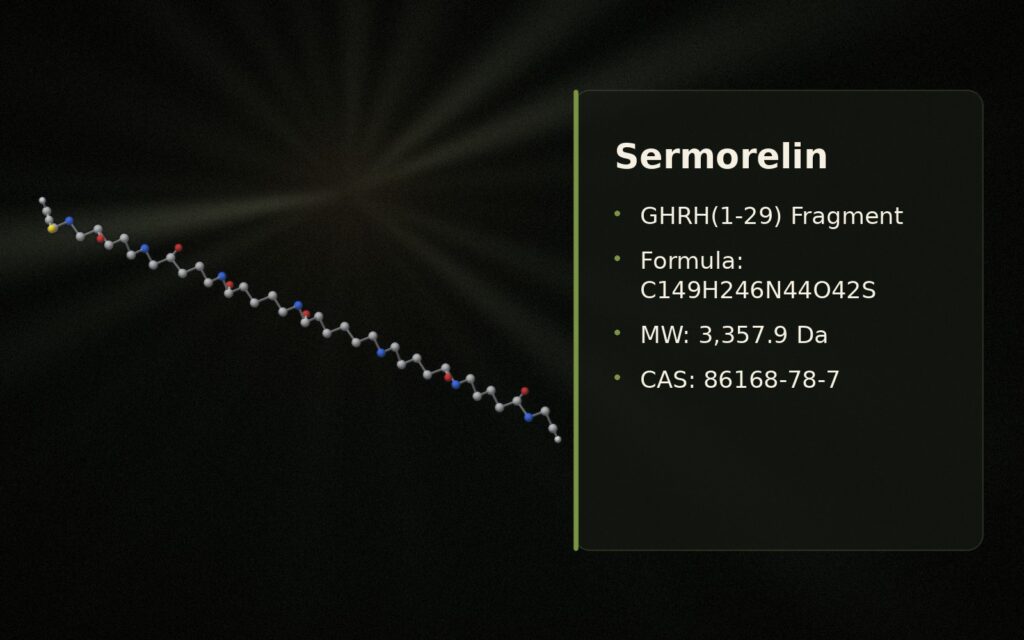
Sermorelin (also called GRF(1-29), GHRH(1-29), or sermorelin acetate; CAS 86168-78-7) is a synthetic 29-amino-acid peptide corresponding to the biologically active N-terminal fragment of human growth-hormone-releasing hormone (GHRH), the 44-amino-acid hypothalamic hormone that stimulates growth hormone secretion from the pituitary gland. Its molecular formula is C₁₄₉H₂₄₆N₄₄O₄₂S, with a molecular weight of approximately 3,357.9 g/mol. Sermorelin acetate was FDA-approved between 1990 and 1997 under the brand name Geref, first as a diagnostic agent and later for treating idiopathic growth hormone deficiency in children, before the manufacturer voluntarily discontinued the commercial product in 2008–2009 for business reasons unrelated to safety or effectiveness. Today, sermorelin as marketed by Vericor Bioscience is sold strictly as a research-use-only laboratory compound, not as a pharmaceutical product, and is not intended for human administration.
What Is Sermorelin? Chemical Identity
Sermorelin is the 1–29 fragment of endogenous human GHRH, corresponding to the shortest sequence of the native hormone that retains full receptor-binding and biological activity in published pharmacology literature. Its verified chemical parameters, drawn from chemical reference sources (PubChem CID 16132413, DrugBank DB00010) are:
- CAS number: 86168-78-7
- Molecular formula: C₁₄₉H₂₄₆N₄₄O₄₂S
- Molecular weight: ≈ 3,357.9 g/mol
- Amino acid count: 29 residues, C-terminally amidated
- Sequence: Tyr-Ala-Asp-Ala-Ile-Phe-Thr-Asn-Ser-Tyr-Arg-Lys-Val-Leu-Gly-Gln-Leu-Ser-Ala-Arg-Lys-Leu-Leu-Gln-Asp-Ile-Met-Ser-Arg-NH₂
Unlike several other GHRH-analog research peptides — such as CJC-1295 (Mod GRF 1-29), which carries a D-alanine substitution at position 2 and other changes engineered to resist enzymatic degradation — sermorelin retains the unmodified, native GHRH(1-29) sequence, including a natural methionine at position 27. This is chemically significant: the native sequence is degraded quickly in circulation, with a reported plasma half-life under ten minutes, largely due to cleavage by the enzyme dipeptidyl peptidase-4 (DPP-IV). Researchers should not assume sermorelin shares the extended stability profile reported for chemically modified GHRH analogs; it is, by design, the closest research approximation of the native hormone fragment rather than an engineered long-acting variant.
The Geref History: FDA Approval and Discontinuation
This section is the most important one to get precisely right, because sermorelin’s regulatory history is genuinely different from most compounds discussed in the research-peptide space, and vague treatment of this history is a common source of misleading marketing elsewhere online.
What was approved. Sermorelin acetate was marketed under the brand name Geref by Serono (later EMD Serono) and received two separate FDA approvals:
- NDA 19-863 (Geref, 0.05 mg base/ampule), approved December 28, 1990, for use in evaluating the ability of the somatotroph cells of the pituitary gland to secrete growth hormone — a diagnostic indication.
- NDA 20-443 (Geref, 0.5 mg and 1.0 mg base/vial), approved September 26, 1997, for treatment of idiopathic growth hormone deficiency (GHD) in children with growth failure.
Both approvals reflect real, FDA-reviewed New Drug Applications supported by clinical data submitted at the time — sermorelin acetate is not a compound that was “never approved,” and it should never be described that way.
What happened to the approved product. The manufacturer discontinued the Geref products for commercial, not clinical, reasons: it notified FDA of the 0.05 mg ampule’s discontinuation on July 11, 2008, and of the 0.5 mg/1.0 mg vials’ discontinuation on December 2, 2008, followed by a formal withdrawal request for NDA 19-863 on December 12, 2008. FDA’s withdrawal of approval for the discontinued NDAs took effect June 18, 2009 (announced in the Federal Register on May 19, 2009).
The determination that matters most. On March 4, 2013, FDA published a formal determination in the Federal Register stating that the Geref (sermorelin acetate) products “were not withdrawn from sale for reasons of safety or effectiveness.” This is a specific, legally meaningful FDA finding, made on a product-by-product basis — not a general assumption — and it is the single most important fact governing sermorelin’s downstream regulatory treatment today. Publicly available information indicates the discontinuation followed EMD Serono’s business decision to exit the product line, not any identified safety signal or effectiveness failure. Once made, this determination reopened the door for generic (ANDA) applications referencing Geref, though no such generic product currently reaches the U.S. market — which is why sermorelin has no FDA-approved commercial drug product today.
Why this is not the same as “still approved.” Sermorelin acetate was an FDA-approved drug ingredient, in a product that is no longer approved or marketed. The withdrawal-not-for-safety finding changes how the ingredient is treated in certain regulatory pathways (below) — it does not mean any sermorelin product sold today, including RUO research material, is itself FDA-approved. No sermorelin product is currently approved by FDA for any human use.
Proposed Mechanism of Action
Sermorelin’s proposed mechanism, as described in the pharmacology and endocrinology literature underlying both its original Geref approval and later research on GHRH analogs generally, involves several linked steps:
- GHRH receptor agonism. Sermorelin binds the GHRH receptor (GHRHR), a class II G-protein-coupled receptor on anterior pituitary somatotroph cells, activating the same cyclic-AMP signaling cascade triggered by full-length endogenous GHRH.
- Stimulation of pulsatile GH release. Receptor activation triggers release of stored growth hormone in a pulsatile pattern consistent with the body’s natural GH secretion rhythm, rather than the flat, sustained elevation associated with direct recombinant GH administration.
- Preserved feedback regulation. Because sermorelin acts upstream of the pituitary rather than replacing GH directly, GH release remains subject to the body’s own negative-feedback regulation — chiefly via somatostatin and circulating IGF-1 — a mechanistic hypothesis published research has examined rather than a settled clinical outcome.
- Downstream GH/IGF-1 axis activity. GH released acts primarily on the liver to stimulate IGF-1 production, the mediator of most of GH’s downstream signaling. Sermorelin’s original diagnostic-use approval (Geref, 0.05 mg) relied directly on this axis, using a normal GH response to a sermorelin challenge to assess pituitary somatotroph function.
- Dependence on intact pituitary function. Because sermorelin stimulates the pituitary rather than supplying GH directly, its effects depend on the presence of at least some functional somatotroph tissue — a boundary condition relevant to interpreting any research model.
Researchers should treat this as a well-characterized receptor-and-axis-level model — considerably better established than for many never-approved research peptides, given that it underpinned an actual FDA drug approval — while recognizing that mechanism-level understanding is not the same as an established modern efficacy profile for any particular research application.
Preclinical and Human Research Findings
Original approval-supporting research. Sermorelin’s two FDA approvals (1990 diagnostic use; 1997 pediatric GHD treatment) were themselves supported by clinical trial data submitted to FDA at the time, establishing sermorelin’s ability to stimulate a measurable GH response in both a diagnostic single-dose context and a pediatric treatment context — a meaningfully more robust historical evidentiary base than exists for peptides that have never undergone FDA review.
Human pharmacodynamics in aging adults. A frequently cited controlled human study in the peer-reviewed literature, published in the Journal of Clinical Endocrinology & Metabolism, examined long-term nightly administration of a closely related GHRH(1-29) analog — [Nle27]GHRH-(1–29)-NH₂, distinct from unmodified sermorelin but built on the same backbone — in 19 age-advanced men and women (ages 55–71) over a 5-month single-blind, placebo-controlled protocol. Reported findings included significant increases in nocturnal GH secretion, sustained elevation of IGF-1 and IGFBP-3, increased skin thickness, and increased lean body mass in men; the only reported adverse effect was transient hyperlipidemia that resolved by the study’s end. Researchers should note this study concerns a structurally related analog rather than unmodified sermorelin, and should not treat findings on one molecule as automatically transferable to the other.
Other reported human data. Additional published literature describes GH and IGF-1 responses to sermorelin administration in adults with suspected GH insufficiency, generally consistent with the mechanism above, though much of it predates sermorelin’s 2008–2009 market discontinuation and reflects study designs using the then-approved Geref product rather than present-day research material of unverified sourcing.
What has not been established. There is no current, adequately powered, FDA-reviewed clinical trial program supporting any modern therapeutic claim for sermorelin outside of its original, now-discontinued approved indications (pediatric idiopathic GHD treatment and pituitary diagnostic testing). Claims that sermorelin improves sleep, reverses aging, or builds muscle in a general adult population are not supported by a completed, controlled efficacy trial establishing those specific outcomes, and should not be inferred from adjacent-analog pharmacodynamic data.
Evidence by Research Level
| Research Level | What Has Been Studied | Strength of Evidence |
|---|---|---|
| Receptor / in vitro pharmacology | GHRH-receptor binding and cyclic-AMP signal activation | Foundational; well characterized |
| Original FDA approval studies (1990, 1997) | Diagnostic GH response (single dose); GH response and growth outcomes in pediatric idiopathic GHD | Sufficient to support FDA approval for those specific, now-discontinued indications |
| Human studies, closely related GHRH(1-29) analog | Long-term nocturnal GH/IGF-1 elevation, body-composition markers in age-advanced adults | Documented in one key controlled trial of a related molecule, not unmodified sermorelin itself |
| General adult “anti-aging” or performance use | No completed, controlled efficacy trial for these outcomes | Not established; not supported by the approval record or subsequent literature |
| Current FDA-approved commercial use | Any FDA-approved marketed product containing sermorelin, present day | None — Geref was discontinued and its approvals withdrawn (for business, not safety, reasons) |
Current U.S. Regulatory Status
This section addresses sermorelin’s regulatory status today, which is distinct from its 1990s approval history described above. Both are real and verifiable, and neither should be substituted for the other.
- No FDA-approved sermorelin product is currently marketed. Geref’s approvals were withdrawn effective June 18, 2009, following the manufacturer’s business decision to discontinue the product. No approved generic or branded sermorelin drug product is currently sold in the United States.
- A distinct compounding posture because of the “not withdrawn for safety” finding. Under the Federal Food, Drug, and Cosmetic Act’s compounding provisions (Sections 503A and 503B), a bulk drug substance can be eligible for pharmacy compounding if it is a component of an FDA-approved drug — but that pathway is unavailable for any substance whose approved product appears on FDA’s list of drugs withdrawn or removed from the market for safety or effectiveness reasons (21 CFR 216.24). Because FDA’s March 2013 determination found Geref was not withdrawn for safety or effectiveness reasons, sermorelin acetate has not been placed on that prohibited list, and state-licensed 503A/503B compounding pharmacies have generally treated it as eligible for compounding into a prescription product for an individual patient — a materially different posture than never-approved research peptides (such as BPC-157 or TB-500), which must instead go through FDA’s separate bulk-substance nomination and evaluation process and benefit from no prior-approval pathway at all.
- This compounding-eligibility pathway does not apply to RUO research material. Do not conflate the legal pathway available to a licensed 503A/503B pharmacy compounding a patient-specific prescription product under a physician’s order with research-use-only laboratory chemical sold for laboratory research. Vericor Bioscience’s sermorelin is not manufactured, labeled, dispensed, or sold as a compounded pharmaceutical, is not provided pursuant to a prescription, and is not FDA-approved for human use as sold. The nuance above explains why sermorelin has a different compounding history than other research peptides — it does not make RUO sermorelin a lawful substitute for a physician-prescribed, pharmacy-compounded product, and it should never be marketed or used as one.
- Research-use-only status. In the United States, sermorelin is lawfully offered by Vericor Bioscience only as a research-use-only laboratory chemical for qualified personnel and institutions, not for human consumption or self-administration.
- General enforcement climate. FDA has taken enforcement action against companies marketing peptide products, as a category, for unapproved human use, unsubstantiated therapeutic claims, or misbranding, regardless of a given peptide’s approval history. Treat sermorelin’s approval history as relevant regulatory context, not as a basis for treating RUO product as a consumer health product.
Regulatory status for compounded and bulk substances can change, and researchers should independently verify current status through primary FDA sources — including the Federal Register and FDA’s compounding guidance pages — before making any compliance-related decision.
Safety Considerations and Unknown Risks
- Reported adverse effects in the historical and analog literature. Documentation associated with sermorelin’s original approved use, and with studies of closely related GHRH(1-29) analogs, describes injection-site reactions (redness, itching, pain, or swelling), flushing, headache, and — in the aging-adult study of a related analog discussed above — transient hyperlipidemia. These reports come from supervised clinical research settings, not unsupervised or self-directed use, and should not be read as a complete safety profile for unregulated research material.
- Theoretical considerations tied to GH/IGF-1 axis activity. Because GH and IGF-1 signaling can influence cell proliferation and insulin sensitivity, the broader endocrinology literature flags caution around use in any research model involving pre-existing or suspected neoplastic disease and calls for careful interpretation of proliferation- and metabolism-related endpoints.
- Dependence on pituitary function. Because sermorelin’s mechanism requires at least some functional pituitary somatotroph tissue, its effects in any research model may vary substantially depending on that model’s pituitary status — a variable that should be characterized rather than assumed.
- No current post-market surveillance, and no safety data for unsupervised use. Because no sermorelin product is currently FDA-approved or marketed, there is no ongoing adverse-event surveillance comparable to a marketed pharmaceutical, and safety data from decades-old, physician-supervised Geref trials cannot be assumed to extend to unregulated research-grade material of unverified sourcing.
- Sourcing and purity risk. As with any peptide obtained outside a validated pharmaceutical supply chain, identity, purity, and degradation state can vary substantially between sources. Research use should involve independent analytical verification (e.g., HPLC, mass spectrometry) rather than reliance on vendor claims alone.
Sermorelin, as sold by Vericor Bioscience, is not intended for human use of any kind. It should be handled only by qualified personnel in appropriate laboratory settings, following institutional biosafety and chemical-handling protocols and all applicable research-use regulations.
Research Evaluation Checklist
Researchers evaluating sermorelin — or any RUO GHRH-analog peptide with a mixed regulatory history — should consider working through the following steps before drawing conclusions from vendor or third-party materials:
- Verify chemical identity independently. Confirm molecular formula (C₁₄₉H₂₄₆N₄₄O₄₂S), molecular weight (≈3,357.9 g/mol), CAS number (86168-78-7), and the unmodified 29-residue sequence against a primary chemical database (PubChem, DrugBank) rather than a vendor page alone.
- Separate the historical approval from current status. Confirm from primary sources that Geref was FDA-approved from 1990–2009 and separately that no sermorelin product is currently FDA-approved or marketed — both facts are true and neither cancels out the other.
- Trace pharmacodynamic claims to primary literature. Identify whether a GH/IGF-1 claim originates from sermorelin’s own approval-era studies, a related analog (such as [Nle27]GHRH-1-29), or unsourced marketing copy.
- Confirm the compounding-eligibility nuance does not apply to your product. If a source calls sermorelin “compounding-eligible,” verify it’s describing a licensed 503A/503B pharmacy pathway requiring a prescription — not a basis for treating RUO material as equivalent.
- Review the 2013 Federal Register determination directly, rather than a secondary summary, when the safety-vs-business distinction matters to your work.
- Demand analytical documentation. Request a current, lot-specific Certificate of Analysis (COA) confirming identity and purity for any research material.
- Design studies around the correct pharmacokinetic profile. Account for the short plasma half-life of the unmodified native sequence when planning dosing intervals and sampling timepoints.
- Confirm RUO labeling and handling practices. Ensure the product is labeled and distributed strictly for laboratory research use, with no suggestion of human dosing or therapeutic outcomes.
People Also Ask About Sermorelin
Yes — one of the few things that distinguishes sermorelin from most other research peptides. Sermorelin acetate was FDA-approved under the brand name Geref: first in 1990 (NDA 19-863) for diagnostic evaluation of pituitary GH-secretion capacity, and again in 1997 (NDA 20-443) for treatment of idiopathic growth hormone deficiency in children. The manufacturer discontinued the product for business reasons in 2008–2009, and FDA formally determined in 2013 the withdrawal was not for safety or effectiveness reasons. No sermorelin product is FDA-approved or currently marketed today.
No. Those past approvals (as Geref, 1990–2009) were withdrawn after the manufacturer discontinued the product commercially. No sermorelin drug product is currently approved by FDA for any use, and research-use-only sermorelin sold today is not an FDA-approved product.
Public FDA records indicate the manufacturer, EMD Serono, discontinued Geref for business reasons. FDA’s March 2013 Federal Register determination explicitly states the products “were not withdrawn from sale for reasons of safety or effectiveness” — a specific agency finding, not an inference.
No. Both are GHRH(1-29)-based research peptides, but sermorelin retains the native, unmodified sequence, while CJC-1295 (Mod GRF 1-29) carries amino-acid substitutions engineered to resist enzymatic degradation and extend half-life. They are chemically distinct with different stability profiles and should not be treated as interchangeable in research design.
Sermorelin can be lawfully purchased in the United States as a research-use-only chemical for laboratory research by qualified personnel or institutions — not for human consumption or self-administration. Separately, licensed 503A/503B compounding pharmacies may compound sermorelin acetate into a prescription product for an individual patient under a valid prescription; that is a distinct legal pathway from purchasing RUO research material and does not apply to it.
No completed, controlled human efficacy trial has established that sermorelin produces anti-aging effects or improves sleep quality in a general adult population. Its FDA-approved historical indications were limited to pediatric growth hormone deficiency treatment and pituitary diagnostic testing.
Expert Sermorelin Q&A
How should a researcher describe sermorelin’s regulatory history without misleading anyone?
In two separate sentences. First: sermorelin acetate was FDA-approved as Geref from 1990 to 2009, for a diagnostic indication and later for pediatric growth hormone deficiency. Second: those approvals were withdrawn after the manufacturer discontinued the product commercially, FDA found the withdrawal was not safety-related, and no sermorelin product is FDA-approved or marketed today. Merging those into one sentence — implying either “still approved” or “never approved” — is where most inaccurate marketing on this compound goes wrong.
Does the 2013 FDA determination that Geref wasn’t withdrawn for safety reasons have any practical significance?
Yes, within a specific regulatory lane. It’s why sermorelin acetate hasn’t been placed on FDA’s list of drugs barred from pharmacy compounding (21 CFR 216.24), and why licensed 503A/503B pharmacies have generally treated it as compounding-eligible as a component of a formerly approved drug — a meaningful difference from a peptide never approved at all, which must go through a separate nomination and safety-review process. It has no bearing on the status of RUO research material, which is not compounded, prescribed, or FDA-approved.
Why does published sermorelin research look different from research on peptides that were never approved?
Because its original approvals were supported by clinical data submitted to and reviewed by FDA, there is a real historical evidentiary base — imperfect and decades old, but genuine — underlying its diagnostic and pediatric-GHD uses. Most never-approved research peptides lack any equivalent regulatory-grade dataset. Even so, the approval-era studies should be treated as historical and indication-specific, not as support for present-day off-label or wellness claims.
Is the related [Nle27]GHRH(1-29) study relevant to sermorelin research?
It’s relevant context for the GHRH(1-29) analog class generally — GH and IGF-1 responses to nightly receptor stimulation in older adults — but it used a structurally modified analog, not unmodified sermorelin, so its findings should be cited as related-compound evidence, not extrapolated as sermorelin-specific efficacy data.
What’s the biggest compliance mistake researchers or marketers make with sermorelin?
Treating its unusual approval history as if it confers current legitimacy on unapproved human use of RUO material. The compounding-eligibility nuance under 503A/503B is real, but it describes a licensed-pharmacy, prescription-based pathway — not a basis for marketing or using research-labeled sermorelin as a substitute for that pathway.
Conclusion
Sermorelin is a chemically well-defined, 29-amino-acid analog of native human GHRH — and one of the few compounds in the research-peptide space with a genuine, verifiable FDA approval history behind it. That history is worth stating precisely: sermorelin acetate was approved as Geref from 1990 to 2009 for a diagnostic indication and later pediatric growth hormone deficiency treatment, and the manufacturer’s 2008–2009 discontinuation was a business decision FDA formally determined was not for reasons of safety or effectiveness. That specific finding is also why sermorelin has been treated differently than never-approved peptides in the 503A/503B compounding-eligibility framework. None of this changes the fact that no sermorelin product is currently FDA-approved, and that history does not extend to research-use-only material sold for laboratory investigation.
Sermorelin, as sold by Vericor Bioscience, is not intended for human use, self-administration, or any diagnostic or therapeutic purpose, and nothing in this article should be construed as such. Qualified researchers who want to review current specifications and analytical documentation for sermorelin as a laboratory research compound can visit Vericor Bioscience’s research product page.