
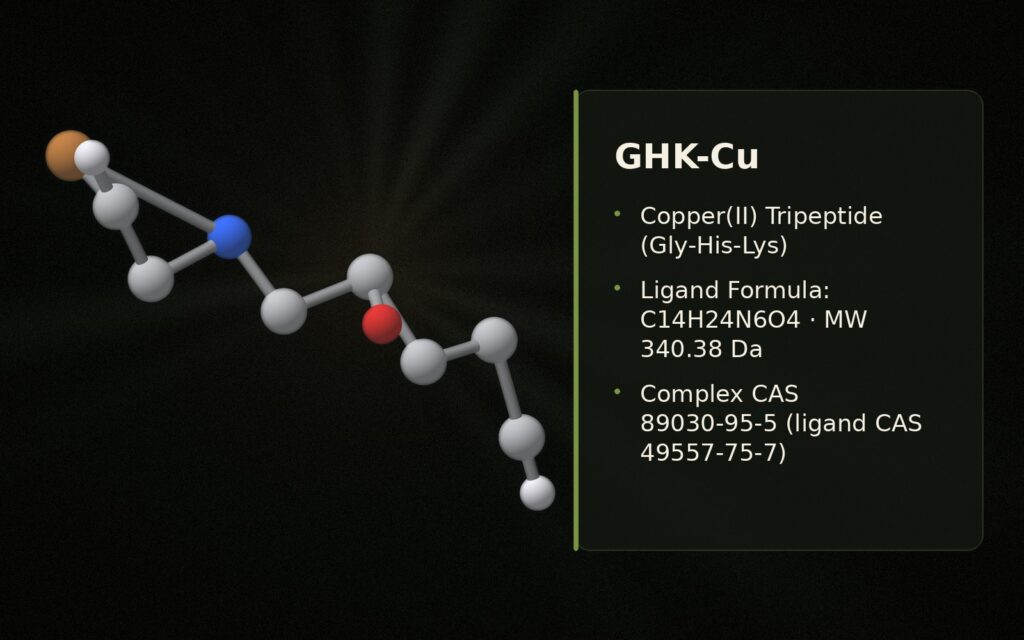
GHK-Cu, also known as copper tripeptide-1 or the copper complex of glycyl-L-histidyl-L-lysine, is one of the more extensively studied naturally occurring peptides in the biomedical literature. It has attracted sustained research interest because it is not a synthetic novelty invented in a lab — it is a small copper-binding tripeptide that human plasma already contains, at concentrations that appear to fall as people age. That combination of endogenous origin and a large published dataset on tissue remodeling has made GHK-Cu a recurring subject in dermatology, wound-healing, and copper-biology research for more than four decades.
Before going further, it is worth drawing a distinction that gets blurred constantly in consumer content about this molecule: GHK-Cu already has a long, legitimate history as a cosmetic ingredient (INCI name Copper Tripeptide-1) in topical serums and creams sold over the counter, and separately, GHK-Cu is also sold as a research-use-only (RUO) compound — typically as a lyophilized powder — for use by qualified laboratory personnel studying its biochemistry in vitro or in animal models. These are two different products, sold through two different regulatory pathways, with two very different evidence bases behind them. This article is about the second category. Vericor Bioscience supplies GHK-Cu strictly as a research chemical for laboratory use by qualified researchers and institutions. Nothing here describes, recommends, or endorses use of any Vericor product in or on the human body, and none of it should be read as skincare advice or a substitute for consulting a physician.
Featured definition: What is GHK-Cu?
GHK-Cu is a naturally occurring tripeptide-copper(II) complex composed of glycine, histidine, and lysine bound to a copper ion. First isolated from human plasma in the 1970s by biochemist Loren Pickart, it has since been identified in saliva and urine as well. In basic and preclinical research, GHK-Cu has been studied for its roles in copper transport, gene-expression modulation, and connective-tissue remodeling. It is separately recognized as a cosmetic ingredient (Copper Tripeptide-1) used in topical skincare formulations. As a laboratory research compound, GHK-Cu is not approved by the U.S. Food and Drug Administration (FDA) for any therapeutic use, is not a drug, and is not intended for human or animal administration.
What It Is: Natural Occurrence and Chemical Identity
GHK-Cu is the copper(II) complex of the tripeptide glycyl-L-histidyl-L-lysine (Gly-His-Lys, or GHK). The free tripeptide has the molecular formula C₁₄H₂₄N₆O₄ (molecular weight approximately 340.4 g/mol); once complexed with a copper ion, the compound most commonly supplied and cited in the literature (CAS 89030-95-5) is reported with the formula C₁₄H₂₂CuN₆O₄ and a molecular weight in the range of roughly 401–404 g/mol, depending on the reference source and salt form. Researchers sourcing material for laboratory work should always confirm formula, molecular weight, and purity against the certificate of analysis (COA) for the specific lot in hand, since reported values can vary slightly across suppliers and reference databases.
What makes GHK-Cu distinctive among peptides studied for tissue biology is that it is not a fully synthetic construct — it occurs endogenously. Pickart’s original work and subsequent literature report that GHK-Cu is detectable in human plasma, with concentrations that appear comparatively higher in younger adults and lower with advancing age (published estimates commonly cited in the literature describe plasma levels on the order of roughly 200 ng/mL around age 20 declining to roughly 80 ng/mL by age 60, though these figures originate from older, small-scale analytical work and should be treated as illustrative rather than definitive). This age-associated decline is one of the observations that led researchers to investigate whether restoring GHK-Cu levels, in cell and animal systems, could influence processes like collagen turnover and tissue remodeling — questions that remain active areas of preclinical study rather than settled clinical fact.
Chemically, the copper ion in GHK-Cu is coordinated by the peptide’s glycine amino terminus, the imidazole nitrogen of histidine, and a deprotonated peptide-bond nitrogen. This coordination chemistry is thought to be central to the molecule’s proposed biological activity, since it appears to allow copper to be shuttled and buffered in a form less prone to generating free-radical damage than unbound copper ions — a property researchers have studied in the context of oxidative stress and metalloenzyme biology.
Cosmetic Ingredient vs. Research Material: A Critical Distinction
This is the single most important section of this article, because it is also the point where consumer content about GHK-Cu most often becomes misleading.
Copper Tripeptide-1 as a cosmetic ingredient. GHK-Cu, under its International Nomenclature of Cosmetic Ingredients (INCI) name Copper Tripeptide-1, has been used in topical over-the-counter skincare products — serums, creams, and similar formulations — for many years. Cosmetic ingredients in the United States are regulated under a different framework than drugs: the FDA does not “approve” cosmetic products or ingredients before they reach the market the way it approves new drugs. Instead, manufacturers are responsible for product safety, and FDA can take enforcement action against products found adulterated or misbranded after the fact. So when marketing describes GHK-Cu as a long-used cosmetic ingredient, that is verifiable — but it reflects the light-touch cosmetic regulatory pathway, not an FDA finding that the ingredient safely or effectively treats any medical condition, and it says nothing about injecting or otherwise systemically administering the compound.
GHK-Cu as an RUO research compound. The material Vericor Bioscience supplies is an entirely different product category: a research-grade peptide-copper complex, typically supplied as a lyophilized powder, intended solely for in vitro, in vivo (animal), or other non-human laboratory research conducted by qualified personnel. It has not been evaluated by FDA as a drug, is not manufactured under pharmaceutical (cGMP) drug standards, is not tested or labeled for human dosing, and is not intended for human consumption, injection, or any other form of human or veterinary administration. The evidence base for topical cosmetic use does not transfer to conclusions about an injectable or systemically administered research material, which involves an entirely different absorption route, dose range, and risk profile far less studied in humans.
In short: the fact that a topical cosmetic ingredient with the same chemical identity is legally sold in skincare aisles does not mean that injecting, ingesting, or otherwise self-administering a research-grade version of that same molecule is safe, legal for that purpose, or has been studied to any comparable degree. Vericor’s product exists for laboratory research use only, and this article should not be read as an endorsement of, or instructions for, using it any other way.
Proposed Mechanism of Action
Research into GHK-Cu’s biological activity centers on a handful of interconnected, and still incompletely understood, hypotheses:
- Copper delivery and redox buffering. In cell-based studies, GHK-Cu is proposed to act as a physiological copper chaperone, delivering copper to enzymes that require it as a cofactor (such as lysyl oxidase, involved in collagen and elastin cross-linking) while limiting the free-radical activity associated with unbound copper ions.
- Gene-expression modulation. Microarray and gene-expression studies in cultured human cells have reported that GHK-Cu exposure is associated with changes in expression of genes involved in extracellular matrix production, antioxidant defense, and tissue-remodeling pathways. Researchers describe these as broad, pleiotropic signaling effects rather than a single defined receptor-ligand mechanism, and the functional significance of these changes in a whole organism remains an open question.
- Extracellular matrix and growth-factor signaling. In fibroblast and skin-explant models, GHK-Cu has been studied for its association with increased collagen and glycosaminoglycan synthesis, reported effects on growth factors such as VEGF and BDNF, and modulation of matrix metalloproteinase (MMP) activity — enzymes responsible for breaking down and remodeling connective tissue.
- Anti-inflammatory and antioxidant signaling. Some preclinical work has examined GHK-Cu in the context of oxidative-stress and inflammatory-signaling pathways, again primarily in cell culture and animal models rather than in controlled human trials.
None of these mechanistic threads currently constitutes a validated, FDA-recognized mechanism of therapeutic action in humans. They represent active hypotheses under investigation in the peptide and copper-biology research literature.
Preclinical and Human Research Findings
The published literature on GHK-Cu is unusually large for a small peptide, spanning several decades, but it is heavily weighted toward in vitro and animal studies, with a comparatively small number of controlled human trials — almost all of which involve topical application rather than injection.
Animal and cell-culture wound-healing research. A frequently cited line of research involves full-thickness skin wounds in rodent models, where local administration of GHK-Cu has been reported to accelerate measures of wound closure compared to untreated controls in some experiments. Reviews covering tripeptides in wound healing (including GHK-Cu alongside other peptides such as BPC-157) summarize animal data suggesting effects on granulation tissue formation, angiogenesis markers, and collagen deposition, while consistently noting that translation from rodent wound models to human clinical outcomes is not established.
Topical human research. The best-characterized human data on GHK-Cu comes from small controlled trials of topical cosmetic formulations, generally assessing skin-appearance endpoints such as fine lines, skin density, or elasticity over several weeks of daily application. These studies are generally described by researchers as promising but limited by small sample sizes, short durations, and formulation-specific variables (a cream’s other ingredients and delivery vehicle affect outcomes independent of the peptide itself).
Injectable/systemic research. By contrast, controlled human studies of injectable or systemically administered GHK-Cu are essentially absent from the peer-reviewed literature as of this writing. Physicians quoted in medical press coverage of the compound’s rising off-label use have been explicit on this point, describing the human safety database for injection as effectively nonexistent, in contrast to the more established topical evidence. Any research interest in systemic or injectable GHK-Cu today is working from a foundation of animal pharmacology and mechanistic plausibility rather than human trial data — precisely the kind of open question laboratory research using RUO material is designed to help investigate.
Evidence by Research Level
| Research Context | Route Studied | General Findings Reported in Literature | Strength of Evidence |
|---|---|---|---|
| Cell culture (fibroblasts, keratinocytes) | N/A (in vitro) | Associated with increased collagen/GAG synthesis, altered gene expression, antioxidant enzyme activity | Preclinical, mechanistic only |
| Rodent and other animal wound models | Local injection / topical | Reported acceleration of wound-closure measures vs. controls in some studies | Preclinical, animal-model only |
| Human skin studies (cosmetic formulations) | Topical | Small trials report improvements in some skin-appearance measures over weeks | Limited human data; small samples, short duration |
| Human systemic/injectable studies | Injection | No published controlled human trials identified | No established human evidence base |
| Endogenous physiology | N/A (plasma) | Naturally present in human plasma; levels reported to decline with age in older analytical studies | Observational, dated, and not causally linked to any health outcome |
This table reflects the general shape of the published literature and is not exhaustive. Researchers should conduct their own literature review of primary sources before designing any study.
U.S. Regulatory Status
GHK-Cu’s regulatory picture in the United States has two distinct tracks, and conflating them is a common source of confusion.
As a cosmetic ingredient. Copper Tripeptide-1 is used in topical cosmetic products under the FDA’s cosmetic regulatory framework. As noted above, this does not involve FDA premarket approval; cosmetic ingredients are not “FDA-approved” the way drugs are, and their sale as topical products does not establish or imply safety or efficacy for any other route of administration or use.
As a drug substance for pharmacy compounding. GHK-Cu has separately been the subject of ongoing FDA rulemaking concerning bulk drug substances eligible for compounding under Section 503A of the Federal Food, Drug, and Cosmetic Act. In a September 2023 interim bulk-substances categorization update, FDA placed GHK-Cu (for non-injectable routes, with certain limitations) into “Category 1” — substances under evaluation, for which FDA generally does not intend to take immediate enforcement action against compounding — while placing injectable GHK-Cu into “Category 2,” the category reserved for substances FDA has identified as raising significant safety concerns, where compounding is not permitted. Through 2026, FDA’s Category 1/2/3 bulk-substance list has continued to be revised as part of a broader peptide review, with FDA indicating it intends to convene its Pharmacy Compounding Advisory Committee to further evaluate GHK-Cu and related peptides before deciding whether to add any of them to the formal 503A Bulks List. None of this activity has resulted in FDA drug approval of GHK-Cu for any indication, and its compounding categorization has continued to shift as the review proceeds. Researchers and institutions should consult FDA’s current published bulks lists directly for up-to-date status rather than relying on secondary summaries, including this one.
As a research chemical. Separate from both of the above, GHK-Cu sold as a research-use-only laboratory compound — the category Vericor Bioscience’s product falls into — has no FDA drug approval, is not reviewed or cleared by FDA for any human or animal therapeutic use, and is not manufactured, labeled, or distributed as a drug product. It is intended exclusively for use by qualified researchers in controlled laboratory settings, consistent with federal and state research-chemical regulations. It is not a dietary supplement, cosmetic product, or compounded medication.
Safety Considerations and Unknown Risks
Because the strongest human safety data on GHK-Cu comes from topical use, and topical exposure is toxicologically very different from systemic or injectable exposure, it is important to separate what is reasonably well characterized from what is not.
Reasonably well characterized (topical use). Topical GHK-Cu-containing cosmetic formulations have an established history of use with a generally favorable tolerability profile reported in dermatology literature — localized irritation in sensitive individuals is the most commonly reported issue.
Not well characterized (systemic/injectable exposure, the relevant category for research use). Published, controlled human data on injected or otherwise systemically administered GHK-Cu are lacking. Concerns raised by clinicians and researchers discussing off-label injectable use — concerns relevant to any research handling of this material — include:
- Copper accumulation and homeostasis. Copper is an essential trace element, but the body tightly regulates it, and there is limited data on how repeated systemic exposure to a copper-peptide complex affects copper homeostasis, liver function, or other copper-sensitive systems over time.
- Immunogenicity and injection-site effects. As with any peptide administered parenterally, there is potential for local reactions or immune responses that have not been systematically characterized for this specific compound.
- Product variability and contamination risk. Because research-grade peptide material is not manufactured to pharmaceutical drug standards, purity, sterility, and identity can vary significantly between sources — frequently cited by physicians as a major real-world hazard associated with unregulated peptide products generally.
- Unknown long-term and dose-response effects. Controlled human pharmacokinetic and toxicology data for systemic GHK-Cu are not available in the public literature, so dose-response relationships, elimination pathways, and long-term effects in humans remain unestablished.
For these reasons, GHK-Cu research material distributed by Vericor Bioscience is intended strictly for laboratory research (e.g., in vitro assays or properly permitted animal studies conducted by qualified personnel) and is not tested, labeled, packaged, or intended for human use of any kind, including self-administration.
Research Evaluation Checklist
Researchers considering GHK-Cu for a laboratory study should work through the following before beginning:
- Confirm identity and purity. Obtain and review the certificate of analysis (COA) for the specific lot, including mass spectrometry or HPLC data confirming identity, formula, and purity.
- Define the research question precisely. Distinguish in the study design whether the objective concerns mechanistic/gene-expression, in vitro tissue-culture, or in vivo animal endpoints — the existing literature varies substantially in relevance across these categories.
- Review institutional and regulatory requirements. Confirm compliance with institutional biosafety/IACUC requirements (for any animal work) and applicable federal and state research-chemical regulations.
- Separate topical cosmetic literature from systemic/injectable literature. Note the route of administration used in each cited study; do not extrapolate topical human findings to injectable or systemic study designs without independent justification.
- Check current FDA bulk-substance categorization if compounding-adjacent work is contemplated. GHK-Cu’s 503A/503B categorization has changed multiple times — confirm current status against FDA’s published lists rather than older secondary sources.
- Establish appropriate storage and handling protocols. Lyophilized peptide-copper complexes generally require specific reconstitution, temperature, and light-exposure handling; follow supplier guidance and the relevant safety data sheet (SDS).
- Document everything for reproducibility. Record lot numbers, reconstitution methods, storage conditions, and protocols in sufficient detail to support peer review and replication.
- Do not use the material outside the research setting. The product is not intended for human or animal therapeutic use, and no human dosing information should be sought from, or provided by, a research-chemical supplier.
People Also Ask About GHK-Cu
Chemically, the active molecule — the copper complex of glycyl-histidyl-lysine — is the same peptide-copper structure in both contexts. But the products are not equivalent: a cosmetic serum is a finished, regulated topical formulation, while a research-grade vial is an unformulated laboratory chemical manufactured for research purposes, not for application to or into the human body. The evidence behind each (topical safety data vs. essentially no injectable human data) is also very different, so the shared chemical identity should not be read as a shared risk profile or intended use.
No. GHK-Cu is not an FDA-approved drug for any human or veterinary indication. Its use in cosmetic products does not require or constitute FDA drug approval, since cosmetics follow a different regulatory pathway. Separately, its status as a bulk substance eligible for pharmacy compounding has been the subject of ongoing FDA review and category changes, and that review does not amount to drug approval either.
A substantial body of preclinical (cell-culture and animal) research has explored GHK-Cu’s association with processes relevant to wound healing and tissue remodeling, and small human studies of topical formulations have reported some favorable skin-appearance findings. These describe research observations, not established medical treatments, and none of this literature evaluates the systemic or injectable research material RUO suppliers provide.
Its endogenous presence in human plasma, its reported decline with age, and its documented in vitro effects on genes and pathways related to tissue remodeling make it a useful model compound for studying copper biology and extracellular matrix regulation — independent of any consumer application.
Vericor Bioscience sells GHK-Cu strictly as a research-use-only compound for qualified researchers and institutions. It is not sold, labeled, or intended for personal human use, self-administration, or any therapeutic purpose.
FDA’s bulk drug substance categorization for compounding purposes has treated injectable and non-injectable forms of GHK-Cu differently, and this categorization has changed more than once since 2023. Researchers should check FDA’s current published lists directly, since third-party summaries — including this article — can lag behind the latest agency action.
Expert GHK-Cu Q&A
How should a researcher think about the gap between GHK-Cu’s cosmetic track record and the lack of injectable human data?
As largely separate evidence bases. Topical exposure involves a different absorption barrier, systemic dose, and duration profile than injection. A strong safety record for a topical formulation says very little about the pharmacokinetics or copper-handling implications of a systemically delivered dose, which is why researchers describe the injectable route as comparatively uncharacterized in humans.
What is the significance of GHK-Cu occurring naturally in plasma?
It suggests a possible physiological role in tissue maintenance and provides a rationale for studying whether restoring peptide levels in model systems affects relevant biology. It is not, on its own, evidence that administering additional GHK-Cu in humans is beneficial or safe at a given dose — endogenous presence at low physiological concentrations does not predict the effects of exogenous administration at research doses.
What should researchers watch for regarding product quality when sourcing GHK-Cu for laboratory work?
Independent third-party testing (mass spectrometry, HPLC purity data), a clear certificate of analysis tied to the specific lot, and transparent sourcing are baseline expectations for any peptide research material. Researchers should be attentive to the difference between a supplier offering a research chemical (no human-use claims, no dosing guidance) and any operation implying clinical or compounding use.
Is the mechanism of GHK-Cu well understood?
Not fully. There is a substantial body of gene-expression and cell-culture data describing correlations between GHK-Cu exposure and pathways related to collagen synthesis, antioxidant defenses, and inflammation, but the field has not converged on a single validated receptor or signaling cascade explaining these observations. Continued basic research is warranted before any mechanistic claim is treated as settled.
What is the single most common misunderstanding about GHK-Cu you’d want a researcher to avoid?
Treating “used in FDA-recognized cosmetic products” and “FDA-approved” as if they mean the same thing, and treating “extensively studied peptide” as if it means “extensively studied in humans via injection.” Both conflations understate how much remains genuinely unknown about the systemic research material.
Conclusion
GHK-Cu is a scientifically well-documented example of an endogenous copper-binding tripeptide with a large mechanistic and preclinical literature, a legitimate and distinct history as a topical cosmetic ingredient, and a comparatively thin — effectively absent — human evidence base for systemic or injectable administration. Its regulatory status reflects that split: recognized use in cosmetics under a non-drug framework, and an evolving, unsettled FDA compounding-substance categorization on the drug side that has not resulted in approval for any therapeutic use. For laboratory researchers, GHK-Cu remains a compound worth studying precisely because so many mechanistic questions — about copper signaling, gene expression, and tissue remodeling — remain open.
Vericor Bioscience supplies GHK-Cu strictly as a research-use-only compound for qualified laboratory researchers and institutions. Qualified researchers interested in sourcing GHK-Cu for laboratory study are encouraged to review the technical specifications, certificate of analysis, and intended-use terms on Vericor’s GHK-Cu research product page before beginning any study design.