
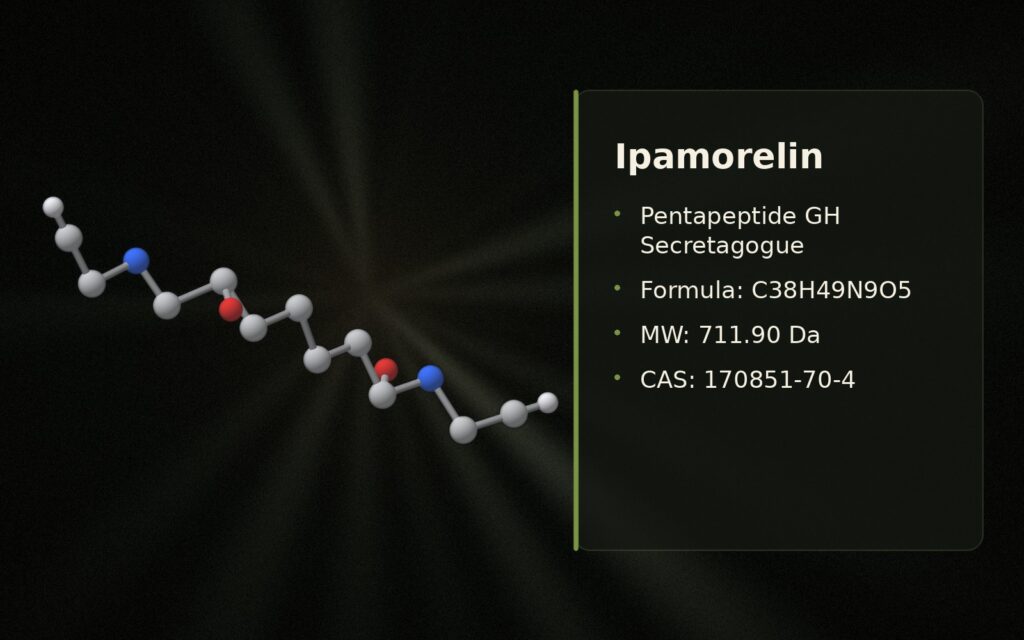
Ipamorelin is among the most frequently cited names in growth-hormone-secretagogue (GH secretagogue) research, largely because of one real, published, and comparatively well-documented property: unlike several older compounds in its class, it was reported in controlled pharmacology studies to stimulate growth hormone (GH) release with minimal effect on cortisol, adrenocorticotropic hormone (ACTH), or prolactin. That selectivity finding is genuine and traceable to the peer-reviewed literature. It is also frequently overstated, stripped of its original context, and repackaged into consumer-facing claims — “no side effects,” “safe for long-term use,” “reverses aging” — that the underlying research does not support.
This article is written for laboratory researchers, institutional buyers, and other qualified personnel evaluating ipamorelin for legitimate in vitro, ex vivo, or animal research. It is sold by Vericor Bioscience strictly as a research-use-only (RUO) laboratory chemical. Ipamorelin is not approved by the FDA for any human use, is not intended for human consumption or self-administration, and nothing in this article should be read as instruction, encouragement, or guidance for using it in or on a person. Where this article describes effects on growth hormone or gastrointestinal motility, those findings come from published preclinical studies and outside-sponsored clinical trials — principally Novo Nordisk’s original development program and later trials in postoperative ileus — not from Vericor Bioscience and not from anecdotal consumer use. The evidence base is real but limited: a solid mechanistic and animal-pharmacology foundation, a handful of controlled human pharmacokinetic studies, and a clinical efficacy trial history that did not establish the therapeutic benefit it was designed to test. Weigh every claim below, and every claim made elsewhere about ipamorelin, against that evidence hierarchy rather than against marketing language.
Featured definition: What is Ipamorelin?
Ipamorelin is a synthetic pentapeptide (five amino acid residues) — sequence Aib-His-D-2-Nal-D-Phe-Lys-NH₂ — that acts as a selective agonist of the growth hormone secretagogue receptor (GHSR-1a, the ghrelin receptor). Its molecular formula is C₃₈H₄₉N₉O₅, with a molecular weight of approximately 711.86 g/mol (CAS number 170851-70-4). It was developed in the 1990s by Novo Nordisk (research code NNC 26-0161) as part of a growth-hormone-releasing-peptide (GHRP) research program, derived structurally from the earlier compound GHRP-1. In the original 1998 pharmacology paper describing it, ipamorelin was characterized as “the first GHRP-receptor agonist with a selectivity for GH release similar to that displayed by GHRH” — a reference to its comparatively narrow hormonal effect profile relative to earlier GHRPs such as GHRP-6 and GHRP-2. It was later studied in Novo Nordisk– and Helsinn Therapeutics–sponsored human clinical trials for postoperative ileus and growth hormone deficiency, but it has never received FDA approval for any indication and today exists in the U.S. market only as a research-use-only laboratory compound.
What Is Ipamorelin? Chemical Identity and Development History
Ipamorelin is a synthetic pentapeptide built from a mix of natural and non-natural amino acids: alpha-aminoisobutyric acid (Aib), L-histidine (His), D-2-naphthylalanine (D-2-Nal), D-phenylalanine (D-Phe), and a C-terminally amidated L-lysine (Lys-NH₂). The non-natural and D-configured residues are what give the peptide its resistance to rapid enzymatic breakdown relative to a peptide built entirely from standard L-amino acids. Verified chemical identifiers, drawn from PubChem (CID 9831659) and ChemicalBook, are as follows:
| Property | Value |
|---|---|
| Chemical class | Synthetic pentapeptide (growth hormone secretagogue / GHRP class) |
| Amino acid sequence | Aib-His-D-2-Nal-D-Phe-Lys-NH₂ |
| Number of residues | 5 (pentapeptide) |
| Molecular formula | C₃₈H₄₉N₉O₅ |
| Molecular weight | ≈ 711.86 g/mol |
| CAS number | 170851-70-4 |
| Research code | NNC 26-0161 (Novo Nordisk) |
| Structural origin | Derived from GHRP-1 |
Development history. Ipamorelin was discovered and developed by Novo Nordisk in the 1990s as part of a broader research effort into growth-hormone-releasing peptides — small synthetic molecules that act on the ghrelin receptor (GHSR-1a) rather than the GHRH receptor to stimulate pituitary GH secretion. The compound’s defining pharmacological finding, published by Raun et al. in 1998, was that it stimulated GH release with a selectivity profile resembling that of GHRH itself, largely sparing the cortisol, ACTH, prolactin, and gonadotropin responses that earlier GHRPs (GHRP-6, GHRP-2, hexarelin) were shown to produce. This selectivity made ipamorelin an attractive drug-development candidate, and it was carried into human studies — first as a pharmacokinetic/pharmacodynamic characterization in healthy volunteers, and later into sponsor-run clinical trials for two indications: growth hormone deficiency and postoperative ileus (impaired bowel motility following abdominal surgery). Development rights were later associated with Helsinn Therapeutics for the postoperative ileus program. Randomized, placebo-controlled Phase II trials in postoperative ileus (registered on ClinicalTrials.gov, including NCT00672074 and NCT01280344) were completed and published; as detailed below, they demonstrated a favorable safety and tolerability profile but did not meet their primary efficacy endpoint with statistical significance, and no ipamorelin product has ever advanced to FDA approval or ongoing clinical use for any indication. Today, ipamorelin is not manufactured or sold as an approved pharmaceutical by any company; it exists in the marketplace almost exclusively as a research-use-only peptide.
Proposed Mechanism of Action
Ipamorelin’s mechanism, as characterized in the pharmacology literature, involves the following elements:
- Ghrelin receptor (GHSR-1a) agonism. Ipamorelin binds and activates the growth hormone secretagogue receptor, the same G-protein-coupled receptor targeted by the endogenous hormone ghrelin. Receptor activation in pituitary somatotroph cells stimulates pulsatile GH release through a pathway distinct from — but capable of synergizing with — GHRH receptor stimulation.
- Reported selectivity for GH release. The 1998 Raun et al. study, using rat and swine models, reported that ipamorelin released GH with potency and efficacy similar to GHRP-6, but — unlike GHRP-6 and GHRP-2 — did not significantly elevate ACTH or cortisol even at doses reported to be more than 200 times the GH-effective dose, and had no significant effect on FSH, LH, TSH, or prolactin. This is the sourced basis for describing ipamorelin as a comparatively “selective” or “clean” GH secretagogue relative to earlier GHRPs.
- Why that selectivity claim needs a hedge. The comparative data come primarily from animal models in a single late-1990s research program, with limited direct human head-to-head comparison against other GHRPs under identical conditions. “More selective than GHRP-6 or GHRP-2 in the studies conducted” is a defensible, sourced statement; “has no hormonal side effects” or “is completely clean” is not — it extrapolates a comparative, dose-dependent animal finding into an unconditional human guarantee the published research does not make.
- Downstream GH/IGF-1 signaling. As with other GH secretagogues, GH released following ipamorelin exposure is proposed to act on the liver and peripheral tissues to stimulate insulin-like growth factor 1 (IGF-1) production, the principal downstream mediator of GH’s signaling. Human pharmacodynamic studies of ipamorelin have used both GH and, to a lesser extent, IGF-1 as markers of receptor engagement.
- Rapid, single-episode pharmacodynamics. Human dose-escalation data (below) describe ipamorelin producing a single, time-limited episode of GH release following administration rather than a sustained elevation — consistent with its short (approximately two-hour) plasma half-life.
Researchers should treat this as a receptor-level working model supported by a real but limited combination of animal pharmacology and a small number of controlled human dosing studies — not as a fully characterized human pharmacological pathway validated across populations, dosing regimens, or long-term exposure.
Preclinical and Human Research Findings
Foundational pharmacology (Raun et al., 1998). The original characterization of ipamorelin, conducted in rats and pigs, established its GH-selective release profile and its comparative lack of ACTH/cortisol/prolactin/gonadotropin effect relative to GHRP-6 and GHRP-2. This paper remains the primary sourced basis for describing ipamorelin as a “selective” growth hormone secretagogue and is the study most often cited — and most often mischaracterized — by downstream marketing content.
Human pharmacokinetic/pharmacodynamic study. A dose-escalation study in healthy male volunteers (published in Pharmaceutical Research) administered five ascending intravenous infusion doses of ipamorelin (approximately 4.2 to 140.5 nmol/kg) and modeled the resulting pharmacokinetics and GH response. Reported findings included a short terminal plasma half-life of roughly two hours, dose-proportional plasma concentrations, and a single GH-release episode peaking around 40 minutes post-infusion before declining to negligible levels. Inter-individual variability in the GH response was reported to be larger than variability in the drug’s own pharmacokinetics — an important caveat for interpreting any dose-response claim.
Postoperative ileus clinical trials. Ipamorelin’s most substantial human efficacy testing occurred in the context of postoperative ileus — delayed return of normal bowel function after abdominal surgery, a ghrelin-receptor-relevant indication given ghrelin’s known role in gut motility. A multicenter, randomized, double-blind, placebo-controlled Phase II trial (published in the International Journal of Colorectal Disease) enrolled 117 adults undergoing bowel resection, who received intravenous ipamorelin (0.03 mg/kg) or placebo twice daily from postoperative day one through day seven or hospital discharge. The primary efficacy endpoint — time to tolerance of solid food — was numerically shorter with ipamorelin (25.3 hours) than placebo (32.6 hours), but the difference did not reach statistical significance (p = 0.15). Adverse event rates were similar between groups (87.5% with ipamorelin versus 94.8% with placebo), and the compound was described as well tolerated, with no distinct safety signal versus placebo. In short: the trial found ipamorelin reasonably well tolerated in this hospitalized surgical population, but it did not demonstrate the efficacy benefit the trial was designed to detect.
Growth hormone deficiency research. Ipamorelin was also studied earlier in its development history in the context of growth hormone secretion and potential use in growth-hormone-deficient populations, building on its selectivity profile relative to other GHRPs. Detailed, independently reproduced human efficacy data specific to a GH-deficiency clinical endpoint are considerably sparser in the published literature than the postoperative ileus dataset, and no ipamorelin product advanced to approval for this or any other indication.
What has not been established. No published, adequately powered, placebo-controlled human trial demonstrates that ipamorelin produces a specific beneficial clinical outcome — whether related to body composition, recovery, sleep, or aging-related endpoints. The available human data consist of pharmacodynamic measurements in healthy volunteers and a discontinued efficacy program in a narrow surgical indication that did not meet its primary endpoint. Long-term human safety data, data in special populations, and data on chronic or repeated self-administration outside a clinical trial setting do not exist in the peer-reviewed literature.
Evidence by Research Level
| Research Level | What Has Been Studied | Strength of Evidence |
|---|---|---|
| Receptor / in vitro pharmacology | GHSR-1a (ghrelin receptor) binding and activation | Foundational; establishes proposed mechanism |
| Animal models (rat, pig) | GH release selectivity vs. ACTH/cortisol/prolactin, comparative potency to GHRP-6/GHRP-2 | Well-documented in one key comparative study (Raun et al., 1998); limited independent replication |
| Human Phase I / pharmacodynamics | Dose-escalation IV infusion in healthy male volunteers; GH pharmacokinetics/pharmacodynamics | Documented in a published controlled study; small sample, single research group |
| Human Phase II efficacy trial | Randomized, placebo-controlled trial in postoperative ileus (bowel resection patients) | Conducted and published; primary efficacy endpoint not statistically significant; favorable tolerability |
| Human growth hormone deficiency efficacy | Early-stage clinical development interest based on selectivity profile | Limited public efficacy data; program did not reach approval |
| Approved clinical use | Any FDA-approved indication | None — ipamorelin has never been approved for any use |
| Chronic/long-term human self-administration | Repeated, unsupervised, non-clinical-trial dosing | Not studied in controlled research at all |
Common Claims vs. Evidence
| Common Marketing Claim | What the Evidence Actually Shows |
|---|---|
| “Ipamorelin has no side effects.” | The postoperative ileus Phase II trial reported adverse event rates similar to or lower than placebo in a closely monitored hospital setting over roughly one week — not an absence of side effects, and not a finding that generalizes to unsupervised, repeated, or long-term use outside a clinical trial. |
| “It’s the cleanest, safest GH secretagogue with zero cortisol/prolactin effect.” | The 1998 animal study found ipamorelin did not significantly raise ACTH/cortisol/prolactin at doses tested, unlike GHRP-6 and GHRP-2 — a real, dose-dependent, largely animal-model finding, not an unconditional guarantee of zero hormonal effect in every human context or dose. |
| “Ipamorelin builds muscle and burns fat.” | No published, placebo-controlled human trial has evaluated body composition, muscle mass, or fat-loss outcomes for ipamorelin as a primary endpoint. Available human data measure GH/IGF-1 blood levels and, separately, gastrointestinal recovery time — neither is a body-composition outcome study. |
| “It’s a safe, natural alternative to growth hormone therapy.” | Ipamorelin is a synthetic peptide, not a naturally occurring hormone, and it has never been evaluated head-to-head against an approved growth hormone product in a comparative efficacy or safety trial. It is not FDA-approved for any therapeutic use. |
| “Clinical trials proved it works.” | The one substantial randomized, placebo-controlled human efficacy trial (postoperative ileus) did not reach statistical significance on its primary endpoint. “Studied in a clinical trial” and “proven effective by a clinical trial” are not the same claim, and only the first is accurate here. |
| “It reverses aging or restores youthful GH levels safely long-term.” | No controlled long-term human study of ipamorelin’s effects on aging-related biomarkers, sleep, or chronic GH restoration exists in the published literature. This category of claim is not supported by any research this article identifies. |
U.S. Regulatory Status
The following reflects publicly available FDA information and regulatory history as of this writing. Regulatory status for compounded and bulk substances continues to evolve, and researchers should independently verify current status through primary FDA sources before making any compliance decision.
- No FDA approval. Ipamorelin is not approved by the FDA for any human therapeutic, diagnostic, or preventive use. No New Drug Application for ipamorelin has ever been approved, in any indication, by any sponsor.
- 503A Bulks List review and exclusion. Ipamorelin was formally evaluated by FDA’s Pharmacy Compounding Advisory Committee (PCAC) at its October 29, 2024 meeting as a candidate for inclusion on the 503A bulk drug substances list — the list that determines whether a substance may lawfully be used by a state-licensed compounding pharmacy to prepare a compounded human drug product. The Committee voted against including both forms considered — ipamorelin free base and ipamorelin acetate — by a vote of 12 “No” to 1 “Abstain” for each form. According to the FDA meeting record, members who voted against inclusion cited a lack of sufficient safety and efficacy data supporting the proposed uses discussed (growth hormone deficiency and postoperative ileus). The practical effect is that ipamorelin remains excluded from the 503A bulks list, meaning it is not positioned as a lawful ingredient for compounded human prescription products in the United States.
- Illustrative enforcement example. FDA has continued to issue warning letters to companies marketing peptide products — including ipamorelin-containing blends — with unapproved therapeutic claims despite research-use-only labeling. In one 2026 warning letter, FDA cited a company’s “BIMORELIN” product (a marketed blend combining tesamorelin and ipamorelin) among several unapproved new drugs, based on website claims describing therapeutic benefits such as body-weight reduction and glucose control that contradicted the product’s RUO labeling. This illustrates a broader enforcement pattern: FDA evaluates a product’s actual marketing claims, not just its label, when determining whether it is being sold as an unapproved drug. Vericor Bioscience’s RUO labeling and this article’s framing are intended to keep ipamorelin research and communications squarely on the “research chemical” side of that line.
- Research-use-only status. In the United States, ipamorelin can lawfully be purchased only as a research-use-only laboratory chemical intended strictly for qualified laboratory personnel and institutions — not for human consumption, compounding into prescriptions, or clinical administration.
- International and anti-doping context. Ipamorelin, as a growth hormone secretagogue, falls within categories of substances prohibited by anti-doping authorities (such as the World Anti-Doping Agency) in competitive sport, reflecting its pharmacological classification rather than a general safety judgment.
Safety Considerations and Unknown Risks
Published research and FDA compounding-review documentation for ipamorelin’s pharmacological class (ghrelin-receptor agonists / GHRPs) point to several considerations researchers should weigh when designing studies or evaluating third-party claims:
- Tolerability data are trial-specific and short-term. The postoperative ileus Phase II trial reported adverse event rates comparable to placebo, but this was a closely monitored, roughly one-week intravenous dosing period in a hospitalized surgical population — not a model for unsupervised, repeated, or indefinite use outside a clinical trial.
- Theoretical effects tied to GH/IGF-1 axis activation. Because ipamorelin stimulates GH release, the broader endocrinology literature on GH-axis stimulation flags class-level considerations relevant to any research model — potential effects on glucose and insulin physiology, fluid retention, and caution in any model involving suspected or confirmed neoplastic (tumor) processes, given GH/IGF-1 signaling’s role in cell proliferation.
- No long-term human safety dataset. Because ipamorelin has never been approved or marketed for ongoing human use, no post-market surveillance data comparable to an approved pharmaceutical exists.
- No established safety data in specific populations. Available research does not establish safety in pregnancy, pediatric populations, or individuals with significant comorbidities.
- Selectivity findings are dose- and species-dependent. The reduced cortisol/ACTH/prolactin effect reported for ipamorelin was characterized primarily in animal models across a defined dose range; researchers should not assume that profile holds unconditionally across all doses, routes, or biological systems.
- Sourcing and purity risk. As with any peptide obtained outside a validated pharmaceutical supply chain, identity, purity, and degradation state can vary substantially between suppliers. Research use should rely on independent analytical verification (e.g., HPLC, mass spectrometry) rather than vendor claims alone.
Ipamorelin is not intended for human use, self-administration, or any diagnostic or therapeutic purpose, and nothing in this article should be construed as such. It should be handled only by qualified personnel in appropriate laboratory settings, following institutional biosafety and chemical-handling protocols and all applicable research-use regulations.
Research Evaluation Checklist
Researchers evaluating ipamorelin — or any RUO growth-hormone-secretagogue peptide — should consider working through the following steps before drawing conclusions from vendor or third-party materials:
- Verify chemical identity independently. Confirm molecular formula (C₃₈H₄₉N₉O₅), molecular weight (≈711.86 g/mol), CAS number (170851-70-4), and amino acid sequence against a primary chemical database (PubChem, ChemicalBook) rather than a vendor product page alone.
- Trace selectivity claims to their source. Distinguish the specific, sourced 1998 animal-pharmacology finding (reduced ACTH/cortisol/prolactin effect versus GHRP-6/GHRP-2 at studied doses) from unqualified marketing claims of “zero side effects” or “completely safe.”
- Separate pharmacodynamic data from efficacy data. Recognize that human GH-level or IGF-1 measurements in healthy volunteers are pharmacodynamic markers of receptor engagement, not proof of a clinical benefit.
- Review the postoperative ileus trial outcome directly. Confirm that the primary published Phase II efficacy trial did not reach statistical significance on its primary endpoint, despite reporting favorable tolerability.
- Confirm current FDA and 503A bulks list status directly. Check FDA meeting records and published bulks-list revisions rather than a supplier’s characterization of legality, and re-verify periodically given the pace of regulatory review activity.
- Demand analytical documentation. Request a current, lot-specific Certificate of Analysis (COA) confirming identity and purity for any research material.
- Scrutinize any marketing claim describing a human outcome. Body composition, sleep, muscle-building, fat-loss, and anti-aging claims lack supporting human efficacy trials for ipamorelin; treat such claims as unsubstantiated until a specific primary source is identified.
- Confirm RUO labeling and handling practices. Ensure any product used in research is labeled and distributed strictly for laboratory research use, with no suggestion of human dosing or therapeutic outcomes.
People Also Ask About Ipamorelin
No. Ipamorelin has never received FDA approval for any human therapeutic use. It was evaluated by FDA’s Pharmacy Compounding Advisory Committee for potential inclusion on the 503A bulk drug substances list in October 2024 and was voted down for both the free base and acetate forms, citing insufficient safety and efficacy data for the proposed uses discussed.
In the original 1998 pharmacology study, ipamorelin stimulated GH release with potency similar to GHRP-6 but, unlike GHRP-6 and GHRP-2, did not significantly raise ACTH or cortisol at the doses tested — a genuine comparative finding from animal models that is often cited (and often overstated) as ipamorelin being the “cleanest” compound in its class.
It was studied in a randomized, placebo-controlled Phase II trial for postoperative ileus in bowel-resection patients. The trial reported favorable tolerability but did not reach statistical significance on its primary efficacy endpoint (time to tolerance of solid food), meaning the trial did not demonstrate the benefit it was designed to detect.
Ipamorelin can lawfully be purchased in the United States only as a research-use-only chemical intended strictly for laboratory research by qualified personnel or institutions — not for human consumption, compounding into prescriptions, or clinical administration.
No published, controlled human trial has evaluated ipamorelin for muscle-building, fat-loss, or anti-aging outcomes. Available human data are limited to pharmacokinetic/pharmacodynamic measurements in healthy volunteers and a postoperative ileus efficacy trial that did not meet its primary endpoint — neither supports outcome-based claims of this kind.
At its October 29, 2024 meeting, FDA’s Pharmacy Compounding Advisory Committee voted against including ipamorelin (both free base and acetate forms) on the 503A bulks list, with members citing a lack of sufficient data supporting safety and efficacy for the proposed clinical uses under discussion.
Expert Ipamorelin Q&A
How solid is the evidence behind ipamorelin’s “selective” GH secretagogue reputation?
It rests on real, peer-reviewed comparative pharmacology — primarily the 1998 Raun et al. study in rats and pigs, which found ipamorelin did not significantly raise ACTH, cortisol, or prolactin at doses well above its GH-effective range, unlike GHRP-6 and GHRP-2. That is a genuine, specific finding — but it is not the same as an exhaustive human safety characterization across all doses and durations of exposure, which does not exist in the published literature.
The postoperative ileus trial didn’t hit significance — does that mean ipamorelin “doesn’t work”?
It means the specific trial, as designed and powered, did not demonstrate a statistically significant improvement in its chosen primary endpoint versus placebo, in a specific hospitalized surgical population, using a specific IV dosing regimen. That is a meaningful negative result for that indication and design, but it is not evidence about any other proposed application of the molecule.
Why does ipamorelin keep showing up in FDA’s compounding-review process instead of just being approved or banned?
FDA’s 503A bulks list process exists to evaluate substances compounding pharmacies want to use in patient-specific compounded prescriptions, distinct from the standard new-drug-approval pathway. Ipamorelin’s rejection from that list in October 2024 reflects the Committee’s judgment that available data didn’t support the proposed compounding uses — layered on top of the more basic fact that ipamorelin has never completed a full FDA drug-approval program either.
What’s the biggest gap between what’s published and what’s marketed about ipamorelin?
The gap between pharmacodynamic data (does GH go up) and efficacy or outcome data (does a specific clinical result reliably follow). Ipamorelin has decent published pharmacodynamic characterization in healthy volunteers and one real efficacy trial that came up short of significance. Consumer marketing routinely elides that distinction, presenting GH-level changes as if they were proof of a downstream benefit that was never actually tested.
What should a lab keep in mind when designing a new ipamorelin study?
Match the dose and exposure window to what has actually been characterized — the human PK/PD data describe single IV infusion doses and a roughly two-hour half-life with a single, time-limited GH-release episode, not a chronic dosing model. Any claim about repeated or long-term exposure needs to be built and validated independently.
Conclusion
Ipamorelin has a genuinely more substantial research record than many compounds sold under the same “research peptide” umbrella: a well-characterized pentapeptide structure, a specific and real comparative selectivity finding from its 1998 pharmacology debut, a published human dose-escalation pharmacokinetic study, and a completed randomized, placebo-controlled Phase II efficacy trial in postoperative ileus. That last trial is also the clearest reminder of why hedged, source-traced claims matter here: it showed favorable tolerability but did not meet its primary efficacy endpoint. Ipamorelin has never received FDA approval for any indication, and in October 2024 FDA’s Pharmacy Compounding Advisory Committee formally voted against adding it to the 503A bulks list, citing insufficient safety and efficacy data for the uses proposed.
Ipamorelin is not intended for human use, self-administration, or any diagnostic or therapeutic purpose, and nothing in this article should be construed as such. Qualified researchers who want to review current specifications and analytical documentation for ipamorelin as a laboratory research compound can visit Vericor Bioscience’s research product page for ipamorelin.