
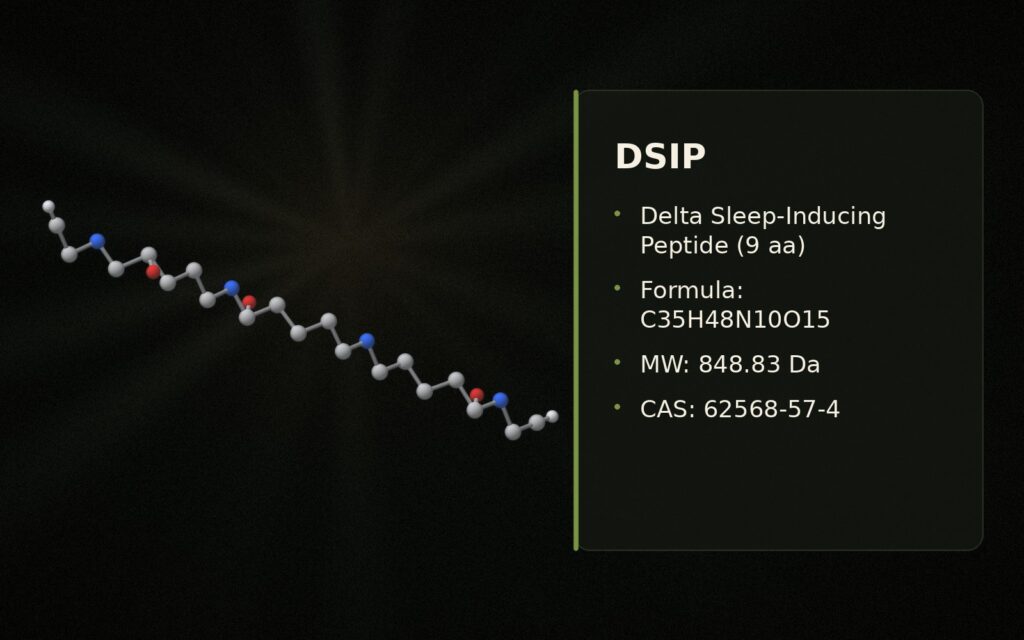
DSIP — short for Delta Sleep-Inducing Peptide — is one of the older entries in the peptide research literature, and one whose name may be doing more persuasive work than its evidence base. It was isolated from rabbit cerebral blood in the 1970s in experiments tied to slow-wave (“delta”) sleep, and the name has followed it ever since. For researchers newly encountering DSIP through peptide catalogs or social-media summaries, that name can create an expectation the modern literature does not clearly support.
This article exists to separate the two. DSIP is a legitimate, decades-old research subject with a real discovery history, a body of preclinical work, and a modest number of human studies from the 1980s and 1990s. It is not an approved medicine, it is not a consumer sleep aid, and — as this article will detail — even the original human sleep studies produced weak, inconsistent, and largely non-replicated results by contemporary methodological standards. As recently as July 2026, an FDA advisory committee reviewed DSIP for a specific regulatory pathway and voted against it, citing unresolved characterization and evidence concerns. Anyone evaluating DSIP as a research subject should start from that evidence-strength gap, not from the name.
Everything that follows is written for laboratory, academic, and other qualified research audiences evaluating DSIP as a subject of ongoing scientific inquiry. Nothing here should be read as guidance for human use, self-administration, or as a substitute for consulting a licensed physician about sleep or any other health concern.
Featured Definition: What Is DSIP?
DSIP (Delta Sleep-Inducing Peptide), also known by the proposed nonproprietary name emideltide, is a nonapeptide (nine amino acids) with the sequence Trp-Ala-Gly-Gly-Asp-Ala-Ser-Gly-Glu (WAGGDASGE). It was first isolated in the 1970s from the cerebral venous blood of rabbits during electrically induced slow-wave sleep, which is how it earned its “sleep-inducing” name. Since then, DSIP has been studied — inconsistently and mostly in older, small-scale trials — for possible effects on sleep architecture, stress hormone regulation, and withdrawal symptoms. It is not FDA-approved for any human use, is sold, when available, strictly labeled For Research Use Only (RUO), and is not intended for diagnostic, therapeutic, or human consumption purposes.
What DSIP Is: Discovery History and Chemical Identity
DSIP’s origin story is one of the more distinctive ones in the peptide literature. In the mid-1970s, a Swiss research group led by Klaus Schoenenberger and Marcel Monnier collected cerebral venous blood from rabbits during electrically induced slow-wave (“delta”) sleep and isolated a small circulating peptide that, when given to other rabbits, appeared to promote similar EEG sleep patterns. The peptide was sequenced and published in 1977 as a nonapeptide: Trp-Ala-Gly-Gly-Asp-Ala-Ser-Gly-Glu, and it was named for the effect it seemed to produce in that original preparation — delta (slow-wave) sleep induction.
Chemical identity (as listed in PubChem, CID 68816):
| Property | Value |
|---|---|
| Sequence | Trp-Ala-Gly-Gly-Asp-Ala-Ser-Gly-Glu |
| Peptide length | 9 amino acids (nonapeptide) |
| Molecular formula | C₃₅H₄₈N₁₀O₁₅ |
| Molecular weight | ≈848.8 g/mol |
| Common synonyms | DSIP, Delta Sleep-Inducing Peptide, Emideltide (proposed nonproprietary name) |
Interestingly, no dedicated DSIP receptor or DSIP-encoding gene has ever been conclusively identified in mammals, and some sequence-alignment work has noted similarity to a hypothetical bacterial protein — an oddity that researchers have periodically flagged without resolving. A 2006 review in the peptide literature summed up decades of work on the molecule under the title “Delta sleep-inducing peptide (DSIP): a still unresolved riddle” — a fair characterization that still applies to much of the field today. The peptide’s name has proven far stickier than its mechanism.
How DSIP Is Proposed to Work
Because no confirmed, dedicated DSIP receptor has been isolated, mechanism-of-action work on DSIP consists of several parallel, only partially overlapping hypotheses rather than one settled pathway. Researchers should treat each of the following as a proposed model under investigation, not an established mechanism:
Sleep-Architecture and Neurotransmitter Hypotheses
Some preclinical work has proposed that DSIP interacts with NMDA glutamate receptor signaling and modulates cholinergic activity (via effects on acetyltransferase through α1-adrenergic pathways), both of which are implicated in sleep-wake regulation and slow-wave sleep generation. Other researchers have proposed indirect modulation of GABAergic tone, given GABA’s central role in sleep architecture, though direct DSIP-GABA receptor binding has not been well established in the literature. None of these pathways has been confirmed as DSIP’s primary mechanism, and animal EEG results across labs have been inconsistent — some studies report increased slow-wave sleep and reduced REM sleep after DSIP administration, while other studies using similar designs report no measurable change in sleep architecture at all.
Stress-Axis (HPA) Hypothesis
A separate and arguably better-supported line of preclinical research frames DSIP as a “stress-limiting” peptide that interacts with the hypothalamic-pituitary-adrenal (HPA) axis, potentially blunting excessive corticotropin-releasing hormone (CRH) and ACTH signaling under stress conditions in animal models. This hypothesis is partly supported by structural homology observed between DSIP-related sequences and glucocorticoid-induced leucine zipper (GILZ), a protein involved in glucocorticoid signaling and downstream MAPK-cascade activity. This has led some researchers to investigate DSIP less as a “sleep peptide” per se and more as a general neuroendocrine stress-modulator, with sleep effects (if any) potentially downstream of stress-axis changes rather than a direct hypnotic action.
Antioxidant and Cellular Hypotheses
A smaller preclinical literature has examined DSIP’s antioxidant activity in isolated rat mitochondria and its effects on cell proliferation pathways, feeding into speculative “geroprotective” and anticarcinogenic hypotheses discussed further below. These remain narrow, early-stage lines of inquiry, not established mechanisms.
The honest summary: after roughly five decades of study, DSIP’s molecular target(s) remain unresolved. Multiple partial mechanisms have been proposed, none has been conclusively validated as primary, and the disconnect between the peptide’s evocative name and its uncertain pharmacology is itself a recurring theme in the review literature.
Preclinical and Human Research Findings
Animal and In Vitro Research
Preclinical DSIP research spans several unrelated domains, with mixed and often small-sample results:
- Sleep EEG studies in animals: Some studies in rabbits and rats reported increased slow-wave sleep and delta-EEG activity following DSIP administration; other studies using comparable methodology reported no significant change, and researchers have noted that synthetic DSIP analogues sometimes show stronger or more consistent sleep effects than the native peptide — an inconsistency that itself raises questions about the reliability of the original findings.
- Stress and HPA-axis studies: Rodent studies have examined DSIP’s effect on corticosterone and ACTH responses to stress, generally reporting attenuated stress hormone spikes, consistent with the “stress-limiting factor” hypothesis above.
- Oxidative stress: Isolated studies have reported antioxidant activity of DSIP in rat mitochondrial preparations.
- Oncology and longevity models: A small, older body of Russian-language and Eastern European literature reported reduced spontaneous tumor incidence and modestly extended lifespan in certain rodent strains given long-term DSIP administration. These findings have not been independently replicated in modern, adequately powered studies and should be treated as preliminary and unconfirmed.
- Stroke recovery model: A more recent (2021) rodent study examined DSIP administration after focal stroke and reported improved motor function recovery in treated animals — a contemporary data point, though it is a single preclinical study in one disease model and does not establish an effect in humans.
Human Research
Human DSIP research is limited in volume, dated, and methodologically inconsistent by modern clinical-trial standards. Key examples researchers frequently cite include:
- Chronic insomnia, double-blind study (Neuropsychobiology, 1992): A double-blind, matched-pairs, placebo-controlled polysomnography study gave intravenous DSIP to a small group of chronic insomnia patients over several nights. The researchers found only weak, partly placebo-confounded improvements in sleep efficiency and sleep latency, with most objective and subjective measures showing no meaningful difference from placebo. The study’s own authors concluded that short-term DSIP treatment was “not likely to be of major therapeutic benefit” for chronic insomnia — a direct, source-level rebuttal of the “DSIP cures insomnia” framing sometimes seen in informal marketing.
- Short-term administration studies in chronic insomniacs (1980s): Earlier open-label and small controlled studies reported modest subjective sleep improvements, but sample sizes were small, blinding was inconsistent, and objective polysomnographic corroboration was limited.
- Phase-shifted (“jet lag”) insomnia: A separate small study examined DSIP for insomnia associated with rapid time-zone shifts, reporting some subjective benefit, though again in a small, dated, and not independently replicated trial.
- Withdrawal and stress-related symptom studies: Older Eastern European clinical literature examined DSIP in the context of opioid and alcohol withdrawal symptom management and stress-related conditions, with some studies reporting substantial symptom relief. These studies generally predate modern trial-registration, blinding, and reporting standards, and have not been replicated in the peer-reviewed Western literature to a degree that would support any clinical conclusion today.
The core takeaway for researchers: the best-controlled human sleep study available — a double-blind, polysomnography-verified trial — found DSIP’s effects on chronic insomnia to be weak and not clearly clinically meaningful. Older, less rigorous studies reported more favorable subjective results, but the gap between DSIP’s reputation and its verified evidence base is a genuine, source-documented finding, not an editorial opinion.
Evidence by Research Level
| Research Level | What’s Been Studied | Strength of Evidence |
|---|---|---|
| In vitro / cellular | Antioxidant activity, MAPK/GILZ-related signaling | Preliminary — mechanistic, not functional, evidence |
| Animal (sleep EEG) | Slow-wave sleep, REM suppression in rabbits/rats | Mixed and inconsistent across studies |
| Animal (stress/HPA) | Corticosterone/ACTH response attenuation | Moderate preclinical support, not confirmed in humans |
| Animal (oncology/longevity) | Tumor incidence, lifespan in rodents | Very limited, old, unreplicated |
| Animal (stroke recovery) | Motor recovery post-focal stroke (2021) | Single study, early-stage |
| Human (open-label, 1980s) | Subjective sleep quality in insomniacs | Weak; small samples, limited blinding |
| Human (double-blind, polysomnography, 1992) | Objective and subjective sleep measures | Weak/non-significant per study authors |
| Human (withdrawal symptoms, dated Eastern-bloc literature) | Opioid/alcohol withdrawal symptom relief | Very limited, not independently replicated |
Across every level, the pattern is the same: more studied in cell and animal models than in humans, and even the best human data available do not support strong or reliable sleep effects.
Common Claims vs. Evidence
Peptide marketing and forum content frequently overstate DSIP’s evidence base. The table below compares commonly repeated claims against what the cited research actually supports.
| Common Claim | What the Evidence Actually Shows |
|---|---|
| “DSIP cures insomnia” | The most rigorous available human trial (double-blind, polysomnography-based) found effects “not likely to be of major therapeutic benefit.” No study supports a cure claim. |
| “DSIP is a natural, safe sleep aid” | DSIP is not FDA-approved, has no established human safety profile from modern trials, and “natural” origin (rabbit blood) does not equate to a demonstrated human safety or efficacy profile. |
| “DSIP works by directly activating sleep receptors in the brain” | No dedicated DSIP receptor has been conclusively identified in the literature; several competing, unconfirmed mechanistic hypotheses exist. |
| “DSIP is clinically proven for anti-aging and cancer prevention” | Based on a small, old body of rodent literature that has not been independently replicated; not evidence of any human effect. |
| “DSIP has decades of solid human research behind it” | DSIP has a decades-long research history, but the human studies within it are few, small, dated, and methodologically inconsistent by current clinical trial standards. |
| “DSIP is legal and approved for sleep support supplements” | DSIP is not FDA-approved for any use and, as of a July 2026 FDA advisory committee review, was not recommended for the 503A compounding bulk drug substances list. |
U.S. Regulatory Status
DSIP (proposed nonproprietary name: emideltide) is not approved by the U.S. Food and Drug Administration for any indication, including sleep, stress, or any other use, and it is not an ingredient in any FDA-approved drug product. It has no established Generally Recognized as Safe (GRAS) status, no approved dietary supplement use, and no FDA-sanctioned pathway for human administration.
DSIP has also been directly evaluated in the specific context of pharmacy compounding. The FDA’s Pharmacy Compounding Advisory Committee (PCAC) reviewed a set of peptides, including emideltide (DSIP), for potential addition to the Section 503A Bulks List — the list of bulk drug substances that outsourcing facilities and compounding pharmacies may legally use to compound patient-specific prescriptions absent an FDA-approved drug equivalent. At its July 2026 meeting, the committee voted against recommending emideltide for that list, citing concerns that included inconsistent naming and characterization standards, an unconfirmed purity profile, and low-quality evidence supporting the proposed uses. This is a meaningful, current data point: even within a regulatory process specifically designed to evaluate peptides like DSIP for limited compounding use, the compound did not clear the bar.
For research suppliers and laboratories, the practical implication is straightforward: DSIP should be treated strictly as a research chemical for laboratory and non-clinical use only, obtained and handled under appropriate institutional and biosafety protocols, and never marketed, sold, or represented as a human drug, supplement, or sleep-aid product. Vericor Bioscience supplies DSIP, where available, exclusively under Research Use Only (RUO) terms consistent with this status.
Safety and Unknown Risks
Because DSIP has not been the subject of modern, adequately powered human safety trials, its risk profile in humans is not well characterized. Researchers should be aware of the following limitations and open questions in the literature:
- No modern pharmacokinetic/toxicology dataset. Most human exposure data comes from small studies conducted decades ago, predating current standards for adverse-event reporting, long-term follow-up, and trial registration.
- Unclear immunogenicity and impurity risk. As the FDA’s PCAC discussion specifically noted, DSIP’s purity profile is difficult to confirm across manufacturing sources, which is a meaningful consideration for any laboratory sourcing or handling decision.
- Unknown drug and hormone interactions. Given DSIP’s proposed involvement with HPA-axis and stress-hormone signaling, any interaction with corticosteroids, other neuroendocrine-active compounds, or existing sleep or psychiatric medications is unstudied in any rigorous human dataset.
- No established dosing framework for any species-appropriate research protocol exists. Study parameters (dose, route, timing) have varied substantially across the limited animal and human literature, with no consensus reference standard.
- Long-term effects are unknown. Almost all available human studies involved short-term administration over a small number of days; nothing in the literature speaks to longer-term exposure.
None of the available literature should be read as establishing DSIP as safe for human use, self-experimentation, or off-label administration in any context. This article does not provide, and is not a substitute for, dosing guidance for human administration; all DSIP handling should occur exclusively within qualified laboratory settings following institutional biosafety, chemical handling, and animal-research protocols as applicable.
Research Evaluation Checklist
Researchers evaluating DSIP as a subject — or evaluating any claims made about it — may find it useful to work through the following:
- Confirm the source’s evidence tier. Is a given claim about DSIP based on in vitro data, animal studies, or human trials? Many marketing claims blur cellular findings into implied human effects.
- Check study age and design. Most human DSIP data predates 2000 and used small samples with inconsistent blinding; weigh accordingly against modern trial standards.
- Distinguish native DSIP from synthetic analogues. Some reported “stronger” sleep effects in the literature come from structurally modified DSIP analogues, not the native nonapeptide — conflating the two overstates the evidence for either.
- Verify purity and characterization documentation. Given the FDA’s specifically stated purity/characterization concerns, request a current Certificate of Analysis (CoA) from any research supplier before use.
- Look for independent replication. Treat single-study findings (e.g., the 2021 stroke-recovery model) as hypothesis-generating, not confirmatory, until replicated.
- Separate mechanism hypotheses from confirmed pathways. No dedicated DSIP receptor has been validated; proposed mechanisms (NMDA, GABAergic, HPA-axis, GILZ-related) remain competing hypotheses.
- Confirm regulatory framing. Note that DSIP is not FDA-approved and was not recommended for the 503A Bulks List as of the July 2026 PCAC vote — regulatory status can inform, but should not be conflated with, safety or efficacy conclusions.
- Ensure institutional compliance. Confirm that any research use complies with institutional review, biosafety, and applicable research-use-only regulations before procurement.
People Also Ask About DSIP
No. DSIP is a research peptide, not an approved sleep medication. It is not FDA-approved, has no established human dosing standard, and current evidence — including the best-controlled human trial available — does not support strong or reliable effects on sleep.
Not reliably, based on the modern evidence available. DSIP was named for effects observed in the original 1970s rabbit experiments, but subsequent animal studies have been inconsistent, and the most rigorous human trial (double-blind, polysomnography-based) found its effects on insomnia were weak and “not likely to be of major therapeutic benefit.”
DSIP can be lawfully sold and purchased in the United States strictly as a research chemical for laboratory and non-clinical research use, not as a drug, supplement, or product intended for human consumption. It is not FDA-approved for human use and was not recommended for the FDA’s 503A compounding bulks list as of the July 2026 PCAC review.
It is not conclusively established. Researchers have proposed several competing hypotheses — including NMDA receptor and cholinergic involvement, GABAergic modulation, and HPA-axis/stress-hormone effects related to structural similarity with GILZ — but no dedicated DSIP receptor has been confirmed, and a 2006 scientific review described the compound’s mechanism as “a still unresolved riddle.”
Yes. The preclinical and older clinical literature has examined DSIP in relation to stress-hormone regulation, opioid and alcohol withdrawal symptoms, antioxidant activity, and — in a small, unreplicated body of rodent literature — tumor incidence and lifespan. None of these lines of research has produced confirmatory modern human data.
DSIP (emideltide) was one of several peptides evaluated by the FDA’s Pharmacy Compounding Advisory Committee for potential inclusion on the Section 503A Bulks List, a list governing which bulk substances compounding pharmacies may use. The committee voted against recommending it, citing characterization, purity, and evidence-quality concerns.
Expert DSIP Q&A
As a researcher new to DSIP, what’s the single most important thing to know before reading further into the literature?
That its name substantially predates and outpaces its confirmed pharmacology. DSIP was named for an effect observed in a specific 1970s animal preparation, and decades of subsequent research have not established a confirmed receptor, a consistent sleep-architecture effect, or a validated human clinical benefit. Read the literature as an open scientific question, not a settled mechanism.
Why do older studies sometimes report better results than newer, more rigorous ones?
This pattern is common across older peptide literature generally, and DSIP is a clear example. Smaller sample sizes, less consistent blinding, and less standardized outcome measures in 1980s-era studies tend to produce larger, less reliable effect estimates. The 1992 double-blind, polysomnography-verified study — methodologically the strongest human DSIP trial available — reported weaker and less clinically meaningful results than earlier open-label work.
Does the existence of a proposed nonproprietary name (emideltide) mean DSIP is closer to approval?
Not necessarily. Nonproprietary naming can occur as part of a substance moving through regulatory evaluation processes, but it does not itself confer approval or endorsement. In DSIP’s case, the same 2026 process that involved this naming also produced a PCAC vote against recommending the compound for the 503A Bulks List.
What would meaningfully change DSIP’s evidence base going forward?
Well-powered, modern, double-blind, placebo-controlled human trials using standardized polysomnography and validated subjective sleep measures — something the existing literature largely lacks. Confirmatory identification of a specific DSIP receptor or binding target would also substantially clarify the mechanistic picture, which currently rests on several competing, unconfirmed hypotheses.
Should researchers assume DSIP analogues behave the same way as native DSIP?
No. Several sources in the literature note that synthetic DSIP analogues have sometimes shown different — occasionally stronger — effects on sleep parameters compared to the native nonapeptide. Structural modifications should be treated as distinct research subjects with their own evidence requirements, not as interchangeable with native DSIP data.
Conclusion
DSIP is a genuinely interesting subject in the history of sleep and neuroendocrine peptide research — a molecule isolated under unusual circumstances in the 1970s, studied across cellular, animal, and limited human contexts for fifty years, and still without a confirmed mechanism of action. What it is not is a validated sleep therapy, an FDA-approved product, or a compound with a modern, well-characterized human safety and efficacy profile. The most rigorous human trial available concluded its effects were unlikely to be of major clinical benefit, and as recently as mid-2026, an FDA advisory committee declined to recommend it for a specific compounding pathway, citing unresolved evidence and characterization concerns. Researchers exploring DSIP should approach it the same way they would any incompletely characterized peptide: with attention to study quality, mechanistic uncertainty, and the real gap that can exist between a compound’s name and its evidence base.
Qualified researchers and institutions interested in DSIP for laboratory, non-clinical research purposes can review current specifications, documentation, and Research Use Only terms on Vericor Bioscience’s DSIP research product page.