
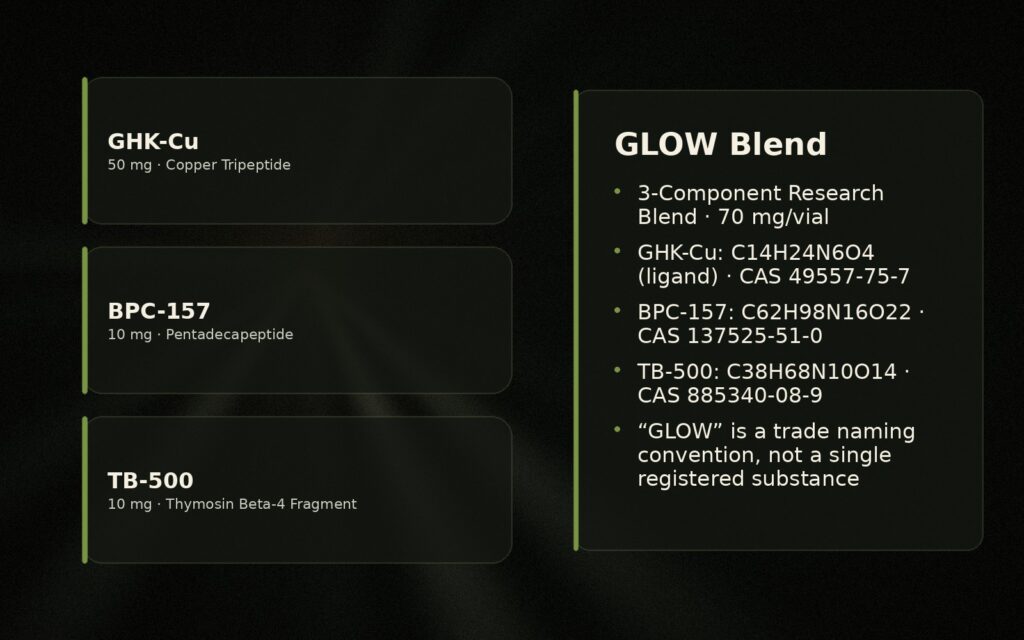
“GLOW” is a combination research product — a single vial containing three separately studied peptides, rather than one compound in its own right. This guide is written for laboratory researchers and institutional buyers evaluating the GLOW blend for legitimate in vitro, ex vivo, or animal research, and it is structured differently from a single-compound guide for that reason: rather than describing one molecule’s mechanism and evidence base, it explains what’s actually in the vial, why these three peptides are commonly combined in the research-chemical trade, and — critically — what is and is not known about the combination itself, as distinct from what is known about each component individually.
Vericor Bioscience’s GLOW blend is sold strictly as a research-use-only (RUO) laboratory product. It is not approved by the FDA for any human or animal use, and nothing in this article describes, recommends, or implies dosing, injection, or administration in people or animals.
Featured definition: GLOW is a research-chemical combination product containing three individually characterized peptides in a single vial: GHK-Cu (a copper-binding tripeptide, 50 mg), BPC-157 (a synthetic 15-amino-acid pentadecapeptide, 10 mg), and TB-500 / Thymosin Beta-4 (a synthetic peptide sold under the TB-500 research name, 10 mg) — 70 mg of total peptide content per vial, matching Vericor’s “GLOW 70mg” product naming. Each component has its own independent research literature and regulatory history; the blend itself has not been independently studied as a combination.
What Is the GLOW Blend? {#what-is-glow}
GLOW is a naming convention that has become fairly standardized across the research-peptide supply trade for a specific three-component combination: GHK-Cu, BPC-157, and TB-500, generally formulated at a 50 mg / 10 mg / 10 mg ratio for 70 mg of total peptide content per vial. The name itself is a marketing convention rather than a registered scientific or regulatory term — there is no single “GLOW peptide” molecule, no CAS number for “GLOW” as a substance, and no FDA or scientific-literature recognition of the term. It functions purely as shorthand for “this specific three-peptide combination,” and researchers should treat it accordingly: as a convenient label for a mixture, not as a claim about a novel or independently characterized compound.
The rationale commonly cited in vendor and research-community discussion for combining these three specific peptides centers on tissue repair and skin/connective-tissue biology: GHK-Cu is studied for effects on collagen synthesis and tissue remodeling, while BPC-157 and TB-500 are both studied — independently, in their own separate literatures — for proposed roles in tissue repair and angiogenesis. The “GLOW” framing (implying skin-related or cosmetic benefit) reflects this thematic overlap rather than any blend-specific research finding.
Component Chemistry and Identity {#component-chemistry}
Each component’s chemical identity is drawn from PubChem and standard chemical-registry sources. Researchers should verify all three independently against their own certificate of analysis (COA) documentation, since a combination product introduces three separate identity- and purity-verification questions rather than one.
| Component | Amount per Vial | Molecular Formula | Molecular Weight | CAS Registry Number |
|---|---|---|---|---|
| GHK-Cu | 50 mg | C₁₄H₂₄N₆O₄ (tripeptide ligand; see note below) | 340.38 g/mol (ligand) | 49557-75-7 |
| BPC-157 | 10 mg | C₆₂H₉₈N₁₆O₂₂ | 1,419.5 g/mol | 137525-51-0 |
| TB-500 (Thymosin Beta-4) | 10 mg | C₂₁₂H₃₅₀N₅₆O₇₈S | 4,963.44 g/mol | 77591-33-4 |
A note on GHK-Cu’s formula: GHK-Cu is properly understood as a copper(II) coordination complex of the tripeptide glycyl-L-histidyl-L-lysine (GHK) — the copper ion is chelated by the peptide, not covalently incorporated into a single fixed-formula molecule the way the atoms in BPC-157 or TB-500 are. Commercial and cosmetic-ingredient databases (including the CAS registration commonly cited for “Copper Tripeptide-1”) conventionally list the free tripeptide ligand’s formula and weight (C₁₄H₂₄N₆O₄, 340.38 g/mol) under the CAS number registered for the copper complex — a long-standing industry simplification, not something specific to any one vendor. Researchers requiring the copper-inclusive formula for analytical work should request lot-specific mass-spectrometry characterization from their supplier rather than relying on the ligand-only figure commonly published online.
A note on “TB-500”: the name “TB-500” is used in the research-chemical trade to refer to Thymosin Beta-4, the full 43-amino-acid protein (the formula and CAS above describe this full protein). Some vendors have historically sold a much shorter 7-amino-acid fragment under the same “TB-500” name; researchers should confirm with their supplier’s COA which form they are actually receiving, since the two are chemically and evidentially distinct.
Why These Three Peptides Are Combined {#rationale}
The stated logic behind the GLOW combination, as discussed across vendor literature and research-community sources, is thematic complementarity rather than a demonstrated pharmacological synergy:
- GHK-Cu is studied in the dermatology and wound-healing literature for proposed effects on collagen and glycosaminoglycan synthesis, antioxidant activity, and tissue remodeling signaling.
- BPC-157 is studied in preclinical models for proposed gastrointestinal-protective and broader tissue-repair effects, with a research history spanning several decades of animal-model work.
- TB-500 / Thymosin Beta-4 is studied for proposed roles in actin regulation, cell migration, and angiogenesis relevant to wound healing.
Combining three peptides that are independently associated with tissue-repair and skin-relevant biology is a reasonable hypothesis for researchers interested in that intersection — but it is a hypothesis, not a validated finding. No published research identified for this article has studied the three-peptide combination as a single research subject; each peptide’s evidence base comes from studies of that peptide alone.
Proposed Mechanisms by Component {#mechanisms}
Because each component has its own detailed, independently reviewed mechanism, this article summarizes rather than duplicates that material — researchers wanting compound-specific depth should consult Vericor Bioscience’s dedicated research guides for BPC-157 and TB-500, which cover mechanism, evidence quality, and regulatory status for those two components in full.
- GHK-Cu is hypothesized to act via copper-dependent modulation of gene expression pathways relevant to tissue remodeling, along with proposed antioxidant and metalloproteinase-regulating activity, based largely on in vitro and animal dermal-research models.
- BPC-157 is hypothesized to support tissue repair and angiogenesis through effects on growth-factor signaling pathways (including VEGF-related mechanisms proposed in some animal studies), though a fully confirmed human molecular target has not been established in the peer-reviewed literature reviewed for Vericor’s BPC-157 guide.
- TB-500 / Thymosin Beta-4 is hypothesized to act primarily through actin-binding activity, influencing cell migration and cytoskeletal dynamics relevant to wound closure and blood-vessel formation in animal models.
None of these mechanisms has been studied specifically in the context of co-administration with the other two components in this blend.
Research Findings by Component {#research-findings}
| Component | Research Base | Independent Combination Research |
|---|---|---|
| GHK-Cu | Multiple decades of in vitro, animal, and human dermatological/cosmetic-science research on the isolated peptide | None identified specific to this three-peptide combination |
| BPC-157 | Preclinical animal-model literature spanning gastrointestinal and broader tissue-repair research; no FDA-reviewed human clinical trials identified | None identified specific to this three-peptide combination |
| TB-500 / Thymosin Beta-4 | Preclinical animal-model and in vitro wound-healing and cardiovascular-repair literature | None identified specific to this three-peptide combination |
This table’s most important cell is the right-hand column, repeated three times: as of this review, no published research was identified that studies GHK-Cu, BPC-157, and TB-500 administered together as a combination, in any species, at any dose. Everything known about “GLOW” as a combination is inferred from the separate literatures on its three components — it is not itself an evidence-based finding.
What’s Not Known: The Blend Itself {#not-known}
Researchers evaluating GLOW should be explicit with themselves — and with anyone they report findings to — about the difference between what is known and what is assumed:
- No combination-specific pharmacokinetic data exists. Whether co-formulating these three peptides changes the absorption, distribution, or degradation kinetics of any individual component relative to that component studied alone has not been published, to the knowledge available for this review.
- No combination-specific safety or toxicology data exists. Each component’s individual safety literature does not automatically extend to a three-peptide mixture; interaction effects, if any, are unstudied.
- No combination-specific efficacy data exists for any proposed research endpoint. Any hypothesis that the three peptides act synergistically, additively, or independently when combined is untested.
- Batch consistency is a three-times-larger question than for a single peptide. A combination product requires verified identity and purity for three separate active substances rather than one, and a COA for a blend product should document each component individually.
None of this means the combination is unsafe or without scientific rationale for research purposes — it means researchers should report and interpret findings from GLOW-based experiments with appropriate caution about what can and cannot be attributed to the combination as such.
U.S. Regulatory Status {#regulatory-status}
None of GLOW’s three components is approved by the FDA for any human or veterinary use, and the blend itself — as a combination product — has no independent FDA review, approval, or regulatory status of any kind.
- BPC-157 has been the subject of recent FDA regulatory attention specifically regarding pharmacy compounding: it has been reviewed by the FDA’s Pharmacy Compounding Advisory Committee (PCAC) in the context of the Section 503A bulk drug substances nomination process, and researchers should consult Vericor’s dedicated BPC-157 guide and current FDA guidance for the latest status.
- TB-500 / Thymosin Beta-4 has likewise been part of recent 503A bulk-substance review discussions; see Vericor’s dedicated TB-500 guide for current detail.
- GHK-Cu has a long history of use in the cosmetic-ingredient industry (as “Copper Tripeptide-1,” subject to FDA cosmetic regulation rather than drug regulation in that context) but has no FDA drug approval, and the research-grade material sold for laboratory use is regulated as an unapproved research chemical, not a cosmetic ingredient, when sold in this form.
Because the individual components’ regulatory postures can change (particularly around 503A bulk-substance nomination status), researchers should treat any stated regulatory status as time-sensitive and verify current status directly with FDA resources before relying on it for compliance purposes.
Safety Considerations Specific to Multi-Peptide Blends {#safety}
- No FDA-reviewed safety, pharmacokinetic, or toxicology dataset exists for the GLOW combination itself, and none of the three individual components has an FDA-reviewed human safety profile either.
- Interaction effects between the three peptides have not been studied. Researchers should not assume that a safety margin established for one peptide in isolation applies unchanged when it is administered as part of this combination.
- Verify each component independently via COA. A combination-product COA should ideally confirm identity and purity for GHK-Cu, BPC-157, and TB-500 separately, not present a single aggregate “purity” figure for the vial as a whole.
- GHK-Cu’s copper content introduces a consideration not present with the other two components — copper is a redox-active transition metal, and researchers working with GHK-Cu-containing solutions in sensitive assay systems (e.g., oxidative-stress readouts) should account for potential copper-related assay interference distinct from the peptide’s intended biological activity.
- This product must never be self-administered or used outside a properly authorized, IRB/IACUC-governed research setting. There is no clinical protocol, human dosing regimen, or self-administration use case described, recommended, or implied anywhere in this article.
Research Evaluation Checklist {#checklist}
- Confirm the exact composition and ratio from your supplier’s COA — “GLOW” is not a standardized regulatory term, and formulations can vary slightly between vendors even when using the same name.
- Verify each of the three components independently, including confirming which molecular form of “TB-500” (full 43-aa Thymosin Beta-4 vs. a shorter fragment some vendors have sold under the same name) is actually present.
- Do not extrapolate single-component research findings as though they were blend-specific evidence. Cite the correct underlying study for the correct individual peptide when reporting findings.
- Account for three-times-compounded batch-consistency risk relative to a single-peptide product when planning experiments that depend on precise, reproducible dosing across replicates.
- Check current FDA 503A bulk-substance status for BPC-157 and TB-500 specifically, since this area has been subject to recent regulatory review activity.
- Consider potential copper-related assay interference from the GHK-Cu component in redox-sensitive experimental systems.
- Restrict all use to qualified, non-clinical research settings with appropriate institutional oversight.
People Also Ask About GLOW Blend
Vericor’s GLOW blend contains GHK-Cu (50 mg), BPC-157 (10 mg), and TB-500 / Thymosin Beta-4 (10 mg), for 70 mg of total peptide content per vial.
No independent research on the three-peptide combination was identified for this review. All available evidence comes from studies of each individual peptide studied alone; the combination’s effects, if any, have not been independently tested.
No. None of the three components is FDA-approved for human or animal use, and the combination product has no independent regulatory status of any kind.
GHK-Cu is a copper coordination complex of the tripeptide GHK. Commercial and cosmetic-ingredient databases conventionally list the copper-free ligand’s formula and weight under the CAS number registered for the complex — a long-standing industry simplification rather than an error specific to any one source.
Not necessarily. The name has historically been used by some vendors to describe the full 43-amino-acid Thymosin Beta-4 protein and by others to describe a much shorter 7-amino-acid fragment. Always confirm the specific form via your supplier’s certificate of analysis.
Expert GLOW Blend Q&A
What’s the biggest evidentiary gap researchers should keep in mind with a product like GLOW?
The absence of any combination-specific research. It’s tempting to treat a blend’s rationale as though it were a finding, but nothing published studies GHK-Cu, BPC-157, and TB-500 given together. Every mechanistic and safety claim available comes from the single-component literature, and researchers should be explicit about that distinction in how they interpret and report results.
Does combining three peptides in one vial create additional quality-control risk compared to a single peptide?
Yes, proportionally. A combination product has three independent identity, purity, and stability profiles to verify rather than one, and a supplier’s COA should reflect that — ideally with component-specific data rather than a single blended purity percentage.
Why does GHK-Cu’s copper content matter for research design specifically?
Copper is redox-active and can interfere with certain oxidative-stress or metal-sensitive assay readouts independent of the peptide’s own biological activity. Researchers running such assays with GLOW should account for this as a potential confound distinct from the intended experimental variable.
How should a researcher decide whether GLOW or an individual component is the right research tool for a given question?
If the research question is about one specific peptide’s mechanism, using that peptide alone (rather than as part of a blend) removes a variable and simplifies interpretation. GLOW is more appropriate when the research question specifically concerns the combination itself — with the explicit understanding that combination-specific literature does not yet exist to compare results against.
Conclusion {#conclusion}
GLOW is a three-peptide combination product — GHK-Cu, BPC-157, and TB-500 — built around a thematic rationale (tissue repair and skin-relevant biology) rather than a demonstrated combination-specific research finding. Each component carries its own independent, differently-sized evidence base and its own regulatory considerations, and none of the three, alone or combined, is FDA-approved for any human or animal use. Researchers should verify each component’s identity independently, cite findings back to the correct single-compound literature, and treat any claim about the blend’s combined effects as an untested hypothesis rather than an established result. This article is provided strictly for laboratory research and educational purposes — it is not a guide to human use, and GLOW is not for human consumption, self-administration, or the treatment of any condition.
Qualified researchers evaluating the GLOW blend for legitimate, non-clinical laboratory investigation are encouraged to review Vericor Bioscience’s research product page for current certificate-of-analysis documentation, sourcing details, and research-use-only terms of sale.