
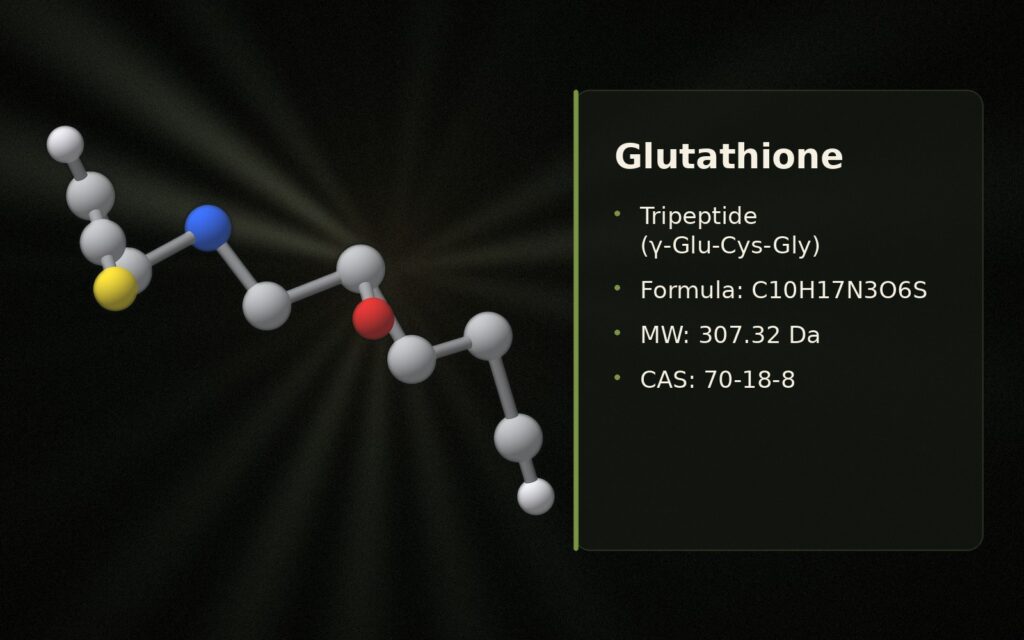
Glutathione is one of the most extensively studied molecules in redox biology — a naturally occurring tripeptide that every human cell manufactures and relies on to manage oxidative stress. Its biological ubiquity has also made it one of the most commercially exploited compounds in the wellness industry, marketed in oral supplements, topical creams, and — most controversially — unsupervised injectable formulations sold for “detoxification” and skin-lightening purposes.
That last category is precisely why this overview exists, and why it opens with a warning rather than a pitch. Regulatory agencies, including the U.S. Food and Drug Administration (FDA) and counterparts in other countries, have issued specific alerts about unsupervised glutathione injection, citing contamination risks, serious adverse events, and the marketing of injectable glutathione for skin-lightening as an unapproved use. Vericor Bioscience does not sell glutathione as a supplement, a cosmetic ingredient, or an injectable product for human self-administration. The glutathione-related material referenced on this site is offered strictly as a research-use-only (RUO) compound intended for in vitro, laboratory, and non-clinical research settings by qualified institutions and investigators. It is not FDA-approved for injection or administration to humans, and nothing in this article should be read as instruction, encouragement, or guidance for personal use, self-administration, dosing, or any human application.
With that framing established, this article reviews what the peer-reviewed and regulatory literature actually says about glutathione: its chemistry, its proposed biological mechanisms, the state of clinical research on injectable/IV formulations, the specific safety-warning history tied to skin-lightening use, and the regulatory distinctions that researchers evaluating this molecule need to understand.
Featured Definition: What Is Glutathione?
Glutathione (GSH) is a low-molecular-weight tripeptide composed of three amino acids — L-glutamate, L-cysteine, and glycine — joined by peptide bonds, with an unusual gamma-linkage between the glutamate and cysteine residues (hence “γ-glutamylcysteinylglycine”). It is synthesized endogenously in the cytosol of virtually all human cells and is widely regarded as the body’s principal intracellular antioxidant, playing a central role in neutralizing reactive oxygen species, supporting Phase II xenobiotic metabolism, and maintaining cellular redox balance. In research contexts, glutathione is studied both as an endogenous biomarker of oxidative stress and as an exogenously administered compound (oral, topical, or intravenous) whose pharmacokinetics and clinical effects remain incompletely characterized, particularly for parenteral routes.
What Is Glutathione? Natural Biological Role and Chemical Identity
Glutathione is not a synthetic research peptide in the way that BPC-157 or Semax are — it is an endogenous molecule, present in essentially every human cell, and it has been characterized in the biochemical literature for over a century. Its molecular formula is C₁₀H₁₇N₃O₆S, with a molecular weight of approximately 307.32 g/mol and CAS registry number 70-18-8. The reduced form (GSH) is the biologically active antioxidant species; under oxidative conditions, two GSH molecules combine (via a disulfide bond between their cysteine thiol groups) to form glutathione disulfide (GSSG), and the cellular ratio of GSH to GSSG is widely used in research as a marker of oxidative stress status.
Biosynthesis occurs in two ATP-dependent enzymatic steps. First, glutamate-cysteine ligase (GCL) — the rate-limiting enzyme in the pathway — catalyzes formation of γ-glutamylcysteine from L-glutamate and L-cysteine. Second, glutathione synthetase adds a glycine residue to complete the tripeptide. The atypical gamma-glutamyl bond (rather than a standard alpha-peptide bond) is notable because it protects glutathione from being broken down by most intracellular peptidases, contributing to its relative stability once synthesized inside the cell.
Because glutathione is ubiquitous and essential to normal cellular physiology, it has attracted research interest across a wide range of domains: oxidative stress biology, hepatic detoxification pathways (glutathione S-transferase-mediated conjugation of xenobiotics), immune cell function, neurodegeneration, and cellular aging. This breadth of legitimate scientific interest is part of why glutathione is also so heavily commercialized — and why researchers evaluating any glutathione-related product need to look carefully at what, specifically, is being studied, in what form, and by what route.
Oral Supplement vs. Injectable/Research-Grade Material: A Critical Distinction
This distinction is central to understanding glutathione’s regulatory and safety landscape, and it is easy to blur if sources are not read carefully.
Oral dietary supplement glutathione is legally marketed in the United States as a dietary ingredient under the framework that governs dietary supplements. Oral glutathione capsules, tablets, and liposomal formulations are widely available as consumer products. However, the oral route has a well-documented pharmacokinetic limitation: ingested glutathione is substantially degraded by proteases in the gastrointestinal tract before absorption, and the intestinal epithelium lacks a dedicated high-capacity transporter for the intact tripeptide. As a result, oral glutathione’s ability to meaningfully raise systemic or intracellular glutathione levels is limited and is itself a subject of ongoing research (some investigators instead study precursors like N-acetylcysteine, which the body can use to synthesize glutathione de novo).
Injectable and IV glutathione is a categorically different matter, both scientifically and regulatorily. Injecting a compound bypasses the digestive tract entirely, which means the sterility, purity, and endotoxin profile of the material — not just its identity — determine whether it is safe to introduce into the bloodstream. The FDA has explicitly and publicly warned that dietary-supplement-grade glutathione is not suitable for use in compounding sterile injectable products, precisely because supplement-grade ingredients are not manufactured or tested to the standards required for parenteral administration (see the Regulatory Status section below for specifics).
The material referenced on this site falls into neither of the above consumer categories. Vericor’s glutathione-related offering is positioned strictly as a laboratory research chemical for in vitro or non-clinical research applications — not as an oral supplement, not as a compounded injectable drug, and not as a product intended, labeled, or sold for human administration of any kind. Researchers should treat any glutathione research material the same way they would treat any other RUO compound: verify certificate-of-analysis data, confirm the supplier’s quality documentation, and use it only within an appropriate institutional research framework.
Proposed Mechanism of Action: Antioxidant and Detoxification Pathways
In cellular and biochemical research, glutathione’s proposed mechanisms of action center on redox chemistry:
- Direct antioxidant activity. The thiol (-SH) group on glutathione’s cysteine residue is readily oxidized, allowing GSH to donate electrons that neutralize reactive oxygen species (ROS) and free radicals, converting itself to GSSG in the process. Cellular systems (notably glutathione reductase, using NADPH) regenerate GSH from GSSG, sustaining the cycle.
- Enzymatic detoxification (Phase II conjugation). Glutathione S-transferase (GST) enzymes catalyze the conjugation of glutathione to a wide range of electrophilic xenobiotics and reactive metabolites, rendering them more water-soluble and facilitating their excretion via bile or urine — a pathway studied extensively in hepatic and xenobiotic metabolism research.
- Regeneration of other antioxidants. Glutathione is studied for its role in helping to maintain vitamins C and E in their reduced (active) states, situating it within a broader cellular antioxidant network rather than functioning in isolation.
- Immune modulation. Research has explored glutathione’s involvement in lymphocyte proliferation and function, with intracellular GSH levels proposed as a factor influencing immune cell responses, though causal mechanisms in vivo remain an active area of study.
It is important to note that “detoxification pathway” in this context refers to a specific, well-characterized enzymatic conjugation mechanism studied in cell and animal models — it is not equivalent to, and should not be conflated with, colloquial marketing claims that a supplement or injection “detoxifies the body” in a global or therapeutic sense for a person taking it.
Research Findings on Injectable and IV Glutathione
The scientific literature on intravenous or injectable glutathione is considerably thinner and more mixed than popular marketing suggests, and researchers should approach it with appropriate skepticism.
Clinical investigation of IV glutathione has occurred in a handful of contexts, most notably:
- Neurodegenerative disease research. Small studies and case series have explored glutathione (including intranasal and IV formulations) in Parkinson’s disease, based on the hypothesis that oxidative stress and depleted glutathione levels in the substantia nigra contribute to dopaminergic neuron loss. Results have been inconsistent, and larger controlled trials — including intranasal glutathione studies supported by research foundations focused on Parkinson’s — have generally not demonstrated the disease-modifying benefit that early hypotheses suggested. This remains an open research question, not an established treatment finding.
- Liver disease research. Glutathione’s role in hepatic detoxification has prompted investigation of IV glutathione in non-alcoholic fatty liver disease (NAFLD) and other hepatic oxidative stress models. Findings are preliminary and pharmacological reviews in this space describe the evidence as still emerging rather than conclusive.
- Cosmetic/skin-lightening research. As detailed in the dedicated section below, the limited controlled-trial evidence for IV glutathione’s skin-lightening effect is specifically negative-to-disappointing, in contrast to modest, reversible effects reported for oral and topical routes.
Across this literature, a consistent theme emerges: IV/injectable glutathione is the route with the weakest clinical evidence base and the highest documented rate of serious adverse events, despite being the form most aggressively marketed direct-to-consumer, particularly in medical spa and wellness-clinic settings. Researchers evaluating claims about injectable glutathione should treat the oral, topical, and IV literatures as scientifically distinct — a finding in one route does not generalize to another — and should note that much of the clinical trial base for any route remains small in sample size and short in duration.
The Skin-Lightening Safety-Warning History
No honest discussion of glutathione’s research and commercial landscape can omit this history, because it is directly relevant to why regulators view unsupervised injectable glutathione with concern.
Glutathione, at high doses via IV or intramuscular injection, has been marketed for years — especially in parts of Asia and increasingly in U.S. medical spas — as a “skin-whitening” or “skin-lightening” agent, based on a proposed mechanism in which glutathione shifts melanin synthesis away from the darker eumelanin pathway toward lighter pheomelanin. This use case has drawn specific, repeated regulatory scrutiny:
- The U.S. FDA has published consumer guidance warning that injectable skin-lightening products — commonly containing glutathione alongside vitamin C, collagen, or other ingredients — are unapproved new drugs. The FDA has stated plainly that no injectable drug has been approved in the United States for skin whitening or lightening, and has taken enforcement action against distributors of such products (for example, a 2014 U.S. Marshals seizure of glutathione-containing “whitening kits” from a Florida distributor after a recall was not honored).
- The FDA has separately and specifically warned that dietary-supplement-grade glutathione is not appropriate for compounding into sterile injectable products, following documented adverse events (including fever, chills, and shock-like/sepsis-consistent symptoms requiring hospitalization) traced to a contaminated glutathione lot used by multiple compounding pharmacies. This is a purity/sterility warning distinct from, but compounding, the unapproved-use concern above.
- Regulatory bodies outside the U.S., including the Philippines FDA, have issued advisories describing serious adverse events associated with unsupervised glutathione injection for skin-lightening, including severe skin reactions (Stevens-Johnson syndrome and toxic epidermal necrolysis have been referenced in regulatory and review literature), abdominal pain, thyroid dysfunction, and renal dysfunction.
- Published clinical trial data on IV glutathione for skin lightening is itself sparse (a small number of controlled trials exist across all routes combined) and the one identified IV trial did not find a favorable, lasting effect — while separately reporting a meaningful rate of liver-enzyme abnormalities among treated subjects.
Vericor Bioscience does not offer, market, or endorse glutathione for skin-lightening, cosmetic, or any other human-use purpose. This history is included here because it is directly relevant safety and regulatory context that any researcher, institution, or reviewer evaluating glutathione-related material should be aware of — not because it describes an application of the RUO material discussed on this site.
Evidence by Research Level
| Research Domain | Route Studied | Evidence Strength | Summary |
|---|---|---|---|
| Endogenous antioxidant biochemistry | N/A (basic science) | Strong / well-established | Decades of biochemical and cell-biology research firmly establish GSH’s role in redox homeostasis and Phase II detoxification enzymology. |
| Oral bioavailability | Oral | Well-characterized, limits established | Multiple studies confirm poor intact absorption due to GI proteolysis and lack of a dedicated transporter; effects on systemic GSH levels are modest. |
| Skin pigmentation (oral/topical) | Oral, topical | Limited, preliminary | A small number of controlled trials report statistically significant but modest and reversible reductions in melanin index; evidence base is thin (only a handful of published trials). |
| Skin pigmentation (IV) | Intravenous | Weak / unfavorable | The identified controlled IV trial did not show a favorable or lasting effect and reported notable adverse findings (including liver enzyme changes). |
| Neurodegenerative disease (e.g., Parkinson’s) | Intranasal, IV | Early-stage, inconclusive | Small trials and mechanistic hypotheses exist; larger controlled studies have not confirmed disease-modifying benefit. |
| Hepatic/oxidative stress disease models | IV, oral | Preliminary | Pharmacological reviews describe emerging but not yet conclusive clinical evidence in conditions like NAFLD. |
| Injectable safety/purity | Intravenous/IM | Documented concern | Regulatory bodies have documented specific adverse-event clusters tied to contaminated or unapproved injectable glutathione products. |
U.S. Regulatory Status
Precision matters here, because glutathione’s regulatory status differs sharply by route and grade of material:
- Oral glutathione may be legally marketed in the U.S. as a dietary supplement ingredient, subject to the dietary supplement regulatory framework (which does not require pre-market FDA approval of efficacy the way drug approval does, but does impose manufacturing and labeling requirements).
- Injectable glutathione is not FDA-approved as a drug for any indication, including skin lightening, detoxification, or general wellness use. The FDA has publicly classified injectable skin-lightening products containing glutathione as unapproved new drugs and has taken enforcement action against distributors.
- The FDA has issued specific guidance to compounding pharmacies stating that dietary-supplement-grade glutathione should not be used to compound sterile injectable products, citing contamination and endotoxin risks documented in real adverse-event investigations.
- The research-grade glutathione material referenced on this site is not FDA-approved for injection or administration to humans in any context — research, clinical, or otherwise. It is offered exclusively for in vitro, laboratory, and non-clinical research use by qualified professionals and institutions, consistent with its research-use-only designation. It is not a drug, dietary supplement, or cosmetic product, and Vericor Bioscience does not represent it as suitable for, or intended for, human consumption, injection, or any personal use.
Researchers should independently verify current regulatory status through primary FDA sources before designing any study protocol, and should never treat RUO material as equivalent to a pharmaceutical-grade or compounding-pharmacy product.
Safety Considerations and Unknown Risks
Even setting aside the skin-lightening-specific warnings above, several safety and knowledge gaps are relevant to anyone evaluating glutathione research material:
- Sterility and sourcing risk. As FDA’s own compounding alerts demonstrate, glutathione intended for non-injectable use can carry endotoxin or microbial contamination that is invisible without proper laboratory testing, and that becomes a serious hazard only once a substance is introduced parenterally. Research-grade material should always be accompanied by a certificate of analysis and used within appropriate laboratory biosafety practices — never administered to humans or animals outside a properly authorized and IACUC/IRB-approved protocol.
- Route-dependent pharmacology is not fully mapped. Oral, topical, intranasal, and IV glutathione behave very differently pharmacokinetically, and data from one route cannot be assumed to predict outcomes for another.
- Reported adverse events with injectable use. Published case reports and regulatory advisories associated with injectable glutathione (typically in unsupervised or non-clinical settings) describe reactions ranging from mild to severe, including allergic/anaphylactic reactions, liver enzyme abnormalities, and, per international regulatory advisories, rare severe cutaneous reactions.
- Long-term effects are not well studied. Because most controlled trials are small and short-duration, the long-term safety profile of repeated high-dose glutathione administration by any route remains inadequately characterized in the literature.
- Drug and supplement interactions are not comprehensively cataloged. As with many compounds studied primarily in small trials, systematic interaction data is limited.
Research Evaluation Checklist
For researchers or institutions evaluating glutathione-related material or literature, consider the following:
- Confirm the specific molecule and form. Verify whether reduced glutathione (GSH), oxidized glutathione (GSSG), or a glutathione precursor (e.g., NAC) is under discussion — mechanisms and evidence differ across these.
- Identify the route of administration in any cited study. Oral, topical, intranasal, and IV data should never be treated as interchangeable.
- Check the source and grade of any physical material. Request a certificate of analysis, purity data, and sourcing documentation; do not assume dietary-supplement-grade material is suitable for any parenteral research application.
- Distinguish regulatory status by use case. Confirm whether a claim pertains to oral dietary supplement status or injectable/drug status — these are governed differently and conflating them is a common source of misinformation.
- Scrutinize sample sizes and trial design. Much of the injectable glutathione literature, particularly for skin-lightening, consists of very small trials; treat findings as preliminary.
- Review documented adverse event histories. Consult FDA safety communications and international regulatory advisories before designing any protocol involving glutathione administration.
- Ensure appropriate institutional oversight. Any research involving human or animal administration requires appropriate ethical review (IRB/IACUC) and cannot proceed on the basis of RUO material alone.
- Avoid extrapolating mechanism to outcome. A plausible biochemical mechanism (e.g., antioxidant activity) does not, by itself, establish clinical efficacy for any specific condition or cosmetic outcome.
People Also Ask About Glutathione
No. Glutathione is an endogenous tripeptide the body produces naturally, structurally and regulatorily distinct from synthetic peptide drugs. It should not be compared to, or assumed to share the safety/efficacy profile of, any FDA-approved pharmaceutical.
Regulators have specifically warned against this claim, particularly for injectable products. A small number of controlled trials report modest, reversible melanin-index changes with oral or topical use, but injectable use for this purpose is not FDA-approved and has been the subject of specific safety warnings. This article does not endorse or recommend glutathione for cosmetic use.
Ingested glutathione is substantially broken down by digestive proteases before it can be absorbed intact, and the intestine lacks a dedicated transporter for the whole tripeptide, limiting how much reaches systemic circulation unchanged.
Glutathione as an oral dietary supplement ingredient is legally marketed, but injectable glutathione has not been FDA-approved as a drug for any indication, and the FDA has specifically warned against using dietary-supplement-grade glutathione in compounded injectable products.
It means the material is manufactured and sold strictly for laboratory, in vitro, or non-clinical research applications by qualified investigators — not for human or animal administration, self-experimentation, consumption, or any clinical use.
Glutathione is studied in the context of oxidative stress and cellular aging biology at the basic-science level, but no human clinical evidence supports an anti-aging claim for glutathione supplementation or injection, and no such claim is made or implied here.
Expert Glutathione Q&A
From a biochemistry standpoint, why has glutathione attracted so much research interest?
Because it sits at the center of cellular redox regulation — nearly every cell type synthesizes and uses it, and it’s mechanistically linked to detoxification enzymology, immune cell biology, and oxidative stress pathways implicated in a wide range of disease models. That breadth is exactly why it’s such an active basic-science research subject, and separately, why it gets over-extended into consumer marketing claims that outpace the clinical evidence.
Why do researchers care about the difference between oral and injectable glutathione if the molecule is identical?
The molecule may be identical, but the manufacturing, purity, and sterility requirements are not. A raw material suitable for an oral capsule is not necessarily free of the endotoxins or contaminants that make a material safe to introduce directly into the bloodstream. That’s a manufacturing and quality-control issue, not a chemistry issue, and it’s exactly the concern FDA has raised about supplement-grade glutathione used in compounded injectables.
Is there legitimate science behind glutathione and liver function research?
Yes — glutathione’s role in Phase II hepatic detoxification via glutathione S-transferase enzymes is well-established at the mechanistic level, and it’s an active area of investigation in conditions like non-alcoholic fatty liver disease. That said, the clinical trial evidence in disease populations is still described as preliminary in recent pharmacological reviews, not settled.
What should a lab consider before using glutathione in an in vitro or animal study?
Start with material provenance — a certificate of analysis, purity data, and manufacturing documentation appropriate to the intended research application. Confirm your institution’s protocols are properly authorized for the study design. And be precise in how you characterize the compound in any resulting publication or communication — conflating oral supplement data with injectable research findings, or vice versa, is a recurring error in this literature.
What’s the single most important caution for anyone reading about glutathione online?
Route matters enormously, and marketing claims for injectable glutathione — especially for skin-lightening — have specifically outpaced both the approved regulatory status and the controlled clinical evidence. Regulators have been explicit about this. Any research design or literature review should treat those claims with real skepticism and go back to primary sources: FDA safety communications and peer-reviewed trial data, not clinic marketing material.
Conclusion
Glutathione is a legitimately important, extensively studied biological molecule — an endogenous tripeptide central to cellular antioxidant defense, hepatic detoxification enzymology, and a growing body of research into oxidative stress-related disease processes. At the same time, it is also a compound whose commercial marketing, particularly for injectable and skin-lightening use, has run well ahead of the controlled clinical evidence and has drawn specific, documented safety warnings from the FDA and international regulators, including reports of serious adverse events tied to contaminated or unapproved injectable products.
Vericor Bioscience makes glutathione-related material available strictly as a research-use-only compound for qualified laboratory and non-clinical research applications. It is not sold, marketed, or intended as a dietary supplement, cosmetic product, or injectable drug for human use, and none of the research summarized above should be construed as a recommendation, instruction, or endorsement for personal or clinical use of any kind. Researchers, academic institutions, and industry investigators interested in evaluating glutathione within an appropriate research framework are encouraged to review current certificate-of-analysis documentation and specifications on Vericor’s research product page, and to consult primary FDA and peer-reviewed sources directly when designing any study protocol.