
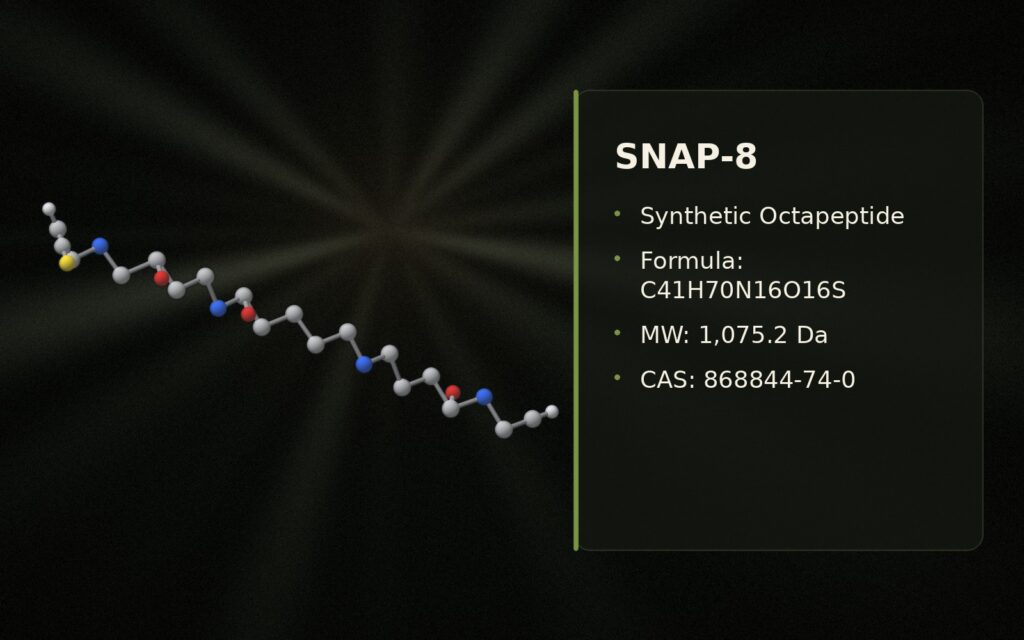
SNAP-8, also known by its INCI name Acetyl Octapeptide-3, is a synthetic peptide studied primarily in cosmetic-science and dermal-biology research for its proposed interference with SNARE-complex-mediated neurotransmitter release. This article is written for laboratory researchers and procurement personnel and is provided strictly for laboratory research use only — SNAP-8 is not a drug, not an FDA-approved cosmetic active, and not intended for human use, self-administration, or application to skin outside of a controlled research setting. Nothing below constitutes skincare advice, dosing guidance, or a treatment recommendation of any kind.
Featured definition: SNAP-8 (Acetyl Octapeptide-3, CAS 868844-74-0) is a synthetic octapeptide — an extended, two-amino-acid analog of the hexapeptide Argireline (Acetyl Hexapeptide-8/3) — studied in cosmetic-science and in vitro research for its proposed ability to interfere with SNARE-complex assembly and reduce vesicle-mediated neurotransmitter release, distinct from the muscle-paralyzing action of botulinum toxin.
What Is SNAP-8?
SNAP-8 is the trade name most commonly used in the cosmetic-ingredient and peptide-research literature for Acetyl Octapeptide-3, a synthetic peptide built from eight amino acids: acetyl-Glu-Glu-Met-Gln-Arg-Arg-Ala-Asp-NH₂. It belongs to a family of peptides designed to mimic short fragments of SNAP-25 (synaptosomal-associated protein of 25 kDa), a component of the SNARE (soluble N-ethylmaleimide-sensitive-factor attachment protein receptor) complex that mediates fusion of neurotransmitter-containing vesicles with the presynaptic membrane at the neuromuscular junction.
SNAP-8 is best understood as a direct structural extension of an earlier, better-known peptide in the same family: Acetyl Hexapeptide-8, marketed under the trade name Argireline. Argireline is a six-amino-acid peptide (acetyl-Glu-Glu-Met-Gln-Arg-Arg-NH₂) that was one of the first commercially marketed “SNARE-inhibiting” cosmetic peptides, developed as a topical, non-injectable alternative inspired by the wrinkle-smoothing effects associated with botulinum toxin. SNAP-8 was subsequently developed by appending two additional amino acids — alanine and asparagine — onto the Argireline sequence, extending it to eight residues. The rationale published in cosmetic-science literature is that the longer peptide sequence more closely approximates a larger portion of the native SNAP-25 N-terminal domain, which developers have proposed could improve competitive binding at the SNARE complex relative to the shorter hexapeptide. It is important to be precise about what that claim is and is not: it is a manufacturer- and cosmetic-industry-published structure-activity rationale and in vitro comparison, not an independently replicated, peer-reviewed head-to-head clinical efficacy trial establishing that SNAP-8 outperforms Argireline in human skin.
Both peptides fall into the same broad research category — synthetic SNARE-interfering octapeptides/hexapeptides studied almost exclusively for topical, cosmetic-adjacent applications — rather than the injectable secretagogue and metabolic-peptide category that makes up most of the broader research-peptide catalog. This is a meaningful distinction for researchers evaluating SNAP-8: unlike growth-hormone secretagogues, GLP-1 analogs, or other systemically administered research peptides, the published literature on SNAP-8 originates almost entirely from cosmetic chemistry, dermal-explant work, and in vitro neuromuscular-junction models, not from pharmacokinetic or systemic-administration studies. Any research design built around SNAP-8 should account for that narrower evidentiary base from the outset.
Chemical Identity & Structure
Independent verification of a compound’s chemical identity is a baseline requirement before any research use, so the identifiers below are drawn directly from PubChem (National Center for Biotechnology Information) and cross-checked against supplier and cosmetic-ingredient databases.
- INCI / common name: Acetyl Octapeptide-3
- Trade name: SNAP-8
- CAS Registry Number: 868844-74-0
- PubChem CID: 71587832
- Amino acid sequence: Acetyl-Glu-Glu-Met-Gln-Arg-Arg-Ala-Asp-NH₂ (N-terminal acetylation, C-terminal amidation)
- Molecular formula: PubChem lists the compound as C₄₂H₇₂N₁₆O₁₅S, with a molecular weight of approximately 1,073.2 g/mol. Some commercial and supplier reference sheets instead list C₄₁H₇₀N₁₆O₁₆S at approximately 1,075.2 g/mol. The two figures are close enough (and the underlying sequence and CAS number consistent enough across sources) that the discrepancy most likely reflects differences in how individual databases have registered the entry rather than two distinct substances — but it is exactly the kind of detail a researcher should resolve against the certificate of analysis (COA) for a specific lot rather than relying on any single secondary source, including this one.
- UNII: 8K14HJF88S
- Structure: SNAP-8 is a linear, N-acetylated, C-amidated octapeptide. Both termini are capped (acetylation at the N-terminus, amidation at the C-terminus), a common modification strategy in synthetic cosmetic peptides intended to improve stability against exopeptidase degradation. The peptide backbone contains two arginine residues carrying guanidinium side chains, a methionine with a thioether side chain, and acidic (glutamate/aspartate) and amide (glutamine/asparagine) residues that together give the molecule an overall structure resembling the native N-terminal segment of SNAP-25.
Researchers should always request and review a current, lot-specific certificate of analysis — including mass spectrometry or HPLC purity data — from any supplier, rather than assuming that published reference values apply uniformly to a given batch.
Proposed Mechanism of Action
SNAP-8’s proposed mechanism of action is grounded in its structural similarity to a fragment of SNAP-25, one of the three core proteins (alongside syntaxin-1 and VAMP/synaptobrevin) that assemble into the SNARE complex responsible for docking and fusing neurotransmitter-containing vesicles with the presynaptic membrane.
The hypothesis advanced in the cosmetic-peptide literature runs as follows: because SNAP-8 mimics part of the SNAP-25 N-terminal sequence, it can competitively interact with the other SNARE-complex components in a way that is proposed to partially interfere with productive SNARE complex assembly. If SNARE assembly is impeded, vesicle fusion — and therefore release of catecholamines and other neurotransmitters at the neuromuscular junction — is expected to be reduced, in principle producing a localized, reversible reduction in the muscle micro-contractions researchers associate with the formation of expression-line wrinkles.
This is frequently, and usefully, contrasted with the mechanism of botulinum toxin. Botulinum toxin type A acts as a protease that enzymatically cleaves SNAP-25, permanently destroying the protein until the nerve terminal regenerates it — an irreversible, enzymatic mechanism that produces pronounced, temporary muscle paralysis. SNAP-8, by contrast, is proposed to act non-enzymatically, through competitive binding/steric interference rather than cleavage, which is the mechanistic basis for describing it as a comparatively milder, non-paralytic, and reversible SNARE modulator. It is worth stating plainly that this comparison is a mechanistic contrast between two different classes of molecule — it is not evidence that SNAP-8 produces botulinum-toxin-comparable clinical effects. The magnitude, durability, and even the degree to which this proposed mechanism operates as described in intact human skin (as opposed to isolated in vitro systems) remain incompletely characterized in the independent, peer-reviewed literature.
Researchers should also note that most published mechanistic characterization of SNAP-8 comes from in vitro biochemical assays and structure-based reasoning extending outward from the better-studied Argireline mechanism, rather than from direct electrophysiological or vesicle-release measurements specific to the octapeptide itself. This is a legitimate and active area for further mechanistic research rather than a settled question.
Research Findings
The evidence base for SNAP-8 is real but narrow in scope, and researchers should be precise about what type of study supports each claim before extrapolating from it.
Analytical chemistry and quality-control research. A peer-reviewed method-development paper published in the Journal of Analytical Science and Technology (Springer Nature) describes a validated liquid chromatography–tandem mass spectrometry (LC-MS/MS) method for quantifying acetyl octapeptide-3 in cosmetic formulations, including dissolving microneedle patches. This paper is useful confirmation of SNAP-8’s chemical identity, its use context (cosmetic and transdermal-delivery formulation research), and the analytical tools available for verifying compound identity and concentration — it is not an efficacy or safety study.
In vitro and cell-based research. Cosmetic-science literature describing SNAP-8 generally reports in vitro comparisons of SNARE-complex-related inhibitory activity between SNAP-8 and Argireline, along with fibroblast and skin-explant work examining downstream markers. These studies originate substantially from ingredient-manufacturer technical literature (Lipotec S.A., now part of Lubrizol Life Science, which originated both Argireline and SNAP-8) rather than from independent academic laboratories, which is common for proprietary cosmetic actives but means the findings should be read as industry-reported preclinical data pending independent replication.
Human topical research. Small in vivo studies of topical SNAP-8-containing formulations — applied to periorbital skin over several weeks — have been described in manufacturer and cosmetic-industry technical publications, using non-invasive measures such as silicone skin replicas and profilometry or confocal imaging to assess wrinkle depth. Figures describing double-digit percentage reductions in measured wrinkle depth appear repeatedly across secondary and marketing sources, but they trace back to manufacturer-sponsored formulation studies rather than large, independently conducted, peer-reviewed randomized controlled trials, and this article does not restate specific percentage figures as established clinical fact for that reason. Researchers designing their own studies should treat these industry figures as a starting hypothesis to test, not as a validated benchmark.
Systemic, injectable, or mechanistic neuromuscular research. Controlled, peer-reviewed human data on SNAP-8 delivered by any route other than topical application are essentially absent from the literature. Direct electrophysiological confirmation of SNARE-inhibition activity at a human neuromuscular junction, as opposed to biochemical or cell-based proxy assays, is likewise limited. This is consistent with SNAP-8’s origin and near-exclusive development history as a topical cosmetic ingredient rather than a systemically administered compound.
Evidence by Research Level
| Research Level | Finding | Source Type |
|---|---|---|
| Analytical chemistry / method validation | LC-MS/MS method validated for quantifying acetyl octapeptide-3 in cosmetic and microneedle-patch formulations | Peer-reviewed (Journal of Analytical Science and Technology, 2020) |
| In vitro biochemical assay | Reported SNARE-complex-related inhibitory activity, compared against Argireline in cell-free or cell-based systems | Industry/manufacturer technical literature |
| Fibroblast / skin-explant studies | Reported effects on markers associated with dermal tissue models | Industry/manufacturer technical literature; limited independent replication identified |
| Human topical application (small in vivo studies) | Reported reductions in measured periorbital wrinkle depth after weeks of topical use | Manufacturer-sponsored formulation studies; small sample sizes |
| Human systemic/injectable studies | No independently published, peer-reviewed controlled human studies identified | Not established |
| Direct neuromuscular electrophysiology in humans | Not identified in the independently published literature reviewed | Not established |
This table reflects the general shape of publicly available literature as of this writing and is not exhaustive. Researchers should independently verify current sources before designing a study or making any procurement decision.
U.S. Regulatory Status
SNAP-8’s regulatory status is comparatively simple relative to many research peptides, precisely because its development and use history has been almost entirely cosmetic rather than pharmaceutical.
Cosmetic ingredient status. Acetyl Octapeptide-3 is registered and used as a cosmetic ingredient under its INCI name, appearing in topical formulations marketed as anti-aging or anti-wrinkle serums and creams. In the United States, cosmetic ingredients are regulated under the FDA’s cosmetics framework, which does not involve FDA premarket approval of the ingredient the way new drugs are approved. Manufacturers of finished cosmetic products bear responsibility for the safety of their formulations, and FDA can act against products found to be adulterated or misbranded after they reach the market. Listing as a cosmetic ingredient is not equivalent to, and should never be described as, “FDA approval.”
Not an FDA-approved drug. SNAP-8 has no FDA drug approval for any human indication, has not been evaluated by FDA as a therapeutic agent, and is not manufactured to pharmaceutical (cGMP drug) standards when sold as a research or cosmetic-ingredient material.
Not on the FDA 503A Bulks List. Unlike many injectable research peptides (growth-hormone secretagogues, for example) that have been reviewed by FDA under Section 503A of the Federal Food, Drug, and Cosmetic Act for pharmacy-compounding eligibility, SNAP-8 is not a compound that has been the subject of that review process, because it has not been developed or marketed as an injectable or systemically compounded drug substance. It does not appear on FDA’s bulk drug substance category lists in the way that injectable secretagogue peptides do, and there is no established pathway or precedent for its use in pharmacy compounding.
No human injectable-use approval. There is no FDA approval, clearance, or established regulatory pathway for injectable or otherwise systemic human administration of SNAP-8. Its entire legitimate commercial history is as a topical cosmetic active.
As a research compound. SNAP-8 sold for laboratory research use — the category Vericor Bioscience’s product falls into — is a distinct product from either the finished cosmetic formulations described above or any pharmaceutical substance. It is not reviewed or cleared by FDA for human or animal therapeutic use, is not labeled or intended for human application of any kind, and is supplied exclusively for use by qualified researchers under appropriate laboratory conditions.
Researchers should independently confirm current regulatory status against FDA’s own published resources rather than relying on this or any other secondary summary, since regulatory frameworks and agency guidance can be updated.
Safety Profile & Unknown Risks
Because SNAP-8’s evidence base is concentrated in cosmetic and in vitro research rather than systemic human studies, its safety characterization is correspondingly narrow.
What is comparatively better characterized. Topical cosmetic formulations containing SNAP-8 have an established history of over-the-counter commercial use, and the cosmetic-science literature generally describes a favorable topical tolerability profile, with localized skin irritation in sensitive individuals as the most commonly reported concern. This reflects finished cosmetic formulations applied to intact skin, not the unformulated research-grade peptide material itself.
What is not well characterized.
- Systemic pharmacokinetics. There is little to no published human pharmacokinetic data describing absorption, distribution, metabolism, or elimination of SNAP-8 following any route other than topical application to intact skin.
- Neuromuscular and off-target effects at non-topical exposure levels. Because SNAP-8’s proposed mechanism directly involves neurotransmitter-release machinery, any research exploring non-topical exposure routes should treat the absence of systemic human safety data as a significant unknown, not as a presumption of safety by analogy to its cosmetic track record.
- Immunogenicity. As with any peptide, there is potential for immune recognition or local reactions under exposure routes and concentrations that have not been systematically studied for this specific molecule.
- Product variability. Research-grade peptide material is not manufactured to pharmaceutical drug standards, and purity, sequence fidelity, and identity can vary meaningfully between suppliers and lots — a general risk that applies to sourcing any synthetic peptide for laboratory work and underscores the importance of lot-specific analytical verification.
- Long-term and dose-response data. Controlled toxicology and dose-response studies for SNAP-8 outside topical cosmetic concentrations are not established in the published literature.
For these reasons, SNAP-8 research material distributed by Vericor Bioscience is intended strictly for laboratory research (for example, in vitro assays, biochemical characterization, or properly authorized non-human research) conducted by qualified personnel, and is not tested, labeled, packaged, or intended for human use of any kind, including topical self-application, cosmetic use, or any form of self-administration.
Research Evaluation Checklist
Researchers evaluating SNAP-8 for a laboratory study should work through the following before beginning:
- Confirm identity and purity against a lot-specific COA. Request mass spectrometry or HPLC data verifying sequence, molecular formula, and purity for the exact batch, rather than relying on generic reference values, given the minor formula/MW discrepancies noted across public databases.
- Define the research question by evidence category. Distinguish clearly whether the study concerns in vitro biochemical/SNARE-binding assays, dermal-explant/fibroblast models, or topical formulation testing — the existing literature supports these categories very differently.
- Do not conflate cosmetic-industry technical claims with independently validated clinical data. Treat manufacturer-published efficacy figures as a hypothesis to test experimentally, not as an established benchmark.
- Review the narrow evidence base for non-topical research designs. If a proposed study involves any exposure route other than topical application, recognize this as exploring largely uncharacterized territory in the human and animal literature.
- Confirm institutional and regulatory compliance. Verify that the intended research complies with institutional biosafety requirements, applicable research-chemical regulations, and — for any animal work — IACUC oversight.
- Establish appropriate handling and storage protocols. Follow supplier guidance and the safety data sheet (SDS) for reconstitution, storage temperature, and stability handling specific to this peptide.
- Document methodology thoroughly. Record lot numbers, analytical verification results, formulation or assay conditions, and protocols in sufficient detail to support reproducibility and peer review.
People Also Ask About SNAP-8
No. SNAP-8 and botulinum toxin both interact with proteins involved in the SNARE complex, but through fundamentally different mechanisms. Botulinum toxin is an enzyme that cleaves and destroys SNAP-25, producing pronounced muscle paralysis until the nerve terminal regenerates the protein. SNAP-8 is proposed to act through competitive, non-enzymatic interference with SNARE assembly — a mechanistically distinct and, by design, far milder interaction. The comparison is useful for understanding mechanism, not for equating clinical effect.
No, though the two are closely related. Argireline (Acetyl Hexapeptide-8/3) is a six-amino-acid peptide; SNAP-8 (Acetyl Octapeptide-3) extends that same sequence with two additional amino acids. Both are studied for proposed SNARE-related activity in cosmetic research, and SNAP-8 is generally described in industry literature as the later, extended-sequence compound developed with the goal of improved activity — a claim based primarily on manufacturer in vitro comparisons rather than independent head-to-head human trials.
No. SNAP-8 has no FDA drug approval for any indication. It is used as a cosmetic ingredient under FDA’s cosmetics framework, which does not involve premarket ingredient approval, and it is not on FDA’s bulk drug substance lists for pharmacy compounding. Cosmetic-ingredient use should never be described or understood as “FDA approval.”
Small, primarily manufacturer-sponsored, topical human studies and in vitro/dermal-explant research have reported measurements consistent with reduced wrinkle depth after topical application. These findings come from a comparatively narrow, industry-associated evidence base rather than a large body of independent, peer-reviewed clinical trials, and they concern finished topical cosmetic formulations — not the unformulated research-grade peptide material.
Most other research peptides in this catalog (growth-hormone secretagogues, healing peptides, and similar compounds) are studied predominantly through systemic or injectable research models. SNAP-8’s evidence base, by contrast, comes almost entirely from cosmetic-science and topical dermal research. Researchers should not assume that systemic-administration research norms or evidence standards from other peptides transfer to SNAP-8.
Vericor Bioscience supplies SNAP-8 strictly as a research-use-only compound for qualified laboratory researchers and institutions. It is not sold, labeled, tested, or intended for use in consumer cosmetic formulation, personal skincare application, or any other form of human use outside a controlled research setting.
Expert SNAP-8 Q&A
How should a researcher weigh the “30% more active than Argireline” type of claim that circulates in cosmetic literature?
As an industry-reported in vitro comparison rather than a settled clinical fact. These figures generally originate from proprietary manufacturer assay data comparing SNARE-related inhibitory activity between the two peptides in a defined in vitro system. They are a reasonable starting hypothesis for further experimental work, but they have not been consistently reproduced by independent laboratories using standardized protocols, and in vitro potency differences do not automatically translate into proportional differences in a topical or dermal-explant readout.
What is the biggest evidentiary gap in the SNAP-8 literature?
Direct, independently conducted electrophysiological or vesicle-release measurements confirming the proposed SNARE-inhibition mechanism at an actual neuromuscular junction, in either animal or human tissue. Most of the supporting mechanistic literature relies on structural analogy to SNAP-25 and biochemical or cell-based proxy assays rather than direct functional confirmation, which is a meaningful gap for anyone designing mechanistic research.
Why does SNAP-8’s evidence base look so different from injectable research peptides like growth-hormone secretagogues?
Largely because of divergent development histories. SNAP-8 was developed and commercialized from the outset as a cosmetic ingredient, so essentially all funded research — including most human studies — has been designed around topical formulation testing rather than systemic pharmacology, dose-ranging, or pharmacokinetics. That shapes what is knowable from the existing literature and is a key design consideration for any researcher proposing non-topical experimental work.
What analytical methods are available for verifying SNAP-8 identity and purity in a research setting?
Peer-reviewed method-development work has validated liquid chromatography–tandem mass spectrometry (LC-MS/MS) for quantifying acetyl octapeptide-3, including in complex cosmetic and microneedle-patch matrices. HPLC-based purity assessment and mass spectrometry for sequence/mass confirmation remain standard baseline verification tools that researchers should request from suppliers as part of a lot-specific certificate of analysis.
What is the most important caution for a researcher new to this compound?
Not to import the risk and evidence assumptions from other, better-studied injectable research peptides. SNAP-8’s track record is topical and cosmetic; extrapolating systemic safety or efficacy conclusions from that narrower base — or vice versa, dismissing it because it lacks injectable-peptide-style data it was never designed to generate — both misread what the existing literature actually supports.
Conclusion
SNAP-8 (Acetyl Octapeptide-3, CAS 868844-74-0) is a well-defined synthetic peptide with a clear chemical identity and a plausible, mechanistically grounded rationale — competitive interference with SNARE-complex assembly — that distinguishes it from the enzymatic action of botulinum toxin. Its research history, however, is narrower and more cosmetic-industry-concentrated than that of many other peptides, with the strongest evidence limited to in vitro assays, dermal-explant work, analytical chemistry, and small, largely manufacturer-sponsored topical human studies. It is not an FDA-approved drug, is not FDA-approved as a cosmetic (cosmetic ingredients are not subject to that approval pathway), does not appear on FDA’s 503A bulk-substance compounding lists, and has no established human injectable-use data. SNAP-8 as supplied by Vericor Bioscience is intended strictly for laboratory research use only — not for human use, not as a drug, and not as a finished cosmetic product. Qualified researchers interested in sourcing SNAP-8 for laboratory study can find the compound, its certificate of analysis, and its full intended-use terms on Vericor Bioscience’s SNAP-8 research product page.