
This article is provided strictly for laboratory research use only (RUO). Tesamorelin, as offered by Vericor Bioscience, is not for human use, is not a drug, and is not the same product as the FDA-approved prescription medication Egrifta. Nothing below should be read as dosing guidance, clinical advice, or an endorsement of any use outside a controlled research setting by qualified personnel.
Tesamorelin occupies an unusual position in the peptide research space: it is one of a small number of growth-hormone-releasing hormone (GHRH) analogs with a genuine, narrow FDA-approved indication under a specific brand name. That fact makes accurate, careful communication essential. This guide summarizes the peer-reviewed and regulatory literature on tesamorelin’s chemistry and mechanism, and it draws a firm, explicit line between the approved pharmaceutical product (Egrifta) and Vericor’s unapproved research-grade compound, which is sold exclusively to qualified researchers and institutions for in vitro and preclinical investigational use.
Featured definition: Tesamorelin is a synthetic 44-amino-acid analog of human growth-hormone-releasing hormone (GHRH) that acts as a GHRH receptor agonist. It is the active ingredient in the FDA-approved prescription drug Egrifta/Egrifta WR, used clinically only for excess abdominal fat in HIV-associated lipodystrophy; Vericor’s tesamorelin is a separate, unapproved research chemical, not that drug product.
What Is Tesamorelin?
Tesamorelin is a synthetic peptide analog of human growth-hormone-releasing hormone (GHRH), also referred to in the older literature as growth hormone-releasing factor (GRF). It belongs to the GHRH-analog class of research peptides, a group that also includes sermorelin (a truncated GHRH 1-29 fragment) and CJC-1295. Structurally, tesamorelin retains the complete 44-amino-acid sequence of native human GHRH(1-44) but adds an N-terminal trans-3-hexenoic acid moiety, a modification designed to confer resistance to enzymatic degradation by dipeptidyl peptidase-4 (DPP-4), extending the peptide’s plasma half-life relative to unmodified GHRH (DrugBank; PubChem CID 16137828).
In the research literature, tesamorelin is studied as a tool compound for probing the somatotropic (growth hormone/insulin-like growth factor-1) axis — specifically, how selective GHRH receptor stimulation influences downstream endocrine and metabolic signaling in model systems. It is one of the few peptides discussed on this site that also underlies an FDA-approved medicine (see the dedicated distinction section below), which makes precise sourcing and labeling especially important for any laboratory handling it.
Chemical Identity & Structure
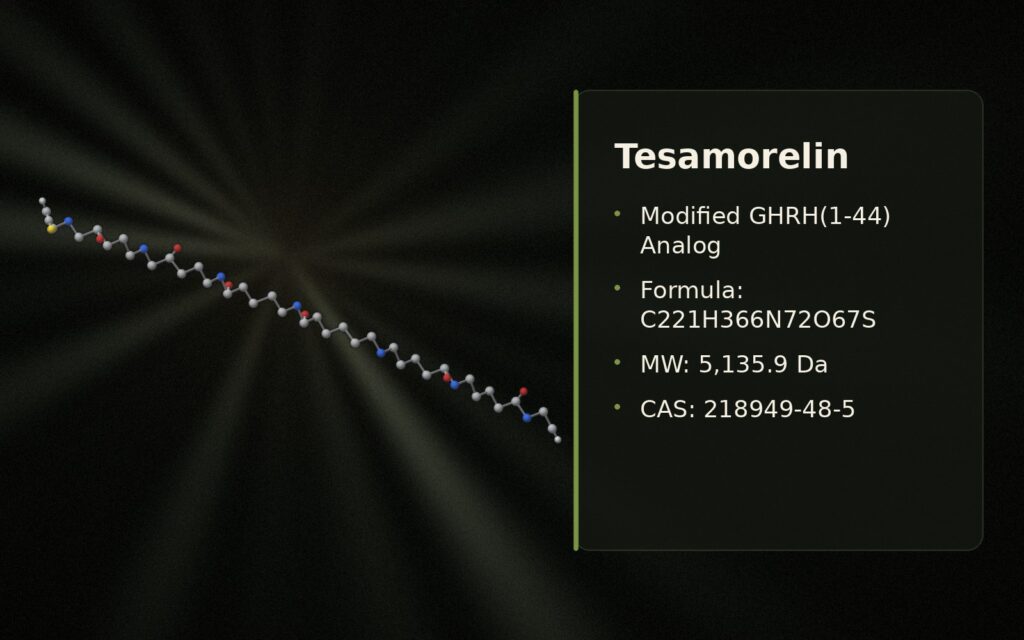
Verified chemical identifiers for tesamorelin, cross-referenced against PubChem, DrugBank, and ChemicalBook:
| Property | Value |
|---|---|
| Common name | Tesamorelin |
| Drug class | GHRH analog / growth hormone-releasing factor analog |
| CAS number (free base) | 218949-48-5 |
| CAS number (acetate salt) | 901758-09-6 |
| Molecular formula | C₂₂₁H₃₆₆N₇₂O₆₇S |
| Molecular weight | ≈5,135.9 g/mol |
| PubChem CID | 16137828 |
| DrugBank ID | DB08869 |
| Structure type | 44-residue linear peptide, C-terminal amide |
Amino acid sequence: Tesamorelin consists of the full 44-residue sequence of human GHRH(1-44)NH₂, N-acylated at the N-terminus with a trans-3-hexenoyl group:
trans-3-hexenoyl-Tyr-Ala-Asp-Ala-Ile-Phe-Thr-Asn-Ser-Tyr-Arg-Lys-Val-Leu-Gly-Gln-Leu-Ser-Ala-Arg-Lys-Leu-Leu-Gln-Asp-Ile-Met-Ser-Arg-Gln-Gln-Gly-Glu-Ser-Asn-Gln-Glu-Arg-Gly-Ala-Arg-Ala-Arg-Leu-NH₂
The C-terminus is amidated (as in native GHRH), and the trans-3-hexenoic acid cap at the N-terminus is the key synthetic modification distinguishing tesamorelin from unmodified endogenous GHRH. As with any 44-residue peptide, batch purity, correct amidation, and absence of truncated or deamidated impurities are material to any research result and should be confirmed by certificate of analysis (HPLC and mass spectrometry) for each lot used in a study.
Proposed Mechanism of Action
The mechanistic literature on tesamorelin centers on its action as a selective agonist at the GHRH receptor (GHRHR), a class B G-protein-coupled receptor expressed primarily on somatotroph cells of the anterior pituitary. Reported and proposed steps in this signaling cascade, as described in pharmacological and clinical-pharmacology literature (DrugBank; published clinical trial reports for tesamorelin), include:
- Receptor binding: Tesamorelin binds GHRHR on pituitary somatotrophs, mimicking the action of endogenous GHRH.
- Gs/cAMP signaling: Receptor activation is coupled to Gs-protein signaling, increasing intracellular cyclic AMP (cAMP) and activating protein kinase A (PKA)-dependent pathways.
- Pulsatile GH release: This signaling drives the synthesis and pulsatile secretion of endogenous growth hormone (GH) from the pituitary, rather than delivering exogenous GH directly.
- Downstream IGF-1 induction: Circulating GH acts on hepatic and peripheral tissue GH receptors to stimulate production of insulin-like growth factor-1 (IGF-1), the principal downstream mediator of many GH effects.
- Metabolic and body-composition effects studied in the approved-drug literature: In the clinical trials that supported Egrifta’s approval, sustained increases in GH/IGF-1 signaling were associated with reductions in visceral adipose tissue, attributed largely to enhanced lipolysis in visceral fat depots.
For research purposes, tesamorelin is frequently discussed as a more physiologic alternative to direct exogenous GH administration in preclinical models, because it works upstream of the pituitary and is subject to at least partial endogenous feedback regulation (via somatostatin and IGF-1 negative feedback) rather than delivering GH directly. This is a mechanistic hypothesis explored in the literature, not a settled characterization of Vericor’s unapproved research material, which has not been independently evaluated by Vericor for these or any other effects.
Tesamorelin vs. Egrifta: An Important Distinction
This section exists because the distinction matters, both scientifically and legally, and it must not be glossed over.
Egrifta and Egrifta WR are FDA-approved prescription drugs. They are manufactured, marketed, and sold exclusively by Theratechnologies, Inc. under strict pharmaceutical Good Manufacturing Practice (cGMP) controls, subject to FDA oversight of manufacturing, labeling, and post-market safety monitoring. Egrifta is approved for one specific indication: reduction of excess abdominal fat in HIV-infected adult patients with lipodystrophy (FDA-approved labeling, accessible via DailyMed/FDA.gov). It is available only by prescription, is intended for use under a physician’s supervision, and its labeling includes specific limitations of use (for example, the FDA label states Egrifta WR is not indicated for general weight-loss management, as it has a weight-neutral effect in the studied population).
Vericor’s tesamorelin is a separate, unapproved research chemical. It is:
- Not manufactured, reviewed, or approved by the FDA as a drug product.
- Not tested, inspected, or verified equivalent to Egrifta’s active pharmaceutical ingredient formulation, excipients, sterility, or manufacturing controls.
- Not sold for, or intended for, human or animal administration of any kind.
- Not a substitute for Egrifta, and not interchangeable with it in any clinical, therapeutic, or personal-use context.
- Intended strictly for in vitro, analytical, and preclinical laboratory research conducted by qualified personnel at institutions or companies capable of handling investigational compounds appropriately.
Put simply: Egrifta is a regulated medicine for a defined patient population under medical supervision. Vericor’s tesamorelin is a laboratory reagent for scientists studying GHRH-receptor pharmacology, peptide stability, analytical methods, or related basic and preclinical research questions. The two should never be conflated, compared as equivalent options, or discussed as though a purchaser could choose between them for the same purpose. Any research finding regarding Egrifta’s clinical safety or efficacy in patients cannot be assumed to apply to Vericor’s unapproved research material, which has not undergone the same identity, purity, sterility, or clinical testing.
Research Findings
The published literature on tesamorelin is dominated by the clinical trial program that supported Egrifta’s approval, alongside subsequent mechanistic and observational studies. The summary below is organized by evidence type; all findings described are attributed to their original source population (typically HIV-positive adult patients in registered clinical trials) and should not be extrapolated to general research use, animal models, or other populations without independent replication.
Evidence by Research Level
| Evidence Level | Description | Example Focus in Tesamorelin Literature |
|---|---|---|
| Randomized controlled trials (RCTs) | Phase 3 clinical trials in the FDA approval package | Reduction in visceral adipose tissue (VAT) in HIV-associated lipodystrophy patients over 26–52 weeks |
| Mechanistic/pharmacodynamic studies | Receptor-binding and endocrine-axis studies | GHRHR agonism, pulsatile GH secretion, IGF-1 elevation kinetics |
| Observational/post-marketing data | Post-approval surveillance required by FDA | Long-term cardiovascular safety monitoring (explicitly noted by FDA as not yet established) |
| Preclinical/in vitro research | Cell- and tissue-based investigations | GHRH receptor pharmacology, peptide stability and degradation pathways |
Key points documented in the clinical and regulatory record for tesamorelin (as Egrifta):
- Phase 3 trials in HIV-infected adults with lipodystrophy demonstrated statistically significant reductions in visceral adipose tissue compared with placebo, which formed the basis for FDA approval.
- The FDA-approved label explicitly states that long-term cardiovascular safety of Egrifta WR “has not been established,” underscoring that even for the approved drug, important safety questions remain open and are subject to ongoing monitoring — a caution that applies with even greater force to any unapproved research analog.
- The FDA label further states Egrifta WR is not indicated for weight-loss management generally, only for the specific visceral-fat indication studied in the approved trials.
- Mechanistic studies describe tesamorelin’s DPP-4 resistance (from the N-terminal hexenoyl modification) as the basis for its extended half-life relative to native GHRH, a structure-activity relationship of ongoing interest in peptide-stability research.
No claims in this article should be read as describing effects of, or supporting any use for, Vericor’s unapproved research compound. All efficacy data above pertain to the clinical development program for the approved drug product and are cited as regulatory/scientific background only.
U.S. Regulatory Status
To state this precisely: Tesamorelin, as the active ingredient in Egrifta and Egrifta WR, received initial FDA approval in 2010, with a reformulated version (Egrifta WR) subsequently approved. The approval is narrow and specific — reduction of excess abdominal fat in HIV-infected adult patients with lipodystrophy — and is not a general approval for fat loss, body recomposition, athletic performance, anti-aging use, or any indication outside the studied HIV-lipodystrophy population. Egrifta is a prescription-only (Rx) product, legally available exclusively through licensed pharmacies under a physician’s prescription, and it is manufactured solely by Theratechnologies, Inc.
Vericor’s tesamorelin is not an FDA-approved drug product. It has not been evaluated by the FDA for safety, efficacy, identity, purity, or any other quality attribute as a pharmaceutical. It is sold strictly as a research chemical, for laboratory research use only, and is not labeled, marketed, or intended for use in humans or animals, for diagnosis, treatment, cure, mitigation, or prevention of any disease, or as a dietary supplement, cosmetic, or food additive. Purchasers are responsible for ensuring their use complies with all applicable institutional, state, and federal regulations governing research chemicals and controlled research materials.
This is a fast-moving regulatory area, and formulations, labeling, and approval status can change; researchers should always confirm current information directly from FDA.gov, DailyMed, and Theratechnologies’ own published materials rather than relying solely on third-party summaries, including this one.
Safety Profile & Unknown Risks
Because Vericor’s tesamorelin is sold strictly for laboratory research use and has not been evaluated by any regulatory body as a pharmaceutical, its safety profile as a research chemical is, by definition, not established for human or animal exposure. Important context:
- Even the FDA-approved drug Egrifta carries labeled cautions, including that its long-term cardiovascular safety “has not been established,” and it carries other labeled warnings and precautions specific to its approved patient population and clinical monitoring context.
- Those cautions apply to a pharmaceutical-grade product manufactured, tested, and dosed under medical supervision — conditions that do not apply to an unapproved research compound handled outside a clinical setting.
- No safety, purity, sterility, or stability claims are made by Vericor about its research compound beyond what is stated on the applicable certificate of analysis.
- Handling should follow standard laboratory biosafety and peptide-handling practices (appropriate PPE, controlled storage conditions, institutional biosafety and chemical-safety protocols) as determined by the receiving institution’s own safety officers — this article does not substitute for institution-specific safety review.
- This compound must not be administered to humans or animals outside of properly authorized, IRB/IACUC-approved research protocols conducted by qualified investigators.
Research Evaluation Checklist
For laboratories evaluating a tesamorelin research compound for a study, consider verifying the following before use:
- Certificate of Analysis (CoA): Confirm lot-specific HPLC purity and mass spectrometry identity confirmation matching the expected molecular formula and mass (C₂₂₁H₃₆₆N₇₂O₆₇S, ≈5,135.9 g/mol).
- Sequence verification: Confirm the full 44-residue sequence and correct C-terminal amidation, since truncated or non-amidated variants are known synthesis impurities in long peptides.
- Storage and stability documentation: Confirm recommended storage temperature, lyophilization status, and reconstitution guidance appropriate for a 44-mer peptide.
- Supplier transparency: Confirm the supplier clearly labels the product as RUO and does not market it for human or animal use, aesthetic use, or as a substitute for or equivalent to Egrifta.
- Institutional approval: Confirm your research protocol has appropriate institutional review (IACUC for animal studies, biosafety committee review as applicable) before beginning work.
- Regulatory awareness: Confirm your intended use and jurisdiction comply with applicable research-chemical and controlled-substance regulations.
- No conflation with the approved drug: Confirm your research documentation and any publications clearly distinguish the RUO research material used from the FDA-approved Egrifta product, to avoid downstream confusion in the literature.
People Also Ask About Tesamorelin
No. Tesamorelin is the active pharmaceutical ingredient in Egrifta and Egrifta WR, but “Egrifta” refers specifically to the FDA-approved, prescription-only drug product manufactured by Theratechnologies under pharmaceutical manufacturing controls. A tesamorelin research compound sold by a supplier such as Vericor is a separate, unapproved research chemical — not the same product, not manufactured to the same standards, and not interchangeable with Egrifta for any purpose.
Tesamorelin is FDA-approved only in the specific form and formulation marketed as Egrifta/Egrifta WR, and only for reduction of excess abdominal fat in HIV-infected adults with lipodystrophy. It is not approved for general weight loss, bodybuilding, anti-aging, or any other use, and unapproved research versions of tesamorelin are not covered by that approval in any respect.
In the scientific literature, tesamorelin is studied as a tool for investigating GHRH receptor pharmacology, GH/IGF-1 axis signaling, and peptide stability/structure-activity relationships (particularly the effect of N-terminal modification on DPP-4 resistance). Vericor’s research compound is intended for this type of laboratory investigation only, not for human or animal administration.
Tesamorelin is a 44-amino-acid peptide corresponding to the full sequence of human GHRH(1-44), modified with an N-terminal trans-3-hexenoyl group and a C-terminal amide. Its molecular formula is C₂₂₁H₃₆₆N₇₂O₆₇S, with a molecular weight of approximately 5,135.9 g/mol (CAS 218949-48-5).
No. Vericor sells tesamorelin strictly for laboratory research use by qualified personnel. It is not sold, labeled, or intended for human or animal use, and it is not a legal or appropriate substitute for the prescription drug Egrifta, which requires a physician’s prescription and medical supervision.
No — mechanistically, tesamorelin does not supply exogenous growth hormone. It acts as a GHRH receptor agonist that stimulates the pituitary to synthesize and release the body’s own endogenous GH, which in turn raises IGF-1 levels. This indirect mechanism is a distinguishing feature relative to direct GH administration in the pharmacological literature.
Expert Tesamorelin Q&A
What distinguishes tesamorelin structurally from unmodified human GHRH?
Tesamorelin retains the complete 44-residue sequence of human GHRH(1-44)NH₂ but adds a trans-3-hexenoic acid group at the N-terminus. This acylation is understood to hinder cleavage by dipeptidyl peptidase-4 (DPP-4), the enzyme primarily responsible for rapid degradation of native GHRH, thereby extending plasma half-life — a structure-activity relationship of interest in peptide stability research.
Why is the GHRH-receptor pathway considered mechanistically distinct from direct GH administration?
GHRH receptor agonism acts upstream of GH release, preserving at least partial physiologic feedback regulation via hypothalamic somatostatin tone and IGF-1-mediated negative feedback on the pituitary. Direct exogenous GH administration bypasses this regulatory loop entirely. This distinction is frequently cited in the mechanistic literature as a reason GHRH analogs are of pharmacological interest, independent of any specific product’s approval status.
What does the FDA label’s cardiovascular safety caveat for Egrifta actually say, and why does it matter for research framing?
The FDA-approved labeling for Egrifta WR states that the long-term cardiovascular safety of the drug has not been established. This is a materially important caveat: it reflects that even for a drug with an approved indication and a completed Phase 3 program, meaningful safety questions remain open under regulatory monitoring. It underscores why claims about tesamorelin’s safety — for the approved drug or, especially, for an unapproved research analog — should never be overstated.
What analytical methods are typically used to confirm the identity of a synthesized tesamorelin research peptide?
Standard approaches described in peptide-characterization literature include reversed-phase HPLC for purity assessment and mass spectrometry (e.g., MALDI-TOF or ESI-MS) to confirm the expected molecular mass (~5,135.9 g/mol) and detect deamidation, truncation, or oxidation impurities common in long synthetic peptides.
Should findings from Egrifta’s clinical trials be used to infer safety or efficacy of an unapproved tesamorelin research compound?
No. Clinical trial data supporting Egrifta’s approval describe a specific, pharmaceutical-grade, cGMP-manufactured drug product administered under medical supervision to a defined patient population. That data cannot be assumed to apply to an unapproved research-grade compound of unverified formulation, manufacturing standard, or purity, and no such extrapolation should appear in research documentation without independent verification.
Conclusion
Tesamorelin is scientifically significant as a well-characterized GHRH receptor agonist, and it is one of the few peptides in this space with a genuine, narrow FDA-approved medical use — as the active ingredient in Egrifta and Egrifta WR, for excess abdominal fat in HIV-associated lipodystrophy specifically. That approval, however, belongs to a distinct, regulated, prescription-only pharmaceutical product manufactured by Theratechnologies under medical supervision. It does not extend to, validate, or apply to Vericor’s tesamorelin research compound, which is sold strictly for laboratory research use only — not for human use, and not as a substitute for or equivalent to the prescription drug Egrifta. Researchers interested in studying tesamorelin’s GHRH-receptor pharmacology or peptide chemistry in an appropriate laboratory setting can review current lot documentation and specifications on Vericor’s tesamorelin research product page.