
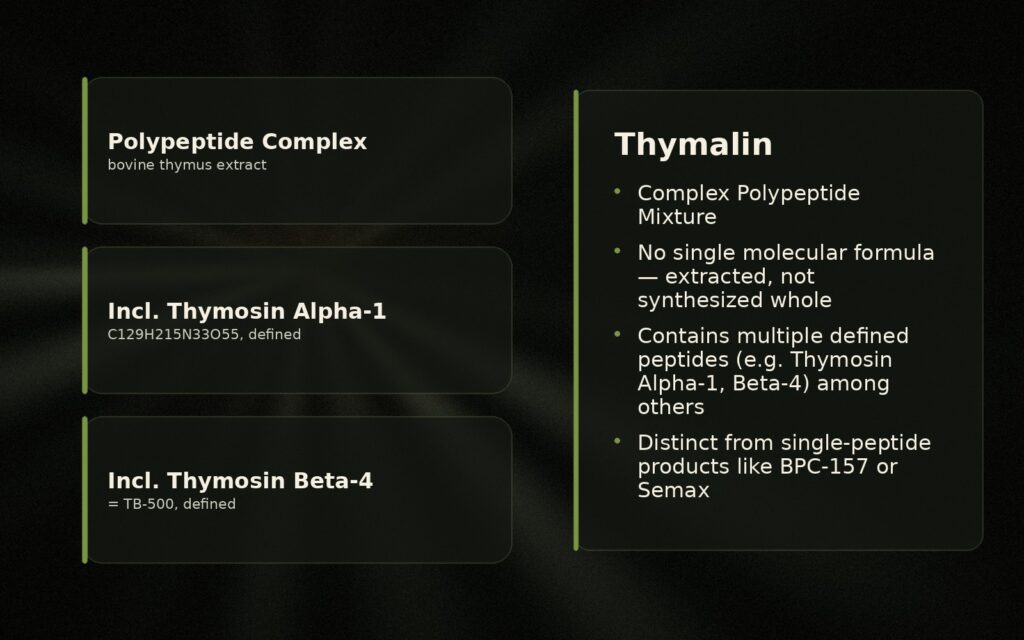
Thymalin is a research-use-only calf thymus polypeptide extract, not a single defined molecule, and it is not approved for human use in the United States. This guide is written strictly for laboratory researchers, procurement teams, and academic audiences evaluating Thymalin as a research compound — nothing here describes, recommends, or implies dosing, injection, or administration in people. Because Thymalin comes out of a specific, largely non-U.S. research tradition, this article also spends more time than usual on evidence quality and sourcing, so researchers can weigh the literature accurately rather than assume it carries the same evidentiary weight as better-characterized single-molecule peptides.
Featured definition: Thymalin is a heterogeneous complex of low-molecular-weight polypeptides extracted from calf (bovine) thymus tissue, developed in the Soviet Union in the 1970s–80s by Vladimir Khavinson and colleagues at what is now the St. Petersburg Institute of Bioregulation and Gerontology. It is not a single defined peptide — unlike Thymosin Alpha-1 or Thymosin Beta-4 (TB-500) — and is sold by Vericor Bioscience strictly for laboratory research use, not for human administration.
What Is Thymalin? {#what-is-thymalin}
Thymalin is a polypeptide complex isolated from the thymus gland of young calves (cattle under approximately one year of age). It was developed in the Soviet Union starting in the 1970s by Vladimir Khavinson and coworkers, initially at the Leningrad Military Medical Academy and later formalized under the institute now known as the St. Petersburg Institute of Bioregulation and Gerontology. Thymalin was one of the first of six related peptide-preparation drugs that group developed from different organ tissues (thymus, pineal gland, blood vessels, brain, retina, and bone marrow) under the broader “peptide bioregulator” research program that continued into the post-Soviet era.
It is important to understand what Thymalin is not before discussing what it is. Thymalin is frequently confused in the research-chemical trade with two chemically distinct substances that share overlapping names or thymic origins:
- Thymulin — a defined, single nonapeptide (sequence Glu-Ala-Lys-Ser-Gln-Gly-Gly-Ser-Asn, CAS 63958-90-7, molecular weight ≈ 859 g/mol) that requires zinc as a cofactor for biological activity. Thymulin is a specific, isolable molecule with a fixed structure.
- Thymosin Alpha-1 and Thymosin Beta-4 (TB-500) — both single, defined peptides with established amino acid sequences, synthesized rather than extracted, and studied under their own distinct research literatures.
Thymalin, by contrast, is not a single molecule. It is a complex mixture (extract) of multiple low-molecular-weight polypeptides obtained by extraction and purification from calf thymus tissue — closer in kind to a standardized biological extract than to a synthetic reference peptide. This distinction matters for researchers: it affects how the compound can be characterized analytically, how batch-to-batch consistency should be verified, and how directly findings from single-peptide research can (or cannot) be extrapolated to it.
Historically, Thymalin was registered and manufactured as a pharmaceutical product in Russia (marketed there under the name Thymalin/Тималин, produced by manufacturers such as Samson-Med/Samson Pharma in St. Petersburg as a lyophilized powder for injection), used within the Russian and post-Soviet clinical system for indications related to immune function. That domestic registration history in Russia is a separate matter from U.S. regulatory status, discussed later in this guide, and does not establish safety or efficacy under U.S. standards.
Chemical Composition {#chemical-composition}
Because Thymalin is a polypeptide complex rather than a single compound, it does not have one molecular formula or one exact molecular weight the way a synthesized reference peptide like BPC-157 or Thymosin Alpha-1 does. Researchers should treat any single “molecular weight” figure for Thymalin with caution, and should not expect a clean structural diagram the way they would for a defined synthetic peptide.
What can be said accurately, based on chemical registry and vendor-database listings:
- CAS Registry Number: 79621-14-0 (registered as “Thymalin, powder for injection,” with EINECS number 236-855-3) — this number refers to the extract/preparation as a registered substance, not to a single defined molecular entity.
- Source material: Polypeptide fractions extracted from calf (bovine) thymus tissue, typically from animals under one year of age.
- Composition type: A heterogeneous mixture of multiple low-molecular-weight polypeptides, generally described in the secondary literature and vendor characterization sheets as falling in an approximate 1–10 kDa range — a range consistent with thymic tissue-derived polypeptide fractions of this kind, though researchers should note that this range is commonly cited rather than independently verified against a peer-reviewed analytical characterization in the primary literature reviewed for this article.
- Molecular formula: Not applicable in the single-compound sense. As a mixture, Thymalin does not have one CAS-registered molecular formula or exact molar mass; any vendor page presenting a single formula/MW for “Thymalin” as though it were one molecule should be treated as imprecise or incorrect.
- Formulation as sold historically: As a registered Russian pharmaceutical product, Thymalin has been supplied as a lyophilized powder (commonly 5–10 mg per vial) intended for reconstitution, with glycine sometimes listed as an excipient in manufacturer documentation. This description of historical drug formulation is provided for chemical-identity and sourcing context only and is not a research-use instruction.
For laboratory identity verification, researchers should request a current, batch-specific certificate of analysis (COA) from any supplier — ideally one that documents the peptide fraction profile (e.g., by HPLC or mass spectrometry fingerprinting) rather than relying on a single stated molecular weight, since batch-to-batch consistency is inherently a bigger question for an extracted mixture than for a synthesized single peptide.
Proposed Mechanism of Action {#mechanism}
The mechanistic hypothesis behind Thymalin sits within the broader “peptide bioregulator” framework developed by Khavinson’s research group: the proposal that thymus-derived polypeptides can support or modulate thymic epithelial and lymphocyte function, potentially through effects overlapping with those attributed to endogenous thymic hormones (such as thymopoietin, thymosin fractions, and thymulin) that are naturally present in thymic tissue extracts.
Under this framework, Thymalin is proposed to act on T-cell differentiation and maturation processes and on general immune-system regulation, largely by analogy to the known biology of the thymus gland itself (which produces T-lymphocytes and secretes several immunoregulatory peptide hormones) rather than through a single, isolated receptor-ligand mechanism that has been experimentally confirmed for Thymalin specifically. Because Thymalin is a mixture, its proposed activity may reflect the combined or synergistic effects of several polypeptide components rather than a single well-characterized pharmacological mechanism, and no single active constituent has been isolated and confirmed as solely responsible for reported effects in the way that, for example, a receptor-binding assay can confirm the target of a defined synthetic peptide.
Researchers should treat “immune modulation via thymic polypeptide activity” as a working hypothesis inherited from the compound’s originating research tradition, not as a mechanism established with the binding-assay, knockout, and dose-response rigor expected of a fully characterized pharmacological agent. This is a meaningfully different evidentiary position than compounds with defined receptor pharmacology, and it should inform how findings are interpreted and cited.
Research Findings {#research-findings}
The published literature most directly concerning Thymalin comes overwhelmingly from Russian and Soviet-era/post-Soviet research groups, much of it associated with Khavinson and the St. Petersburg Institute of Bioregulation and Gerontology, and a substantial portion of it published originally in Russian-language journals or in journals (such as Neuroendocrinology Letters and Bulletin of Experimental Biology and Medicine) that are lower-circulation and less frequently cross-referenced by independent Western laboratories than mainstream immunology or gerontology journals. Researchers should weigh this literature honestly rather than assume it carries the same independent-replication weight as compounds with a broader, internationally distributed evidence base.
Representative published lines of research include:
- Immune-function and lymphoid tissue studies. Early Soviet-era and later Russian work examined the effects of thymic polypeptide fractions (including Thymalin) on lymphoid tissue development and thymus/spleen growth in animal models, generally reporting supportive effects on lymphoid organ parameters in young and aged rats studied in organ culture and in vivo.
- Geroprotective (aging-related) research. A frequently cited line of work by Khavinson and Morozov, published in Neuroendocrinology Letters (2003), reported on a long-term (6–8 year) observational/interventional study of 266 elderly participants given course treatment with Thymalin and/or Epithalamin (a related pineal-derived peptide preparation from the same research program). The reported outcomes included reduced incidence of acute respiratory illness, cardiovascular and other age-associated conditions, and lower all-cause mortality in treated groups compared to controls over the observation period. This is the most-cited “human” evidence associated with Thymalin, and it should be read with several caveats: the study originates entirely from the compound’s own developing research group, was published in a journal outside the mainstream indexed immunology/gerontology literature, and — based on publicly available descriptions — does not appear to meet the randomization, blinding, and independent-monitoring standards expected of a modern controlled clinical trial.
- Multiple sclerosis-related research. Older Russian clinical literature (circa 1990) examined a proposed “homeostatic effect” of thymalin in multiple sclerosis patients, reporting immune-parameter changes; this work predates modern MS immunotherapy standards and has not been replicated in the context of current disease-modifying treatment paradigms.
- General thymic peptide reviews. Thymalin is discussed within broader reviews of natural and synthetic thymic peptides as a category of interest for immune dysfunction research, typically grouped alongside — but explicitly distinguished from — single-molecule thymic peptides such as thymulin and thymosin fractions.
An honest reading of this literature: it is genuinely long-running (spanning roughly five decades) and includes some larger observational cohorts unusual for a research-chemical-tier compound, but it is also narrow in its independent geographic and institutional spread, concentrated heavily in one research lineage, published disproportionately outside major Western-indexed journals, and has not been the subject of a modern, internationally replicated, randomized controlled trial meeting current clinical-research standards. None of the studies referenced above support any claim of treatment, cure, or prevention of disease in humans, and none should be read that way.
Evidence by Research Level
| Research Level | What Exists | Strength of Evidence |
|---|---|---|
| In vitro (cell/organ culture) | Lymphoid organ culture studies (thymus, spleen) in animal-derived tissue | Limited; largely older Soviet/Russian-era work |
| Animal models | Studies on lymphoid tissue growth and thymus/spleen development across age groups in rats | Limited; not broadly independently replicated outside originating research network |
| Human observational/interventional (geroprotective) | Long-term cohort study (Khavinson & Morozov, 2003) in elderly subjects reporting reduced morbidity/mortality | Weak by modern standards; single research group, non-mainstream journal, methodology not consistent with contemporary RCT standards |
| Human clinical (disease-specific, e.g., MS) | Small older Russian clinical reports | Very limited; outdated relative to current standards of care |
| Independent Western replication | Minimal identified in this review | Not established |
| Regulatory review (U.S.) | No FDA evaluation identified | Not applicable |
U.S. Regulatory Status {#regulatory-status}
Thymalin is not approved by the U.S. Food and Drug Administration for any human or veterinary use, and it is not recognized as a drug, biologic, or dietary supplement under U.S. law. A review did not identify Thymalin on the FDA’s Section 503A bulk drug substances list, and — unlike single-molecule peptides such as BPC-157, TB-500, and Thymosin Alpha-1, which have been the subject of recent Pharmacy Compounding Advisory Committee (PCAC) review — Thymalin does not appear to have been part of that same recent regulatory review process, consistent with its status as a heterogeneous tissue extract rather than a defined bulk drug substance of the type currently under FDA compounding review.
Separately, Thymalin has a documented history as a registered pharmaceutical product in Russia, manufactured domestically (for example, by Samson-Med/Samson Pharma in St. Petersburg) and used within the Russian healthcare system. This Russian drug-registry history is a real, verifiable fact about the compound’s regulatory history, but it carries no equivalent standing under U.S. law. Russian pharmaceutical registration does not constitute, imply, or substitute for FDA approval, and the evidentiary and manufacturing standards behind that registration are not equivalent to the standards required for U.S. drug approval. In the United States, Thymalin should be understood strictly as an unapproved research chemical: it must not be marketed, sold, or represented as a treatment, therapy, supplement, or approved drug product for humans or animals.
Safety Profile & Unknown Risks {#safety}
There is no FDA-reviewed or internationally standardized human safety, pharmacokinetic, or toxicology dataset for Thymalin that meets current Western regulatory evidentiary standards. Because it is a polypeptide mixture rather than a single defined compound, its safety profile is inherently harder to characterize than that of a single-molecule peptide: batch composition, relative proportions of individual polypeptide fractions, and impurity profiles can vary between extraction runs and manufacturers in ways that a single synthesized molecule does not experience to the same degree.
Researchers evaluating Thymalin for laboratory work should assume:
- No validated safe dose range exists for any species under modern regulatory research standards, regardless of historical use as a registered drug product in another regulatory system.
- Long-term and repeat-exposure toxicology has not been systematically characterized to current Western standards.
- As a tissue-derived biological extract, additional considerations apply that do not arise with fully synthetic peptides — including potential for lot-to-lot compositional variability, extraction-process residuals, and the general biological-material handling and sourcing-traceability concerns relevant to any animal-tissue-derived research material.
- Only third-party-verified, batch-specific certificates of analysis should be relied upon for compound identity and purity; because Thymalin is a mixture, a COA ideally documents a fraction/fingerprint profile rather than a single purity percentage against one molecular reference standard.
- This compound must never be self-administered or used outside a properly authorized, IRB/IACUC-governed research setting. There is no clinical protocol, human dosing regimen, or self-administration use case described, recommended, or implied anywhere in this article.
All laboratory work with Thymalin should follow standard institutional biosafety and chemical-handling protocols applicable to biologically derived research materials, and should remain strictly confined to qualified non-clinical research use.
Research Evaluation Checklist {#checklist}
- Confirm you are evaluating Thymalin, not Thymulin, Thymosin Alpha-1, or TB-500. These are frequently confused in vendor marketing but are chemically and evidentially distinct; verify sequence/composition claims against the correct compound before citing any study.
- Request a batch-specific, mixture-appropriate certificate of analysis. Because Thymalin is a polypeptide complex, a COA should characterize the fraction profile (e.g., chromatographic fingerprint) rather than present a single molecular-weight/purity figure as if for a defined peptide.
- Trace geroprotective or immune-modulation claims back to the primary source. Identify whether a claim rests on the Khavinson & Morozov cohort literature or on animal/organ-culture work, and note the journal, methodology, and independence of the research group in each case.
- Weigh the evidence-quality caveats explicitly. Recognize that most Thymalin literature originates from one research lineage, is disproportionately published outside mainstream Western-indexed journals, and has limited independent replication — this should shape confidence levels, not just footnotes.
- Do not extrapolate Russian drug-registry status into U.S. regulatory meaning. Historical registration as a pharmaceutical product in Russia has no bearing on FDA approval status or U.S. legal standing.
- Verify sourcing and material traceability. As an animal-tissue-derived extract, confirm the supplier documents sourcing, extraction, and purification methodology, not just a finished-product specification sheet.
- Restrict all use to qualified, non-clinical research settings with appropriate institutional oversight, and never as a self-administered or consumer product.
People Also Ask About Thymalin
No. Thymulin is a single, defined nonapeptide (CAS 63958-90-7) that requires zinc for activity. Thymalin is a heterogeneous complex of multiple low-molecular-weight polypeptides extracted from calf thymus tissue. The similar names are a frequent source of confusion in the research-chemical trade.
No. Thymalin has no FDA approval for any human or animal use and is not recognized as a drug, biologic, or dietary supplement in the United States.
No. Because Thymalin is a polypeptide mixture rather than a single compound, it does not have one defined molecular formula or exact molar mass. Its components are generally described as falling in a roughly 1–10 kDa range, and researchers should treat any single-value formula/MW claim for “Thymalin” with skepticism.
The large majority of published research on Thymalin originates from Soviet-era and post-Soviet Russian research groups associated with Vladimir Khavinson and the St. Petersburg Institute of Bioregulation and Gerontology, with limited independent replication identified outside that research network.
Thymalin has a documented history as a registered pharmaceutical product in Russia, manufactured domestically for use within the Russian healthcare system. This is a real historical/regulatory fact specific to Russia and does not confer FDA approval or equivalent status in the United States.
No. This article does not describe, recommend, or imply any human treatment use. Thymalin is not an approved therapy for any immune condition or for aging, and it is sold strictly as a research-use-only laboratory chemical.
Expert Thymalin Q&A
How should researchers handle the fact that Thymalin doesn’t have a single molecular formula?
Treat it the way you would any biological extract or mixture used in research — characterize it by fraction profile and source material rather than expecting the single-molecule specification sheet appropriate for a synthesized peptide. A COA that shows a chromatographic fingerprint against a reference lot is more informative than a single stated molecular weight, and any vendor asserting one exact MW for “Thymalin” as a whole compound should be questioned on that point specifically.
How does the Khavinson & Morozov geroprotective cohort study hold up by contemporary clinical-trial standards?
Not particularly well by modern standards, though it remains historically notable. The reported effect sizes (reductions in mortality and morbidity) are large, but the study originates entirely from the compound’s own developing research group, appeared in a journal outside the mainstream indexed immunology/gerontology literature, and — from publicly available descriptions — does not appear to have used the randomization, blinding, and independent outcome adjudication that would be expected of a study submitted for regulatory consideration today. It should be read as a historically significant but methodologically dated data point, not as confirmatory clinical evidence.
Why does Vericor distinguish Thymalin so carefully from Thymulin and Thymosin Alpha-1 in this article?
Because the names are easily confused and the underlying chemistry is genuinely different — one is a mixture, the others are single defined molecules with distinct sequences and mechanisms. Conflating them in citations or procurement decisions produces avoidable errors, since a study on one compound does not validate claims about another.
What would most improve confidence in Thymalin’s proposed immune-modulation mechanism?
Modern analytical characterization of the specific polypeptide fractions responsible for any observed activity, isolation and independent testing of individual constituents, and replication of immune-parameter findings by laboratories outside the compound’s originating research network, ideally using current receptor-binding and dose-response methodology.
What sourcing red flags should researchers watch for with Thymalin specifically?
Vendor claims of a single exact molecular formula or molecular weight (a sign the seller may not understand, or may be obscuring, its mixture composition), the absence of any documented extraction/purification methodology, and COAs that report only a generic “purity” percentage without a fraction or fingerprint analysis appropriate to a polypeptide complex.
Conclusion {#conclusion}
Thymalin is a calf thymus-derived polypeptide complex — not a single defined molecule — developed within a specific, long-running Soviet and post-Soviet Russian research tradition led by Vladimir Khavinson and colleagues. Its evidence base includes decades of animal, organ-culture, and observational human research, but that base is concentrated in one research lineage, published disproportionately outside mainstream Western-indexed journals, and has not been independently replicated or evaluated under modern controlled-trial standards. Thymalin has a documented history as a registered pharmaceutical product in Russia, but this carries no FDA approval or equivalent regulatory status in the United States, where it remains an unapproved, unreviewed research chemical. This article is provided strictly for laboratory research and educational purposes — it is not a guide to human use, and Thymalin is not for human consumption, self-administration, or the treatment of any condition.
Qualified researchers evaluating Thymalin for legitimate, non-clinical laboratory investigation are encouraged to review Vericor Bioscience’s research product page for current certificate-of-analysis documentation, sourcing details, and research-use-only terms of sale.