
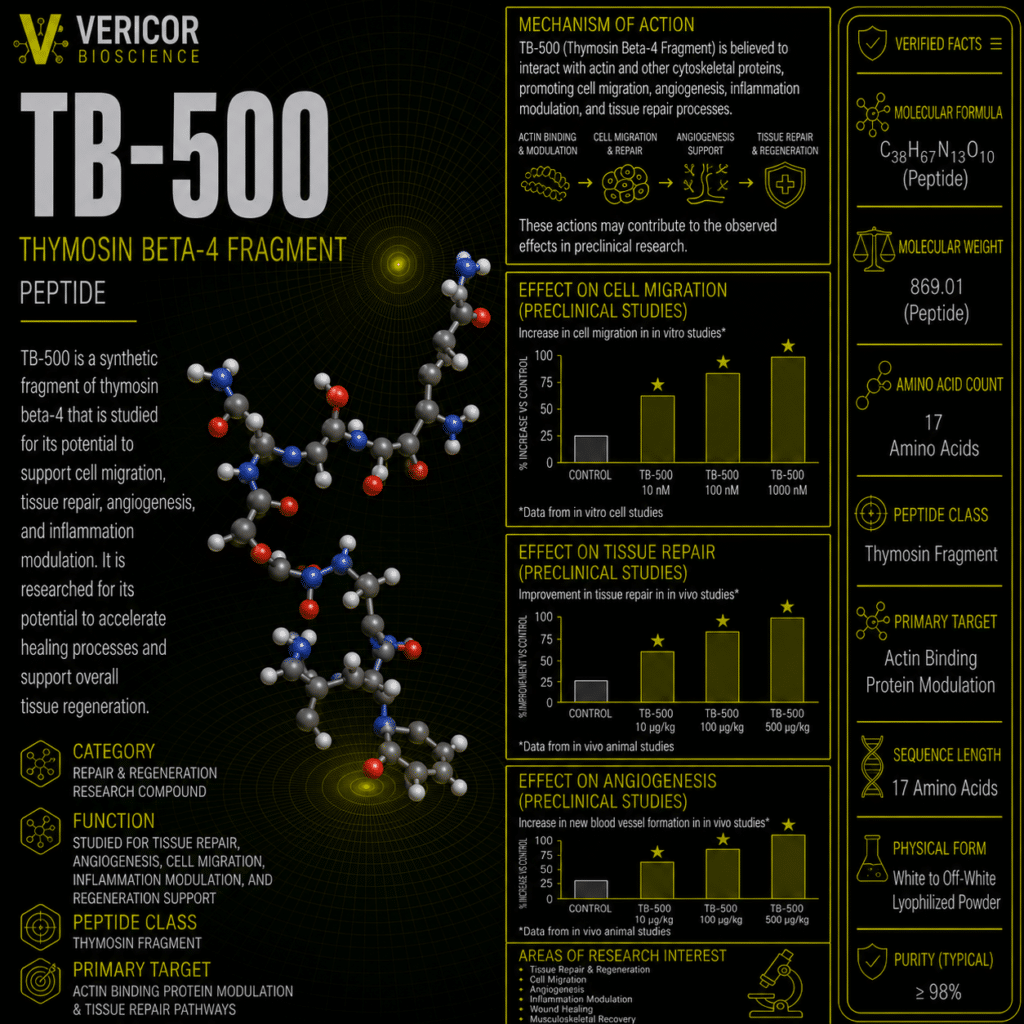
TB-500 has gained attention in the United States through online claims about faster recovery, tendon repair, muscle healing, flexibility, inflammation, and athletic performance. However, most of those claims are not supported by controlled human studies. TB-500 is an experimental seven-amino-acid peptide fragment related to thymosin beta-4, but it is not the same substance as the complete naturally occurring protein.
From an evidence-review perspective, the most important task is to separate research on full-length thymosin beta-4 from research on TB-500 itself. These substances are often discussed as though they are interchangeable. In reality, their size, structure, metabolism, biological activity, and supporting evidence differ.
TB-500 is not an FDA-approved treatment for sports injuries, tendon damage, muscle strains, wounds, inflammation, or any other medical condition. In addition, the FDA reported in 2026 that it found no published articles in which TB-500 had been administered to humans. Therefore, claims about human recovery, dosing, or safety remain highly uncertain.
Featured Definition: What Is TB-500?
TB-500 is a synthetic seven-amino-acid peptide related to an actin-binding region of thymosin beta-4, a naturally occurring 43-amino-acid protein. Researchers have examined TB-500 and its metabolites in laboratory and animal models, but controlled human evidence, approved dosing, long-term safety, and therapeutic effectiveness have not been established.
Table of Contents
- What TB-500 Is
- TB-500 Versus Thymosin Beta-4
- How TB-500 May Work
- TB-500 and Tissue-Repair Research
- Tendon, Ligament, and Muscle Claims
- TB-500 and Wound-Healing Research
- Human Evidence and Its Limitations
- TB-500 Safety and Unknown Risks
- TB-500 and Athletic Anti-Doping Rules
- U.S. Regulatory and Compounding Status
- Research Quality and Product Evaluation
- People Also Ask About TB-500
- Expert TB-500 Q&A
- Conclusion
What Is TB-500?
TB-500 is commonly described as a synthetic fragment associated with thymosin beta-4. Its reported peptide sequence is:
Acetyl-Lys-Leu-Lys-Lys-Thr-Glu-Thr-Gln, commonly shortened to Ac-LKKTETQ.
The “Ac” indicates an acetyl group attached to the peptide’s amino end. This chemical modification may affect stability, metabolism, and biological behavior.
TB-500 contains seven amino acids. By comparison, naturally occurring thymosin beta-4 contains 43 amino acids. Therefore, TB-500 represents only a small part of the full thymosin beta-4 molecule.
This difference is critical. A fragment can retain one function of a larger protein, lose several functions, gain new properties, or behave differently after it is metabolized. As a result, findings involving thymosin beta-4 should not automatically be attributed to TB-500.
The FDA has evaluated both TB-500 free base and TB-500 acetate as separate bulk drug substances. The agency noted that neither form has an applicable United States Pharmacopeia or National Formulary monograph, and neither is a component of an FDA-approved drug.
TB-500 Versus Thymosin Beta-4
Online discussions frequently use “TB-500” and “thymosin beta-4” as if they were two names for the same compound. That is not chemically accurate.
Thymosin beta-4 is a naturally occurring protein found in many tissues and body fluids. It is involved in actin regulation and has been studied in relation to cell migration, inflammation, blood-vessel development, tissue remodeling, and wound repair.
TB-500 is a much shorter synthetic peptide associated with a section of thymosin beta-4 that has been linked to actin binding.
| Feature | TB-500 | Thymosin beta-4 |
|---|---|---|
| Structure | Seven-amino-acid synthetic peptide | Naturally occurring 43-amino-acid protein |
| Common sequence | Ac-LKKTETQ | Full 43-amino-acid sequence |
| Natural human molecule | Not established as a naturally occurring complete molecule | Naturally present in human tissues and fluids |
| Human research | FDA found no published human administration studies | Some human research has examined full-length thymosin beta-4 formulations |
| Proposed role | Experimental fragment associated with actin-related biology | Broader cellular, inflammatory, and repair-related functions |
| FDA approval | Not FDA-approved | No general FDA approval for injury recovery |
| Athletic status | Prohibited under anti-doping rules | Thymosin beta-4 and related factors are prohibited |
This distinction affects how research should be interpreted.
For example, a study involving full-length thymosin beta-4 in a skin or eye model does not prove that TB-500 will produce the same outcome. Likewise, safety findings for one formulation cannot automatically establish the safety of another peptide.
How May TB-500 Work?
The precise biological activity of TB-500 has not been fully established.
Its sequence comes from a region of thymosin beta-4 associated with actin binding. Actin is a major structural protein found in cells. It helps maintain cell shape and supports processes such as movement, division, wound closure, and tissue organization.
Researchers have proposed that TB-500 or its metabolites may affect:
- Actin-related cellular processes
- Fibroblast movement
- Cell migration
- Wound closure
- Angiogenesis
- Inflammatory signaling
- Tissue remodeling
However, these proposed functions should be described carefully.
A peptide may be rapidly broken into smaller metabolites after entering biological fluids. Consequently, the original peptide may not be responsible for an observed laboratory result.
TB-500 metabolism may change its activity
A 2024 study examined TB-500 metabolism in human serum, laboratory enzyme systems, and rats. Researchers identified several metabolites and tested the parent peptide and its metabolites in a fibroblast wound-healing model.
The study reported that the metabolite Ac-LKKTE showed significant wound-healing activity in the laboratory assay, while the parent TB-500 did not demonstrate the same result. The authors suggested that wound-related effects previously attributed to TB-500 might partly result from a metabolite rather than the intact peptide.
The study can be reviewed through the National Library of Medicine TB-500 metabolism publication.
This finding illustrates why simple marketing explanations can be misleading. Statements such as “TB-500 activates healing” do not explain:
- Whether the intact peptide remains in circulation
- Which metabolites are produced
- Which metabolite reaches the relevant tissue
- What concentration is required
- How long the effect lasts
- Whether the effect occurs in humans
- Whether the same pathway could create unwanted effects
Therefore, the proposed mechanism remains experimental.
The Biological Role of Actin
Actin exists in two main forms inside cells.
Globular actin, or G-actin, consists of individual actin molecules. These molecules can join together to form filamentous actin, or F-actin.
Actin filaments help cells:
- Maintain their structure
- Move through tissue
- Change shape
- Divide
- Transport internal materials
- Close wounds
- Form cellular extensions
Thymosin beta-4 can bind to G-actin and influence how much actin is available for filament formation. Because cell migration is part of tissue repair, this biology has led to interest in thymosin-related peptides.
However, actin regulation is not a simple “more is better” process. Cells require carefully controlled actin assembly and disassembly. Disturbing that balance could affect many tissues and cellular functions.
In addition, wound repair involves far more than actin. It also requires:
- Blood clotting
- Immune-cell activity
- Removal of damaged tissue
- Fibroblast migration
- Collagen deposition
- New blood-vessel formation
- Tissue remodeling
- Mechanical loading
- Adequate oxygen and nutrition
Therefore, influencing one cellular pathway does not guarantee complete or stronger healing.
TB-500 and Tissue-Repair Research
TB-500 is frequently promoted for “accelerated tissue repair.” Yet this phrase is broader than the evidence permits.
The FDA’s 2026 review identified no published studies in which TB-500 was administered to humans. The agency evaluated the substance primarily in the context of a nomination for compounded wound-healing use.
The available evidence involved:
- Laboratory experiments
- Animal metabolism studies
- Cell-migration assays
- Research on full-length thymosin beta-4
- Online marketing claims
- Anti-doping detection studies
These sources do not establish that TB-500 repairs a torn human tendon, ligament, or muscle.
What counts as meaningful tissue repair?
A credible human injury study would need more than a laboratory wound-closure result.
Researchers might measure:
- Pain
- Swelling
- Range of motion
- Strength
- Imaging-confirmed tissue structure
- Time to return to activity
- Reinjury rates
- Need for surgery
- Long-term function
- Adverse events
Without these outcomes, it is difficult to determine whether a biological signal improves a person’s recovery.
A compound could change cell movement in a dish yet fail to improve tissue strength. It might also speed one phase of healing while disrupting another.
Does TB-500 Heal Tendons?
There is no established human clinical evidence showing that TB-500 heals tendon injuries.
Tendons connect muscles to bones. Common tendon injuries include tendinopathy, partial tears, and complete ruptures.
Tendon recovery can be slow because tendons generally have less blood supply than many other tissues. Healing also depends on the type of injury, the tendon involved, age, activity level, medication use, metabolic health, and rehabilitation.
Standard evaluation may involve:
- Physical examination
- Ultrasound
- Magnetic resonance imaging
- Load-management planning
- Physical therapy
- Progressive resistance exercise
- Pain management
- Surgery for selected injuries
TB-500 should not be presented as a replacement for diagnosis or rehabilitation.
Moreover, a reduction in pain does not always mean that a tendon has regained structural strength. Returning to heavy activity before adequate repair may increase the risk of reinjury.
Does TB-500 Repair Ligaments?
Human evidence does not establish TB-500 as a ligament-repair treatment.
Ligaments connect bones to other bones and help stabilize joints. Injuries range from mild sprains to complete tears.
Ligament healing depends on:
- Injury grade
- Joint stability
- Blood supply
- Tissue alignment
- Mechanical loading
- Rehabilitation
- Age
- Smoking status
- Nutrition
- Other medical conditions
Some ligament injuries recover with structured rehabilitation. Others may require bracing or surgery.
Claims that TB-500 “regenerates ligaments” generally rely on biological theories or evidence involving thymosin beta-4 rather than controlled human TB-500 trials.
TB-500 and Muscle Recovery
TB-500 is also marketed for muscle strains, soreness, and faster recovery after exercise. However, no reliable human evidence establishes these effects.
Muscle recovery involves several processes:
- Repair of damaged fibers
- Inflammatory signaling
- Protein synthesis
- Restoration of energy stores
- Nervous-system recovery
- Fluid balance
- Sleep
- Adaptation to training
Normal post-exercise soreness usually improves with time. In contrast, a muscle tear may require imaging, rehabilitation, or specialist care.
If a person experiences severe pain, weakness, swelling, bruising, loss of function, or a popping sensation, professional evaluation is important. Using an experimental compound without a diagnosis may delay appropriate treatment.
TB-500 and Wound-Healing Research
Wound healing is the primary use discussed in the FDA’s 2026 TB-500 review.
Normal wound healing occurs in overlapping stages:
- Hemostasis: Blood clotting helps control bleeding.
- Inflammation: Immune cells remove damaged tissue and reduce infection risk.
- Proliferation: Fibroblasts, epithelial cells, and blood vessels help rebuild tissue.
- Remodeling: Collagen and other structures reorganize over time.
Thymosin beta-4 has been studied in these processes. A review of the complete protein described potential effects on cell migration, angiogenesis, inflammation, apoptosis, and scarring.
However, that evidence should not be transferred automatically to TB-500.
The FDA noted that TB-500 has sometimes been improperly equated with thymosin beta-4. It also concluded that available information was not sufficient to establish TB-500’s effectiveness for wound healing.
Why laboratory scratch assays have limits
Many wound-healing experiments use a “scratch assay.” Researchers grow a layer of cells, create a gap, and measure how quickly cells move into the empty area.
This approach can help evaluate cell migration. Nevertheless, it does not reproduce a complete human wound.
A scratch assay lacks:
- Normal skin architecture
- Blood vessels
- Immune responses
- Nerve activity
- Microbial exposure
- Mechanical forces
- Complex extracellular tissue
- Systemic metabolism
Therefore, faster gap closure in a laboratory dish does not prove faster or safer healing in people.
Could Angiogenesis Create Concerns?
Angiogenesis is the process by which new blood vessels form.
New blood vessels are important during normal wound healing because recovering tissue requires oxygen and nutrients. As a result, angiogenesis is often described as a possible benefit in tissue-repair research.
However, angiogenesis is also involved in certain diseases, including some cancers and abnormal vascular conditions. This does not prove that TB-500 causes cancer. Human safety data are insufficient to make that conclusion.
Still, it shows why statements such as “more blood vessels mean better healing” are too simple. Biological effects must be studied in the full context of dose, tissue type, disease status, and duration.
Human Evidence for TB-500
The most important fact for U.S. readers is that direct human evidence is lacking.
In its July 2026 briefing, the FDA stated that its literature search found no articles in which TB-500 was administered to humans. The agency also concluded that the available information did not support clinical effectiveness for wound healing.
Readers can examine the agency’s analysis in the FDA TB-500 scientific briefing document.
This evidence gap means researchers do not have reliable answers to basic clinical questions, including:
- What dose would be effective?
- What dose would be unsafe?
- How is TB-500 absorbed?
- How quickly is it metabolized?
- Which metabolites enter human tissues?
- How long do effects last?
- Does repeated exposure change the response?
- What adverse effects may occur?
- Does it interact with medication?
- Does it affect existing diseases?
- Does it improve injury outcomes?
Without controlled human data, online dosage schedules are not evidence-based medical instructions.
TB-500 Evidence by Research Level
| Evidence level | What has been examined | What it may show | What it cannot prove |
| Chemical analysis | Identity, molecular structure and metabolites | How the peptide can be measured | Human effectiveness |
| Human-serum experiments | Breakdown outside a living human body | Possible metabolic pathways | Whole-body safety or distribution |
| Cell studies | Migration, cytotoxicity and gap closure | Preliminary biological activity | Healing of a human injury |
| Rat studies | Metabolism and urinary detection | How animals process the peptide | Human dosing or effectiveness |
| Thymosin beta-4 research | Activity of the full 43-amino-acid protein | Biological context for the parent protein | That TB-500 produces the same effects |
| Human TB-500 trials | No published administration studies identified by FDA | Evidence remains absent | Any reliable clinical claim |
| FDA evaluation | Characterization, safety, effectiveness and compounding issues | Current regulatory assessment | Approval or therapeutic endorsement |
TB-500 Safety and Side Effects
The absence of extensive human adverse-event reports does not establish safety.
A substance with little controlled human research may appear to have few side effects simply because adverse events have not been systematically collected.
Potential areas of uncertainty include:
- Immune reactions
- Allergic responses
- Injection-site reactions
- Infection
- Incorrect concentration
- Endotoxin exposure
- Microbial contamination
- Peptide aggregation
- Degradation products
- Unintended effects on blood vessels
- Drug interactions
- Effects on blood pressure
- Effects during pregnancy or breastfeeding
- Effects in people with cancer
- Effects in people with liver or kidney disease
These are unresolved concerns rather than confirmed outcomes for every exposure.
Immunogenicity and peptide aggregates
Peptides can form aggregates, particularly when manufacturing, storage, temperature, pH, or formulation conditions are poorly controlled.
The immune system may recognize aggregates or peptide impurities differently from the intended molecule. This could lead to antibody formation, allergic reactions, inflammation, or reduced biological activity.
The FDA reported that the available information was insufficient to rule out potential immunogenicity associated with TB-500 impurities and aggregates.
Injection-related risks
TB-500 is commonly marketed as a powder intended for reconstitution and injection. Injectable administration introduces additional risks because it bypasses many of the body’s protective barriers.
Possible risks include:
- Cellulitis
- Abscess formation
- Tissue injury
- Bloodstream infection
- Incorrect dilution
- Dosing errors
- Contaminated water or equipment
- Reuse of needles
- Damage to nerves or blood vessels
A high analytical purity percentage does not establish that a material is sterile, endotoxin-controlled, stable, accurately dosed, or appropriate for human injection.
TB-500 Free Base Versus TB-500 Acetate
TB-500 free base and TB-500 acetate should not automatically be treated as interchangeable.
| Characteristic | TB-500 free base | TB-500 acetate |
| Core peptide | TB-500 sequence | TB-500 associated with acetate |
| Chemical form | Free base | Acetate salt |
| Molecular properties | Form-specific | Form-specific |
| Documentation needed | Identity, purity and content | Identity, purity, acetate and content |
| Interchangeability | Should not be assumed | Should not be assumed |
| FDA approval | Not approved | Not approved |
The exact form can affect molecular weight calculations, concentration, solubility, testing, and product specifications.
Therefore, a research certificate should clearly identify which form was analyzed.
TB-500 and Athletic Anti-Doping Rules
Competitive athletes face an additional concern.
TB-500 is prohibited under World Anti-Doping Agency rules. The 2026 Prohibited List includes thymosin beta-4 and its derivatives, such as TB-500, within the prohibited growth-factor and growth-factor-modulator category.
The prohibition applies at all times, meaning both in and out of competition. Athletes can review the current rules through the official World Anti-Doping Agency Prohibited List.
Athletes should not rely on claims such as:
- “Research use only”
- “Not a steroid”
- “Natural peptide”
- “Recovery compound”
- “Not prohibited during competition”
A substance does not need to be an anabolic steroid to violate anti-doping rules.
Detection of TB-500 metabolites
Anti-doping laboratories have developed methods to identify TB-500 and its metabolites.
The 2024 metabolism study detected a longer-lasting metabolite in rat urine for up to 72 hours. That result does not define an exact detection window in humans, because metabolism differs between species and laboratory methods continue to improve.
Therefore, athletes should not use estimated “clearance times” from online forums. Detection windows depend on:
- Dose
- Frequency
- Route
- Metabolism
- Sample timing
- Laboratory sensitivity
- Metabolites targeted
- Storage and testing methods
Anti-doping rules are administrative and sport-specific matters. Athletes should seek guidance from their national anti-doping organization, team physician, governing body, or qualified anti-doping professional.
U.S. Regulatory and Compounding Status
TB-500 is not a component of an FDA-approved drug.
In 2026, the FDA evaluated TB-500 free base and TB-500 acetate for possible inclusion on the Section 503A Bulk Drug Substances List. This list concerns certain bulk substances that may be used in traditional pharmacy compounding when federal conditions are satisfied.
The original nomination had been withdrawn. However, the FDA continued its scientific evaluation on its own initiative.
The agency concluded that the evaluation criteria weighed against placing either TB-500 form on the 503A list.
Its concerns included:
- No applicable USP or NF monograph
- No FDA-approved drug containing TB-500
- Incomplete characterization
- Insufficient impurity information
- Potential peptide aggregation
- Unresolved immunogenicity concerns
- No published human administration studies
- No adequate effectiveness evidence
- Limited safety information
- Uncertain injectable-product controls
The FDA’s committee process should not be described as approval. Likewise, a compounded preparation is not automatically FDA-approved.
Administrative and compliance questions should be reviewed by licensed pharmacists, qualified regulatory professionals, or legal counsel. This article provides general information and not legal advice.
Research Use Versus Medical Claims
TB-500 materials marketed strictly for research should not be presented as proven human treatments.
Claims that may imply an intended medical use include statements that TB-500:
- Heals tendon tears
- Repairs ligaments
- Regenerates muscle
- Speeds surgical recovery
- Treats chronic wounds
- Reduces human inflammation
- Prevents scar tissue
- Improves cardiovascular health
- Restores joint mobility
A research disclaimer does not erase conflicting treatment claims.
Responsible research content should focus on:
- Chemical identity
- Analytical methods
- Experimental models
- Study limitations
- Storage requirements
- Lot traceability
- Current evidence
It should avoid consumer dosing instructions, treatment protocols, and guaranteed recovery outcomes.
Product Quality Is More Than “99% Purity”
Purity is only one part of peptide evaluation.
A chromatography report may show that the main detected peak represents a high percentage of the total detected signal. However, it may not confirm the correct sequence, total peptide amount, sterility, endotoxin level, or stability.
A research-quality evaluation may include:
- Amino-acid sequence confirmation
- Molecular-mass testing
- Chromatographic purity
- Peptide content
- Acetate or counterion content
- Water content
- Residual solvents
- Synthesis-related impurities
- Degradation products
- Endotoxin testing
- Bioburden testing
- Stability data
- Lot-specific traceability
- Container compatibility
The required tests depend on the study design. An analytical reference experiment has different requirements from animal or clinical research.
Ten-Point TB-500 Research Evaluation Checklist
Researchers can use this checklist when assessing TB-500 for controlled laboratory work.
- Define the exact research purposeState whether the study examines metabolism, analytical detection, fibroblast migration, stability, or another measurable endpoint.
- Confirm the peptide sequenceVerify that documentation identifies Ac-LKKTETQ rather than full-length thymosin beta-4.
- Identify the chemical formDetermine whether the material is TB-500 free base, TB-500 acetate, or another stated form.
- Review lot-specific documentationThe certificate of analysis should match the supplied lot and show test dates, methods, specifications, and results.
- Confirm molecular identityMass spectrometry or another suitable method can help confirm the expected molecular mass.
- Evaluate peptide-related impuritiesReview truncated sequences, incomplete coupling products, oxidation, degradation, and residual synthesis materials.
- Match testing to the studyCell, animal, analytical, and clinical work require different quality controls.
- Create a storage protocolConsider temperature, moisture, light, oxidation, container type, and repeated temperature changes.
- Use suitable experimental controlsInclude vehicle, untreated, positive, and reference controls when appropriate.
- Report conclusions at the correct evidence level
Do not turn cell migration, rat metabolism, or thymosin beta-4 findings into a human treatment claim.
How to Read TB-500 Studies Critically
Confirm which substance was tested
Was the study about TB-500, a TB-500 metabolite, full-length thymosin beta-4, or another thymosin fragment?
This is the first and most important question.
Identify the experimental model
A cell-culture scratch assay, rat experiment, and human clinical trial provide different levels of evidence.
Check the measured outcome
Faster cell migration does not equal stronger tendon repair. Likewise, chemical detection does not establish a therapeutic effect.
Review the dose and route
Results from a laboratory concentration may not predict what happens after systemic exposure.
Examine the study duration
Short experiments cannot establish long-term healing, reinjury rates, or delayed adverse effects.
Look for independent replication
A finding becomes more credible when unrelated research groups reproduce it.
Review conflicts of interest
Funding and commercial relationships should be disclosed. They do not automatically invalidate a study, but readers should consider them.
Common TB-500 Claims Versus Current Evidence
| Common claim | Balanced interpretation |
| “TB-500 heals tendons” | No controlled human evidence establishes tendon healing. |
| “TB-500 repairs ligaments” | This claim is based mainly on theory and related peptide research. |
| “TB-500 speeds muscle recovery” | Human recovery benefits have not been established. |
| “TB-500 is the same as thymosin beta-4” | TB-500 is a seven-amino-acid fragment, while thymosin beta-4 contains 43 amino acids. |
| “TB-500 reduces inflammation” | Related biological pathways have been studied, but human clinical effects remain uncertain. |
| “TB-500 prevents scar tissue” | Evidence involving full-length thymosin beta-4 should not be transferred directly to TB-500. |
| “TB-500 is safe because it is a peptide” | Peptides can cause immune, quality, contamination, and formulation risks. |
| “High purity means it is safe to inject” | Purity alone does not establish sterility, stability or human safety. |
| “TB-500 is legal for athletes” | WADA prohibits TB-500 at all times. |
People Also Ask About TB-500
No. TB-500 is not a component of an FDA-approved drug. In 2026, the FDA concluded that the available criteria weighed against adding TB-500 free base or TB-500 acetate to the Section 503A Bulk Drug Substances List.
TB-500 is marketed for tissue repair, wound healing, flexibility, inflammation reduction, and athletic recovery. However, these human benefits have not been confirmed through controlled clinical trials.
No. Full-length thymosin beta-4 contains 43 amino acids, while TB-500 is a seven-amino-acid synthetic fragment. Research findings for the complete protein cannot automatically be applied to the smaller peptide.
There is no reliable human clinical evidence showing that TB-500 heals tendon injuries. Tendon pain should be properly assessed because tendinopathy, partial tears, and complete ruptures require different care.
Yes. TB-500 is prohibited at all times under World Anti-Doping Agency rules. Competitive athletes should consult an appropriate anti-doping authority before using any experimental peptide or recovery product.
Expert TB-500 Q&A
1. Why is TB-500 often confused with thymosin beta-4?
TB-500 contains a sequence associated with an active region of thymosin beta-4. Marketing content often shortens this relationship into the claim that the substances are the same. However, their structures differ greatly, and their biological effects cannot be assumed to be identical.
2. Does TB-500 remain intact after administration?
Available laboratory and animal research indicates that TB-500 can break down into smaller metabolites. A 2024 study suggested that one metabolite, rather than the parent peptide, demonstrated wound-related activity in a cell assay. Human metabolism has not been adequately defined.
3. Can TB-500 cause cancer?
There is insufficient human evidence to establish whether TB-500 increases, reduces, or has no effect on cancer risk. Because related biological discussions involve cell migration and angiogenesis, people with cancer concerns should not interpret online claims as proof of safety.
4. What would be required to prove TB-500 works?
Researchers would need a clearly characterized formulation, validated manufacturing controls, pharmacokinetic studies, dose-ranging research, toxicology data, and randomized human trials. Those trials would need to measure meaningful outcomes such as tissue strength, function, pain, return to activity, reinjury, and adverse effects.
5. Why are online TB-500 testimonials unreliable?
Testimonials lack placebo controls, verified diagnoses, standardized products, and objective outcome measurements. Recovery may also result from time, rehabilitation, reduced activity, surgery, or other treatments. Therefore, a personal report cannot establish cause and effect.
TB-500 and BPC-157: Why Researchers Study Them Together
TB-500 is often mentioned alongside BPC-157 in peptide research discussions, and both compounds are frequently offered together as a research blend. While TB-500’s proposed research interest centers on actin regulation and cell migration, BPC-157, derived from a partial sequence identified in human gastric juice, has been studied separately for angiogenesis and gastrointestinal protection in animal models. The two peptides are not interchangeable and do not share a mechanism; each has its own body of preclinical literature.
That distinction is part of why some study designs pair them: researchers exploring tissue repair sometimes examine complementary pathways rather than a single one. This is preclinical, animal-model research only; none of it has been reviewed by the FDA or demonstrates safety or effectiveness in humans. Learn more about BPC-157’s own studied mechanisms and regulatory status in our full BPC-157 research guide.
Conclusion
TB-500 is an experimental seven-amino-acid peptide associated with an actin-binding region of thymosin beta-4. It has gained popularity because of claims involving wound healing, tendon recovery, ligament repair, muscle regeneration, inflammation, flexibility, and athletic performance.
However, the current evidence does not confirm these claims in humans.
The available research mainly involves chemical analysis, cell models, animal metabolism, and studies of full-length thymosin beta-4. A 2024 study also raised an important mechanistic question by reporting that a TB-500 metabolite, rather than the intact parent peptide, demonstrated significant wound-related activity in a laboratory assay.
Moreover, the FDA reported in 2026 that it found no published articles in which TB-500 had been administered to humans. The agency identified unresolved concerns involving characterization, impurities, aggregation, immunogenicity, injectable-product quality, effectiveness, and safety.
Athletes face a separate risk because TB-500 is prohibited at all times under World Anti-Doping Agency rules.
Therefore, responsible TB-500 content should not promise faster recovery, tendon regeneration, muscle repair, or scar prevention. Instead, it should clearly distinguish TB-500 from thymosin beta-4, explain the limitations of laboratory findings, and identify the absence of controlled human evidence.
Qualified investigators conducting legitimate laboratory studies can review TB-500 research product specifications from Vericor Bioscience. Any material should be evaluated according to its exact chemical form, lot-specific documentation, analytical requirements, institutional procedures, and applicable United States research standards. It should not be represented as an FDA-approved treatment or used as a substitute for professional injury assessment and evidence-based medical care.