
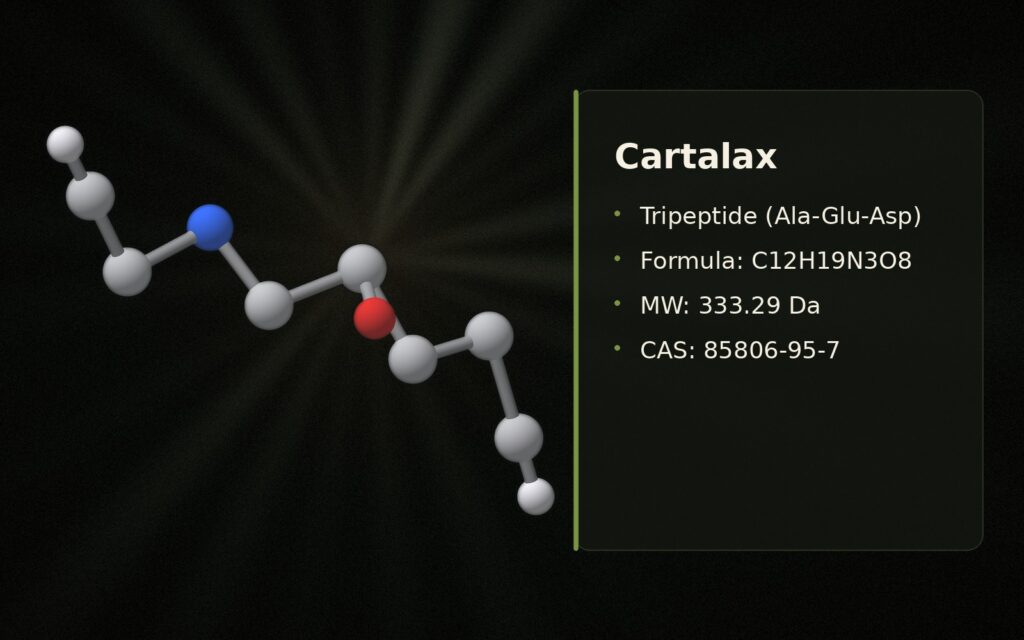
Cartalax is a short synthetic peptide belonging to the same “peptide bioregulator” research family as Epitalon, developed out of the St. Petersburg (Khavinson-affiliated) tradition of short-chain regulatory peptide research. It is marketed in the research-chemical trade as a “cartilage bioregulator,” but readers should understand upfront that the published, indexed research base tied specifically to this compound is narrow: most identifiable studies address general cellular-aging endpoints in tissues such as kidney, skin, and stem cell cultures, not cartilage or chondrocyte biology directly. This article summarizes what is verifiably known about Cartalax’s chemistry and research history, is written strictly for laboratory and academic research audiences, and does not describe, recommend, or imply any human use.
Cartalax is not approved by the U.S. Food and Drug Administration for any purpose, has no established human safety or dosing profile, and is not a treatment, therapy, or supplement for arthritis, joint pain, or any other condition in people. It is sold by Vericor Bioscience, as by other suppliers in this category, strictly as a research-use-only (RUO) chemical for use by qualified researchers in controlled, non-clinical laboratory settings.
Featured Definition: What Is Cartalax?
Cartalax (Ala-Glu-Asp, also referred to as the “AED” peptide) is a synthetic tripeptide with the molecular formula C₁₂H₁₉N₃O₈ and a molecular weight of approximately 333.3 g/mol (CAS 85806-95-7). It belongs to a class of short synthetic peptides — often called “peptide bioregulators” — originally developed by Russian researchers, including Vladimir Khavinson and colleagues, who have proposed that short peptide sequences can modulate gene expression in a tissue-associated manner. Cartalax is marketed for cartilage-tissue research specifically, though this tissue association is drawn primarily from the developers’ broader theoretical framework rather than from a large body of chondrocyte-specific published data. It is not FDA-approved and is not intended for human use.
What Is Cartalax? Chemical Identity and Research Origins {#chemical-identity}
Cartalax is a synthetic tripeptide composed of three amino acids — alanine, glutamic acid, and aspartic acid (Ala-Glu-Asp) — joined in that sequence. Its formula (C₁₂H₁₉N₃O₈, MW ≈ 333.3 g/mol) and CAS number (85806-95-7) are documented in chemical supplier and reference databases. It is sometimes shorthanded as “AED” in the peptide research trade, and it is worth noting explicitly that it is a tripeptide, not the tetrapeptide sequence sometimes attributed to it in casual marketing copy — a distinction that matters for anyone trying to trace it back to a specific study or database entry.
Cartalax comes out of the same broad Russian “peptide bioregulator” research tradition that produced Epitalon (Ala-Glu-Asp-Gly, a related but chemically distinct tetrapeptide studied in connection with pineal gland function). Researchers in this tradition — centered on the St. Petersburg Institute of Bioregulation and Gerontology and associated investigators such as V. Khavinson and N. Lin’kova — have proposed that very short peptide sequences derived from or modeled on tissue-specific regulatory proteins can influence gene expression patterns in the tissue type from which they are conceptually or historically associated. Cartalax has been assigned a cartilage/connective-tissue association within this framework, which is the basis for its “cartilage bioregulator” branding among research-chemical vendors.
It is important for researchers to understand that this tissue-association naming convention is a theoretical and historical framework maintained by the peptide’s originators, not a settled finding independently established across a broad, chondrocyte-specific experimental literature. As discussed below, the indexed published research most directly tied to this specific tripeptide addresses gene-expression and cell-aging endpoints in several tissue types — not predominantly cartilage.
How Cartalax Is Proposed to Work {#mechanism}
The proposed mechanism for Cartalax follows the general “peptide bioregulator” hypothesis advanced by its originating research group: that short peptides of four amino acids or fewer can enter cells and interact with chromatin or promoter regions of DNA, thereby modulating the expression of specific gene sets involved in cellular renewal, differentiation, and senescence. Under this model, different short peptides are proposed to have different degrees of tissue selectivity, with Cartalax’s sequence associated with connective-tissue and cartilage-related gene programs.
Some of the published in vitro work from this research group reports changes in proliferation markers, differentiation markers, or gene-expression profiles in cultured cells exposed to short peptides of this class, including Cartalax. However, the specific molecular target(s) of Cartalax — a receptor, a transcription factor interaction, or a direct chromatin-binding mechanism — have not been established with the kind of mechanistic detail (binding assays, knockout/knockdown validation, dose-response pharmacology) expected for a well-characterized bioactive compound. Researchers should treat the “gene-expression modulator” framing as a working hypothesis under investigation by a specific research group, not as a confirmed pharmacological mechanism of action, and certainly not as a mechanism established specifically in chondrocytes or cartilage tissue.
Preclinical Research Findings {#preclinical-research}
Publicly indexed research directly tied to this tripeptide (searchable in PubMed under the supplementary chemical term “alanyl glutamyl aspartic acid”) includes a small number of in vitro and animal studies, nearly all originating from the same Russian research network associated with Khavinson and colleagues. Representative published work in this line includes:
- Cell-renewal studies in kidney tissue culture comparing peptide effects on cell proliferation in tissue from young versus aged animals (Chalisova et al., Bulletin of Experimental Biology and Medicine, 2015).
- Skin fibroblast aging studies, examining peptide effects on fibroblast function in aging in vitro models (Lin’kova et al., Bulletin of Experimental Biology and Medicine, 2016).
- Broader gene-expression regulation studies describing how a family of short peptides, including Cartalax, may influence gene expression patterns generally (Khavinson et al., Bulletin of Experimental Biology and Medicine, 2016).
- Neuronal differentiation of stem cells exposed to short peptides of this class (Caputi et al., International Journal of Immunopathology and Pharmacology, 2019).
- Renal morphology studies in aged rats (Zamorskii et al., Advances in Gerontology, 2019).
- Gene-expression changes in aging human mesenchymal stem cell cultures modulated by short peptides (Ashapkin et al., Molecular Biology Reports, 2020).
Honest assessment for researchers: this is a genuinely narrow evidence base, and it is narrower in a specific way. Despite Cartalax’s marketing as a “cartilage bioregulator,” a search of the indexed literature did not surface a peer-reviewed study examining Cartalax’s effects directly in chondrocyte cultures, cartilage explants, or a cartilage-degeneration animal model under that compound’s own chemical identity. The published studies that do exist address other tissue and cell types — kidney, skin, immune, and stem cell aging — within the same general “short peptide bioregulator” research program. As with other compounds from this same research tradition (Epitalon included), essentially all of the identifiable literature originates from one affiliated research network, has not been independently replicated by unrelated laboratories at scale, and has not progressed to registered human clinical trials. Any claims connecting Cartalax specifically to cartilage, chondrocyte gene expression, or joint-tissue outcomes should be understood as extrapolation from this compound’s branding and theoretical tissue-association framework, not as a conclusion drawn from a body of cartilage-specific published data.
Evidence by Research Level {#evidence-table}
| Research Level | What Exists | Strength of Evidence |
|---|---|---|
| In vitro (cell culture) | Studies in kidney, skin fibroblast, neuronal, and mesenchymal stem cell cultures from the same research network | Limited; narrow scope, not independently replicated |
| In vitro (chondrocyte/cartilage-specific) | No indexed peer-reviewed study identified under Cartalax’s chemical identity | Not established |
| Animal models (general aging) | Small studies in aged rats (renal morphology) | Very limited |
| Animal models (cartilage/joint-specific) | None identified | Not established |
| Human clinical trials | None identified | None |
| Regulatory review | No FDA evaluation identified | Not applicable |
U.S. Regulatory Status {#regulatory-status}
Cartalax is not approved by the FDA for any human or veterinary use, and it is not recognized as a dietary supplement, drug, or biologic under U.S. law. A review did not identify Cartalax on the FDA’s Section 503A or 503B bulk drug substances lists, nor did it identify any FDA warning letter, safety communication, or enforcement action specifically naming Cartalax. The absence of FDA action should not be read as an endorsement or as evidence of safety — it most likely reflects that Cartalax has not been formally submitted for, or reached the stage of, U.S. regulatory review, consistent with its status as an early-stage, low-visibility research compound. Cartalax should be handled and labeled strictly as a research-use-only chemical, restricted to qualified laboratory personnel operating under appropriate institutional and biosafety protocols, and must not be marketed, sold, or represented as suitable for human consumption, injection, or therapeutic use.
Safety Considerations and Unknown Risks {#safety}
There is no established human safety, pharmacokinetic, or toxicology database for Cartalax. Unlike compounds with a longer research history and broader dose-ranging or toxicology literature, the published record for Cartalax does not include the kind of systematic safety characterization (acute toxicity, repeat-dose toxicity, immunogenicity, degradation product profiling) that would typically inform even preclinical safety expectations. Researchers should assume that:
- No validated safe dose range exists for any species, including humans.
- Long-term or repeat-exposure effects have not been systematically studied.
- Impurity profiles, degradation products, and batch-to-batch variability can differ meaningfully between suppliers, and only third-party-verified certificates of analysis (COAs) should be relied upon for compound identity and purity in a research setting.
- Because the “cartilage bioregulator” association is largely theoretical rather than data-derived, researchers should not assume Cartalax carries the same risk (or benefit) profile as better-characterized joint- or cartilage-related research compounds.
Any laboratory work with Cartalax should follow standard institutional biosafety, chemical handling, and IACUC/IRB protocols as applicable, and should never involve human dosing outside of a properly authorized, IRB-approved clinical research program — none of which currently exists for this compound.
Research Evaluation Checklist {#checklist}
Researchers and procurement teams evaluating Cartalax or literature about it should consider the following:
- Confirm compound identity independently. Match the vendor’s product to the CAS number (85806-95-7), formula (C₁₂H₁₉N₃O₈), and sequence (Ala-Glu-Asp) against a chemical reference database rather than relying on marketing copy alone.
- Request a current, batch-specific certificate of analysis (COA) showing purity by HPLC and mass spectrometry, not a generic or outdated document.
- Trace claims back to primary literature. Verify whether a claim is supported by a specific, indexed, peer-reviewed study — and check whether that study actually used cartilage/chondrocyte tissue or a different tissue type.
- Note the research network concentration. Recognize that most available literature in this peptide family originates from a single affiliated research group, which limits independent corroboration.
- Distinguish animal/in vitro findings from human relevance. No human clinical data exists for Cartalax; do not extrapolate cell-culture or rodent findings to expected human effects.
- Check for FDA or regulatory flags periodically, since compound status can change as new compounds attract regulatory attention.
- Restrict use to qualified, non-clinical research settings with appropriate institutional oversight, and never as a self-administered product.
People Also Ask About Cartalax
No. Cartalax has no FDA approval for any human or animal use and is not recognized as a drug, biologic, or dietary supplement in the United States.
Cartalax is studied by a small, largely Russia-based research network as part of a broader “peptide bioregulator” research program examining short peptides’ effects on gene expression and cellular aging in various tissue types. It is marketed as a “cartilage bioregulator,” though direct, cartilage-specific published research on this compound is very limited.
No. Both come from the same short-peptide bioregulator research tradition, but they are chemically distinct: Cartalax is the tripeptide Ala-Glu-Asp, while Epitalon is the tetrapeptide Ala-Glu-Asp-Gly.
No registered human clinical trials or peer-reviewed human studies on Cartalax were identified. All available published research is limited to in vitro cell culture and small animal studies.
No. Cartalax is not a treatment for arthritis, joint pain, or any medical condition. It has no approved therapeutic use and is not intended for human administration of any kind. This article is provided for research education only.
The available published literature is concentrated among a small number of affiliated Russian research groups, similar to the research pattern seen with other peptides in this bioregulator family, such as Epitalon.
Expert Cartalax Q&A
How confident can researchers be in the “cartilage-specific” framing of Cartalax?
Not very, based on the currently indexed literature. The cartilage association appears to derive primarily from the compound’s place within the originating research group’s tissue-classification framework rather than from a substantial body of chondrocyte- or cartilage-specific published data. Researchers designing new studies should treat this as an open question, not an established premise.
What would meaningfully strengthen the evidence base for Cartalax?
Independent replication outside the originating research network, mechanistic studies identifying a specific molecular target, and — most importantly for the “cartilage” claim specifically — direct experiments in chondrocyte cultures or cartilage explant/animal models, ideally with dose-response data and appropriate controls.
How does Cartalax’s evidence base compare to other bioregulator peptides Vericor covers, like Epitalon?
Similar in structure — small in vitro and animal studies from a concentrated research network, no human trials — but narrower in one respect: Epitalon at least has a body of published research addressing its associated tissue (pineal/retinal) function directly, whereas comparable cartilage-specific data for Cartalax was not identified in this review.
What quality-control steps matter most when sourcing Cartalax for laboratory work?
Independent, batch-specific COA verification (HPLC purity, mass spec identity confirmation), confirmation of the correct tripeptide sequence and CAS number, and sourcing from a supplier that documents third-party testing rather than relying on marketing claims about biological activity.
Should researchers expect Cartalax to behave like a joint-health therapeutic in future studies?
That cannot be predicted from current data. The existing literature does not support extrapolating from unrelated tissue studies (kidney, skin, stem cells) to cartilage-specific outcomes, and no cartilage-targeted efficacy data currently exists to evaluate.
Conclusion {#conclusion}
Cartalax is a chemically well-defined short synthetic tripeptide (Ala-Glu-Asp, C₁₂H₁₉N₃O₈, CAS 85806-95-7) situated within the broader Khavinson-affiliated “peptide bioregulator” research tradition that also produced Epitalon. Its marketing as a “cartilage bioregulator” reflects a theoretical tissue-association framework from its originating research group rather than a substantial, independently replicated body of chondrocyte- or cartilage-specific published research. The available literature is narrow, concentrated in a small research network, limited to in vitro and small animal studies of general cellular aging in other tissue types, and has not advanced to human clinical trials. Cartalax is not FDA-approved, has no established human safety profile, and is not intended, marketed, or suitable for human use, self-administration, or the treatment of any condition, including joint pain or arthritis.
Qualified researchers interested in Cartalax for legitimate, non-clinical laboratory investigation are encouraged to review Vericor Bioscience’s research product page for current certificate-of-analysis documentation, purity specifications, and research-use-only terms of sale.