
Kisspeptin occupies an unusual position among research peptides: it is the subject of one of the more substantial human clinical research literatures of any compound in this category, including multiple sponsor-run trials at academic medical centers examining its role in reproductive-hormone signaling. That research base is genuinely worth understanding on its own terms. It is also, however, research conducted with pharmaceutical-grade material under institutional review board oversight and investigational new drug protocols — not a description of what any research-use-only (RUO) kisspeptin product is approved or intended to do.
This article is written for laboratory researchers and institutional buyers evaluating kisspeptin-10 for legitimate in vitro, ex vivo, or animal research. Kisspeptin-10 is sold by Vericor Bioscience strictly as a research-use-only (RUO) laboratory chemical. It is not approved by the FDA for any human use, it is not intended for human consumption or self-administration, and nothing in this article should be read as instruction, encouragement, or guidance for using it in or on a person. Where we describe effects on the hypothalamic-pituitary-gonadal (HPG) axis, luteinizing hormone (LH) secretion, or oocyte maturation, those findings come from published preclinical and clinical-trial literature conducted by outside investigators and sponsors — not from Vericor Bioscience, and not from anecdotal consumer use. Because kisspeptin’s real research record is more extensive than that of many other RUO peptides, we describe it in full, including trial design and dosing details reported in the literature — but strictly as a summary of third-party academic research, not as a guide to what a reader should do with any product.
Featured definition: What is Kisspeptin?
Kisspeptin is the collective name for a family of peptides — kisspeptin-54, -14, -13, and -10 — derived by proteolytic cleavage from a single precursor protein encoded by the KISS1 gene (the full-length protein product is also historically known as metastin). All forms share the same biologically active C-terminal ten amino acids and act as agonists at KISS1R (also called GPR54), a G-protein-coupled receptor expressed on gonadotropin-releasing hormone (GnRH) neurons in the hypothalamus. Kisspeptin-10 is the shortest fragment retaining full receptor-binding activity and is the form most commonly available as a research-use-only laboratory peptide. In the peer-reviewed literature, kisspeptin is best characterized as the key upstream regulator of the HPG axis — the signaling system that governs GnRH, LH, and follicle-stimulating hormone (FSH) release and, downstream of that, gonadal steroid production. It is not itself a fertility drug, a hormone-replacement product, or an FDA-approved therapeutic of any kind.
What Is Kisspeptin? Discovery and Natural Biology
Kisspeptin was first identified in 1996 by researchers at Hershey Medical Center in Pennsylvania as a metastasis-suppressor gene product, which is the origin of its alternative name, metastin. Its role in reproductive endocrinology was established roughly eight years later, when two independent research groups — studying idiopathic hypogonadotropic hypogonadism in humans and a genetically engineered mouse model, respectively — reported in 2003 that loss-of-function mutations in the KISS1R (GPR54) gene caused failure of pubertal onset and impaired gonadotropin secretion. That discovery, published in The New England Journal of Medicine and PNAS, repositioned kisspeptin from a cancer-biology curiosity to the central gatekeeper of the reproductive endocrine system.
In natural physiology, kisspeptin is synthesized primarily by two hypothalamic neuron populations — in the arcuate nucleus and the anteroventral periventricular nucleus — that project onto GnRH neurons. These kisspeptin neurons are now understood to integrate multiple inputs relevant to reproduction, including circulating sex-steroid feedback, metabolic status (via leptin signaling), and photoperiod and stress cues in some species, and to translate that integrated signal into pulsatile or surge-pattern GnRH release. This positions the kisspeptin/KISS1R system as the proximate trigger for puberty onset, for the ongoing pulsatile GnRH secretion that sustains adult reproductive function, and for the preovulatory GnRH/LH surge in females. Research groups studying the HPG axis frequently describe kisspeptin neurons as the “gatekeeper” or “master regulator” upstream of GnRH — a widely used description in the endocrinology literature, not marketing language coined for this article.
Kisspeptin’s natural biology also has a boundary worth stating plainly: it does not act directly on the gonads, on GnRH receptors in the pituitary, or on estrogen or testosterone receptors. Its documented site of action is upstream, at the GnRH neuron itself, which is why researchers describe it as a regulator of the HPG axis rather than a hormone with direct end-organ activity.
Chemical Identity of Kisspeptin-10
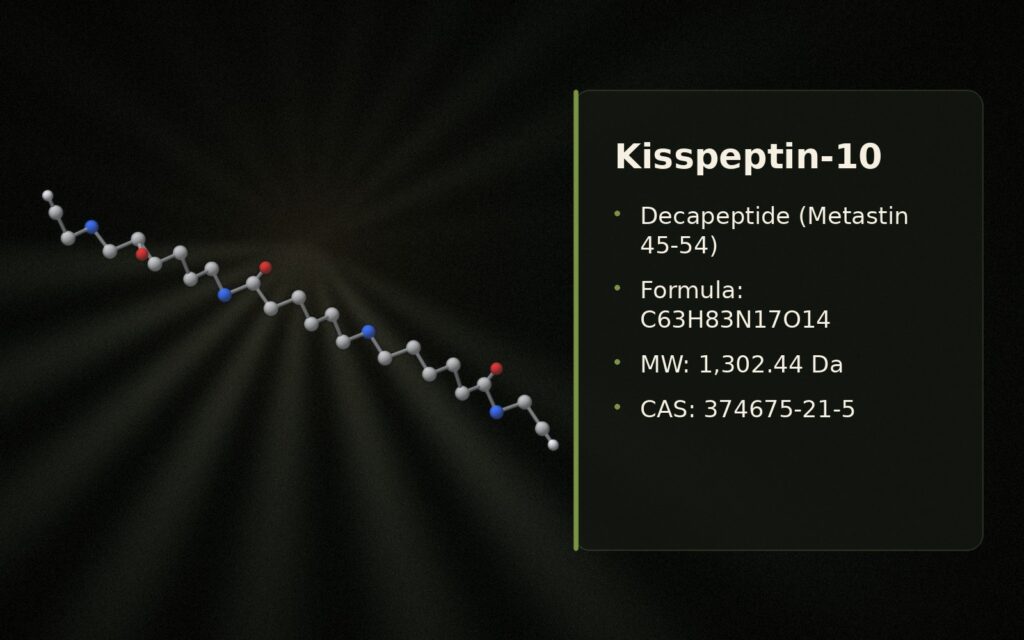
Kisspeptin-10 (also referred to as metastin 45-54, reflecting its position within the full-length precursor protein) is the ten-residue C-terminal fragment of the kisspeptin family and the minimal sequence reported to retain full KISS1R agonist activity.
| Property | Kisspeptin-10 (Human) |
|---|---|
| CAS number | 374675-21-5 |
| Molecular formula | C₆₃H₈₃N₁₇O₁₄ |
| Molecular weight | ≈ 1,302.4 g/mol |
| Amino acid sequence | H-Tyr-Asn-Trp-Asn-Ser-Phe-Gly-Leu-Arg-Phe-NH₂ (10 residues, C-terminally amidated) |
| Receptor target | KISS1R / GPR54 (G-protein-coupled receptor) |
| Relationship to full-length protein | C-terminal decapeptide of the KISS1 gene product (metastin), corresponding to residues 45–54 |
| Related fragments | Kisspeptin-54, kisspeptin-14, and kisspeptin-13 share the same bioactive C-terminal decapeptide core but differ in N-terminal length |
The C-terminal Arg-Phe-NH₂ motif (an “RFamide”) is the structural feature shared across the broader RFamide peptide family and is understood to be essential for KISS1R binding; researchers should note that this same C-terminal motif is conserved across all kisspeptin isoforms, which is why kisspeptin-10 retains full agonist potency despite being a small fragment of the 54-amino-acid parent molecule. Independent chemical verification (e.g., mass spectrometry, HPLC) against primary reference sources such as PubChem or ChemicalBook is recommended before relying on any vendor’s stated identity or purity for a given research lot.
Proposed Mechanism of Action
The mechanism by which kisspeptin regulates the HPG axis is one of the better-characterized signaling pathways in reproductive neuroendocrinology, though researchers should still treat elements of it as an active area of study rather than a fully closed question.
- KISS1R binding on GnRH neurons. Kisspeptin-10 binds KISS1R, a Gq/11-protein-coupled receptor expressed on the surface of hypothalamic GnRH neurons. Receptor activation triggers phospholipase C signaling, generating inositol trisphosphate and diacylglycerol, which in turn depolarizes the neuron.
- Stimulation of pulsatile and surge GnRH release. This depolarization is proposed to be the proximate trigger for GnRH release into the hypophyseal portal circulation, which then drives LH and FSH secretion from the anterior pituitary. Kisspeptin is described in the literature as acting upstream of, and required for, the normal pulsatile pattern of GnRH secretion, as well as the large GnRH/LH surge that precedes ovulation in females.
- Integration point for steroid and metabolic feedback. Kisspeptin neurons themselves express receptors for estrogen, progesterone, and testosterone, and are proposed to be a principal site where circulating sex-steroid feedback (both negative feedback during most of the cycle and, in the case of estrogen in the late follicular phase, positive feedback that triggers the ovulatory surge) is translated into altered GnRH output. Separately, kisspeptin neuron activity is linked to leptin and metabolic signaling, which is proposed as part of the biological explanation for why energy-deficient states can suppress reproductive function.
- No documented direct gonadal or pituitary GnRH-receptor action. Consistent with its role as an upstream regulator, the literature does not describe kisspeptin as acting directly on pituitary GnRH receptors or on gonadal tissue; its effects downstream of the hypothalamus are understood to occur indirectly, via the GnRH-LH-FSH cascade it initiates.
Researchers should treat this as a well-supported receptor-and-circuit-level model built from a combination of animal knockout studies, human genetic studies, and a meaningful body of controlled human physiology research (below) — a stronger evidentiary footing than exists for many hypothalamic peptides, but still short of a fully resolved picture of every input the kisspeptin neuron integrates.
Human and Clinical Research Findings
Kisspeptin has a genuinely substantial human clinical research base relative to most compounds in the RUO peptide category, spanning basic reproductive physiology, fertility-related trigger research, and early investigational work in reproductive and metabolic hormone conditions. All of this work has been conducted by independent academic investigators and sponsors using pharmaceutical-grade material under clinical trial protocols — it describes the compound as a subject of study, not a use case for any RUO product.
Foundational human genetics (2003). Two independent reports — one describing a consanguineous family with idiopathic hypogonadotropic hypogonadism, the other a KISS1R-knockout mouse model — established that loss of KISS1R signaling in humans and mice causes failure of pubertal onset and low gonadotropin secretion. This human genetic evidence, alongside the animal model, is the foundational basis for treating kisspeptin/KISS1R signaling as necessary for normal HPG axis function.
Human pharmacodynamic studies. Multiple controlled studies, including work registered on ClinicalTrials.gov (e.g., NCT00914823 and related protocols) examining kisspeptin administration in healthy adults, have reported that intravenous or subcutaneous kisspeptin administration produces dose-dependent increases in circulating LH (and, to varying degrees, FSH) in men and women, consistent with the proposed mechanism above. These studies establish kisspeptin’s acute neuroendocrine effect in humans but are physiological/pharmacodynamic studies, not efficacy trials for any clinical endpoint.
IVF oocyte-maturation trigger research (Imperial College London). The most extensive body of applied human research on kisspeptin comes from a series of investigator-led clinical trials, principally conducted by the Reproductive and Investigative Endocrinology research group at Imperial College London, examining kisspeptin-54 (a related, longer isoform — not kisspeptin-10) as an experimental trigger for final oocyte maturation in women undergoing in vitro fertilization (IVF). A 2022 review in Frontiers in Endocrinology summarizing three of these trials (combined enrollment of 175 women across studies ranging from 53 to 62 participants) reported that kisspeptin-54 triggered at least one mature oocyte in the large majority of cycles, with dose-dependent oocyte yield peaking in a 9.6–12.8 nmol/kg dosing range, and that the resulting LH surge (reported around 45 IU/L) more closely resembled the natural physiological midcycle LH surge than the substantially higher surge produced by GnRH-agonist triggers. The same body of research reported that, among women at elevated risk for ovarian hyperstimulation syndrome (OHSS) — a potentially serious complication of standard IVF trigger protocols — kisspeptin-54-triggered cycles showed no clinically significant moderate or severe OHSS in the reported trials, a finding investigators have proposed as the clinical rationale for continued study of kisspeptin-class compounds in this setting.
Investigational research in reproductive and hormone conditions. Beyond IVF trigger research, academic and NIH-affiliated investigators have run and, as of this writing, continue to run early-phase clinical trials examining subcutaneous kisspeptin administration in conditions such as hypothalamic amenorrhea and hypogonadotropic hypogonadism, studying its effects on gonadotropin secretion and downstream reproductive hormone levels. These are Phase 1/Phase 2 investigational studies conducted under institutional and regulatory oversight with pharmaceutical-grade compound — they represent active, real research interest in kisspeptin as a potential future therapeutic candidate, not an indication that any RUO kisspeptin product has demonstrated, or is approved for, any such use.
What has not been established. No kisspeptin compound — kisspeptin-10, kisspeptin-54, or any other isoform — has completed a pivotal Phase 3 program or received FDA approval for any indication. The IVF trigger research described above used kisspeptin-54, not kisspeptin-10; researchers should not assume identical dosing, pharmacokinetics, or clinical findings transfer between isoforms simply because they share the same bioactive C-terminal sequence and receptor target. There is no published controlled human efficacy trial of kisspeptin-10 specifically as a fertility, hormone, or reproductive intervention.
Evidence by Research Level
| Research Level | What Has Been Studied | Applies To | Strength of Evidence |
|---|---|---|---|
| Receptor / in vitro pharmacology | KISS1R binding and activation; shared C-terminal RFamide motif | All kisspeptin isoforms (shared bioactive core) | Foundational; well-established mechanism |
| Human genetics | KISS1R loss-of-function mutations causing hypogonadotropic hypogonadism | Endogenous kisspeptin/KISS1R system | Strong; published in high-impact peer-reviewed journals |
| Animal models | KISS1R-knockout mouse phenotype; broader rodent HPG axis studies | Endogenous kisspeptin/KISS1R system | Strong; foundational to the field |
| Human Phase I / pharmacodynamics | Dose-dependent LH/FSH response to kisspeptin administration in healthy adults | Multiple isoforms studied, dosing and isoform vary by trial | Moderate; multiple controlled studies, not large-scale |
| Human applied clinical research (IVF trigger) | Oocyte maturation, LH surge profile, OHSS incidence in IVF cycles | Kisspeptin-54 specifically | Moderate; multiple investigator-led trials, single research center concentration |
| Human investigational trials (hormone conditions) | Reproductive hormone response in hypothalamic amenorrhea, hypogonadotropic hypogonadism | Various isoforms, ongoing | Early-stage; active Phase 1/2 trials, no completed pivotal data |
| Approved clinical use | Any FDA-approved indication, any isoform | None | None — no kisspeptin compound is FDA-approved |
U.S. Regulatory Status
The following reflects publicly available FDA and regulatory-history information as of this writing. Regulatory status for compounded and bulk substances can change, and researchers should independently verify current status through primary FDA sources before making compliance decisions.
- No FDA approval, for any kisspeptin compound or isoform. Kisspeptin-10, kisspeptin-54, and every other kisspeptin fragment remain investigational. No New Drug Application for any kisspeptin compound has been approved by the FDA for any indication, including fertility, reproductive hormone, or metabolic uses.
- Active but early-stage pharmaceutical interest. Unlike many RUO research peptides, kisspeptin has a real and ongoing pipeline of academic and NIH-affiliated Phase 1/Phase 2 investigational trials examining its therapeutic potential in conditions such as hypothalamic amenorrhea and hypogonadotropic hypogonadism, alongside the IVF trigger research described above. This reflects genuine, active scientific interest in kisspeptin as a future drug candidate — it does not mean any kisspeptin product, including kisspeptin-10 sold as an RUO laboratory chemical, has been evaluated or approved by the FDA, or is lawfully positioned as a substitute for or preview of that investigational work.
- Distinction between investigational drug material and RUO material. The clinical trials described in this article use pharmaceutical-grade kisspeptin manufactured and controlled under investigational new drug (IND) protocols, administered by clinical investigators under institutional review board oversight. This is a fundamentally different regulatory category from research-use-only laboratory-chemical kisspeptin sold for in vitro, ex vivo, or animal research, which carries no clinical-grade manufacturing controls, no IND status, and no FDA review of any kind.
- Research-use-only status. In the United States, kisspeptin-10 is lawfully offered only as a research-use-only laboratory chemical for qualified personnel and institutions, not for human consumption, compounding, or clinical administration.
- General enforcement climate. FDA has taken enforcement action against companies marketing peptide products, as a category, for unapproved human use, unsubstantiated therapeutic claims, or misbranding. Researchers should treat reproductive-axis peptides as an area of continued regulatory attention and never present RUO material as suitable for human use, regardless of how promising the underlying academic research may be.
Safety Considerations and Unknown Risks
Published clinical research on kisspeptin administration provides more human safety observation than exists for many research peptides, but this data comes from controlled trials of pharmaceutical-grade material in specific patient populations — it does not establish a safety profile for RUO kisspeptin-10 material of unverified purity used outside a clinical protocol.
- Reported findings in human pharmacodynamic and trigger trials. Published kisspeptin trials, including the IVF trigger research, have generally reported the compound to be well tolerated in the specific dosing regimens and short administration windows studied, with the OHSS-reduction findings described above being the most notable favorable safety signal reported for kisspeptin-54 relative to standard hCG triggers. This should not be read as a general safety finding for kisspeptin-10 or for any dosing regimen or duration outside what was specifically studied.
- Isoform- and dose-specific data, not general safety data. Nearly all of the applied human safety observation in the literature concerns kisspeptin-54 in single-trigger IVF protocols or short-term pharmacodynamic studies — not kisspeptin-10, and not any repeated or extended dosing schedule. Researchers should not extrapolate a favorable safety signal from one isoform, dose, or study duration to another.
- Theoretical reproductive-axis considerations. Because kisspeptin acts directly on the neuroendocrine circuitry governing reproductive hormone secretion, any research model or study design should account for the possibility of downstream effects on gonadotropin and sex-steroid levels as an expected pharmacodynamic consequence of receptor engagement, not an incidental finding.
- No established safety data in specific populations. Available published research does not establish safety in pregnancy (beyond its specific, monitored use as an oocyte-maturation trigger prior to embryo transfer in the cited IVF studies), in pediatric populations, or in individuals with reproductive endocrine disorders outside the specific conditions studied.
- No long-term human surveillance data. Because no kisspeptin compound has ever been approved or marketed for ongoing human use, there is no post-market surveillance dataset comparable to what exists for an approved pharmaceutical.
- Sourcing and purity risk. As with any peptide obtained outside a validated pharmaceutical supply chain, identity, purity, and degradation state can vary substantially between sources. Research use should involve independent analytical verification (e.g., HPLC, mass spectrometry) rather than reliance on vendor claims alone.
Kisspeptin-10 is not intended for human use of any kind. It should be handled only by qualified personnel in appropriate laboratory settings, following institutional biosafety and chemical-handling protocols and all applicable research-use regulations.
Research Evaluation Checklist
Researchers evaluating kisspeptin-10 — or any RUO reproductive-axis peptide — should consider working through the following steps before drawing conclusions from vendor or third-party materials:
- Confirm which isoform is being discussed. Verify whether a source, product listing, or dataset refers to kisspeptin-10, kisspeptin-54, or another fragment — the applied human clinical research (particularly the IVF trigger literature) concerns kisspeptin-54, not kisspeptin-10, and findings should not be assumed to transfer automatically.
- Verify chemical identity independently. Confirm molecular formula, molecular weight, CAS number, and sequence against a primary chemical database (e.g., PubChem, ChemicalBook) rather than a vendor product page alone.
- Trace clinical claims to primary literature. Identify whether a stated finding originates from a peer-reviewed trial (e.g., the Imperial College London IVF trigger studies, ClinicalTrials.gov-registered pharmacodynamic studies) or from unsourced marketing copy.
- Distinguish investigational drug data from RUO material. Recognize that clinical trial findings were generated with pharmaceutical-grade, IND-controlled material administered under clinical protocols — not with RUO laboratory-chemical kisspeptin-10.
- Confirm current FDA status directly. Check FDA and ClinicalTrials.gov sources rather than a supplier’s characterization of legality or clinical progress, and re-verify periodically as investigational trials continue.
- Demand analytical documentation. Request a current, lot-specific Certificate of Analysis (COA) confirming identity and purity for the specific isoform purchased.
- Design studies around the correct isoform and receptor pharmacology. Match experimental design to KISS1R agonism and the HPG-axis endpoints actually supported by the literature, rather than assuming broader hormonal or metabolic effects not documented for the isoform in question.
- Confirm RUO labeling and handling practices. Ensure the product is labeled and distributed strictly for laboratory research use, with no suggestion of human dosing or therapeutic outcomes.
People Also Ask About Kisspeptin-10
In laboratory research, kisspeptin-10 is studied as a KISS1R (GPR54) receptor agonist for investigating the hypothalamic-pituitary-gonadal (HPG) axis — specifically, how kisspeptin signaling regulates GnRH neuron activity and downstream LH/FSH secretion. It is a research tool for reproductive neuroendocrinology, not an approved product for any human use.
Not exactly. “Kisspeptin” refers to a family of related peptides (kisspeptin-54, -14, -13, and -10) cleaved from the same *KISS1* gene precursor protein. All share the same bioactive ten-amino-acid C-terminal sequence and bind the same KISS1R receptor, but kisspeptin-10 is specifically the shortest fragment, and most published applied clinical research (such as the IVF trigger studies) has used the longer kisspeptin-54 isoform instead.
No. No kisspeptin compound or isoform has received FDA approval for any indication. Academic and NIH-affiliated investigational trials are ongoing, but none has completed a pivotal Phase 3 program or resulted in an approved drug.
Yes, more extensively than many research peptides. Kisspeptin has been studied in human pharmacodynamic trials measuring LH/FSH response, in investigator-led IVF oocyte-maturation trigger trials (primarily using kisspeptin-54) at academic centers including Imperial College London, and in ongoing early-phase trials for conditions such as hypothalamic amenorrhea. This is genuine clinical research conducted by independent investigators — it does not mean any RUO kisspeptin-10 product has been clinically tested or approved.
No kisspeptin compound is FDA-approved to treat infertility, low testosterone, or any hormonal condition. While academic research has examined kisspeptin’s role in the IVF trigger process and in specific reproductive hormone conditions, that research used investigational, pharmaceutical-grade material under clinical protocols — it is not evidence that an RUO research peptide can or should be used to treat any condition in a person.
Ovarian hyperstimulation syndrome (OHSS) is a known complication of standard hCG-based IVF trigger protocols. Investigator-led trials of kisspeptin-54 as an alternative trigger have reported reduced OHSS incidence in at-risk patients compared to standard triggers, which is one reason academic researchers have continued to study kisspeptin in this specific clinical research context.
Expert Kisspeptin-10 Q&A
Why is kisspeptin described as the “gatekeeper” of the reproductive axis?
Because the human genetic and animal-model evidence — specifically, that loss-of-function KISS1R mutations cause failure of pubertal onset and low gonadotropin secretion — indicates that kisspeptin/KISS1R signaling is not just one input among many but appears necessary for normal GnRH neuron activity. That’s a stronger evidentiary claim than exists for many upstream neuroendocrine regulators, which is why the terminology has stuck in the field.
Why did the Imperial College London trials use kisspeptin-54 rather than kisspeptin-10?
Published reports of that research program don’t fully detail the isoform-selection rationale, but kisspeptin-54 and kisspeptin-10 differ in size and, potentially, in pharmacokinetics despite sharing the same receptor-binding C-terminal core — a longer isoform may behave differently in circulation. Researchers should treat this as a meaningful design choice rather than an interchangeable detail, and should not assume kisspeptin-10 would reproduce the same trigger and OHSS-related findings without its own dedicated trials.
What’s the most important limitation in the kisspeptin research base for someone designing a new study?
That the isoform used matters. A large share of the most clinically applied human data — the IVF trigger and OHSS findings — concerns kisspeptin-54 specifically, not kisspeptin-10. Anyone designing research or interpreting literature involving kisspeptin-10 should verify whether cited findings actually used that isoform or a related but distinct one.
Does the existence of active NIH-affiliated trials mean kisspeptin is close to becoming an approved drug?
It means there is genuine, ongoing scientific interest in kisspeptin as an investigational candidate for specific reproductive hormone conditions — that’s real and worth noting accurately. But early-phase (Phase 1/2) trials are a preliminary stage of drug development; most investigational candidates at this stage do not reach FDA approval, and there is no public indication of a completed pivotal trial or pending approval for any kisspeptin compound.
What should a lab prioritize when sourcing kisspeptin-10 for research?
Independent analytical verification of identity and purity (HPLC/mass spectrometry) against a lot-specific Certificate of Analysis, clear confirmation that the material is labeled and distributed strictly for research use, and — because so much of the compelling clinical literature concerns a different isoform — careful attention to which specific kisspeptin fragment any comparison study or claim actually used.
Conclusion
Kisspeptin stands out among research-use-only peptides for the depth of its legitimate human clinical research record — a foundational human-genetics discovery linking KISS1R signaling to puberty and gonadotropin secretion, controlled pharmacodynamic studies of LH/FSH response, and a real, ongoing program of investigator-led clinical trials examining kisspeptin-54 as an IVF oocyte-maturation trigger and kisspeptin more broadly in conditions like hypothalamic amenorrhea. That research base is worth understanding accurately, including its genuine strengths, rather than either dismissing it or overstating what it shows. At the same time, it is research conducted with pharmaceutical-grade, IND-controlled material under clinical trial protocols at academic institutions — not a description of what kisspeptin-10 sold as a laboratory research chemical is approved, tested, or intended to do. No kisspeptin compound or isoform, including kisspeptin-10, has received FDA approval for any indication, and the isoform used in most of the applied clinical literature (kisspeptin-54) is not the same molecule sold as the RUO decapeptide.
Kisspeptin-10 is not intended for human use, self-administration, or any diagnostic or therapeutic purpose, and nothing in this article should be construed as such. Qualified researchers who want to review current specifications and analytical documentation for kisspeptin-10 as a laboratory research compound can visit Vericor Bioscience’s research product page.