
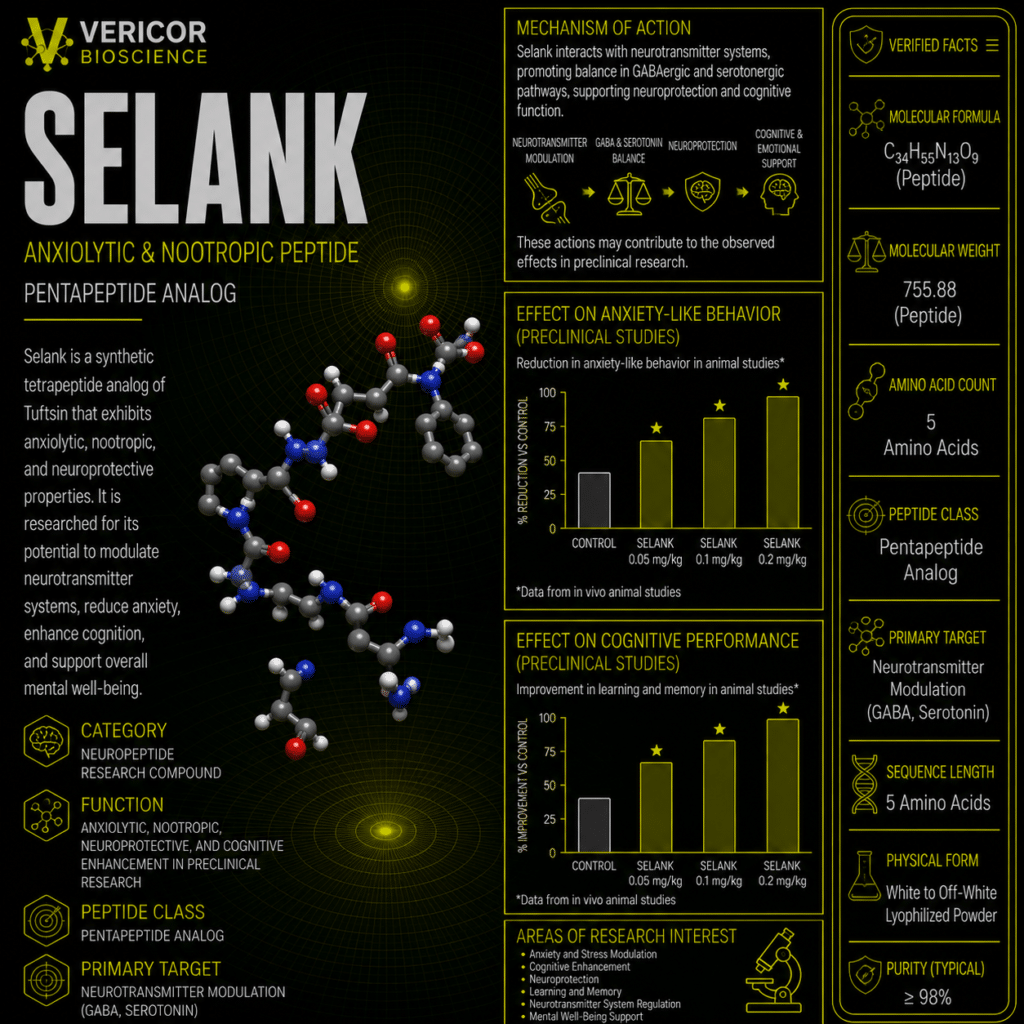
Selank is an experimental peptide that has gained attention in the United States through online discussions about anxiety, stress, cognition, mood, and mental performance. However, the strength of the claims often exceeds the strength of the evidence. Although several laboratory and small human studies are interesting, Selank is not an FDA-approved treatment for anxiety, depression, cognitive impairment, or any other medical condition.
From an evidence-review perspective, Selank is best understood as a research compound rather than an established therapy. Most published research comes from Russia, and much of it involves animals, laboratory models, small participant groups, short observation periods, or combination treatments. Therefore, readers should distinguish early scientific findings from confirmed clinical benefits.
This guide explains what Selank is, how researchers believe it may work, what human studies have reported, what remains unknown, and what United States researchers should consider when evaluating Selank materials.
Featured Definition: What Is Selank?
Selank is a synthetic seven-amino-acid peptide derived from a fragment of tuftsin, a naturally occurring immune-related peptide. Researchers have studied its possible effects on anxiety, stress signaling, neurotransmitters, immune activity, and cognition. However, its effectiveness, standardized dosage, long-term safety, and therapeutic value remain unconfirmed in large U.S. clinical trials.
Table of Contents
- What Selank Is
- How Selank Was Developed
- How Selank May Work
- Selank and Anxiety Research
- Selank and Cognitive Research
- Human Evidence and Its Limitations
- Selank Versus Approved Anxiety Treatments
- Selank Safety and Unknown Risks
- Selank’s United States Regulatory Status
- How to Evaluate Selank Research Quality
- Research Material Evaluation Checklist
- People Also Ask About Selank
- Expert Selank Q&A
- Conclusion
What Is Selank?
Selank is a short synthetic peptide made from seven amino acids:
Threonine–lysine–proline–arginine–proline–glycine–proline
It is also written as Thr-Lys-Pro-Arg-Pro-Gly-Pro or TKPRPGP.
The peptide was developed from a sequence related to tuftsin. Tuftsin is a naturally occurring tetrapeptide involved in certain immune functions. Researchers modified the original sequence by adding a proline-glycine-proline segment, which was intended to improve stability and influence biological activity.
Because Selank contains only seven amino acids, it is classified as an oligopeptide. An oligopeptide is a short chain of amino acids, while larger chains are generally described as polypeptides or proteins.
The FDA’s Global Substance Registration System identifies Selank as a peptide and lists its Unique Ingredient Identifier, or UNII. However, a UNII is an identification code used to standardize substance names. It does not mean the substance has been reviewed or approved as a drug. The FDA’s own UNII service specifically states that the availability of a UNII does not imply regulatory approval.
How Was Selank Developed?
Selank was developed by Russian researchers who were investigating biologically active peptide fragments. It has been described in published studies as an anxiolytic peptide, meaning researchers have examined whether it may reduce anxiety-related behavior or symptoms.
The concept behind Selank differs from that of many conventional anxiety medications. Rather than acting as a direct sedative, it has been proposed to influence several signaling systems associated with stress, emotional regulation, and nervous-system function.
Nevertheless, the historical use or availability of a compound in another country does not establish FDA approval in the United States. Regulatory systems use different standards, submission pathways, manufacturing requirements, and evidence thresholds.
For a medicine to gain FDA approval, its sponsor must normally provide substantial information about:
- Chemical identity
- Manufacturing controls
- Product consistency
- Preclinical toxicology
- Human pharmacology
- Dose selection
- Clinical effectiveness
- Adverse effects
- Contraindications
- Drug interactions
- Long-term safety
- Appropriate labeling
The currently available Selank literature does not represent an FDA approval package.
How May Selank Work?
Selank’s mechanism has not been fully established. Instead, researchers have proposed several possible pathways based on animal experiments, gene-expression studies, biochemical observations, and small human investigations.
These proposed pathways include:
- Gamma-aminobutyric acid signaling
- Serotonin-related signaling
- Brain-derived neurotrophic factor regulation
- Enkephalin activity
- Immune-system modulation
- Stress-response gene expression
- Functional connectivity between brain regions
A proposed mechanism is not the same as a confirmed clinical effect. Biological systems are highly interconnected, so laboratory changes do not always result in noticeable or beneficial outcomes in people.
GABA-related signaling
Gamma-aminobutyric acid, commonly called GABA, is one of the brain’s main inhibitory neurotransmitters. It helps reduce excessive neuronal activity and participates in sleep, relaxation, stress responses, and emotional regulation.
Benzodiazepines, such as certain prescription anxiety medications, enhance signaling through GABA-A receptors. This can reduce anxiety quickly, but it may also cause sedation, impaired coordination, memory problems, tolerance, dependence, and withdrawal symptoms.
Selank has sometimes been described online as acting through the GABA system without the disadvantages associated with benzodiazepines. However, that statement is too definite.
Preclinical findings suggest that Selank may influence the expression of genes associated with GABA-related signaling. Yet the exact receptor activity, effective human exposure, dose-response relationship, and clinical significance remain uncertain.
Therefore, Selank should not be described as a proven non-sedating replacement for benzodiazepines.
Serotonin and emotional regulation
Serotonin participates in mood, sleep, appetite, pain perception, and anxiety regulation. Many FDA-approved medications used for anxiety disorders, including selective serotonin reuptake inhibitors, affect serotonin signaling.
Animal research has suggested that Selank may influence serotonin metabolism under certain conditions. Still, researchers have not shown that it works like an SSRI or produces the same treatment outcomes.
Moreover, neurotransmitter explanations can be oversimplified. Anxiety is not caused by a single chemical imbalance. Genetics, learning, trauma, sleep, physical health, medication use, social conditions, and multiple brain circuits may all contribute.
Brain-derived neurotrophic factor
Brain-derived neurotrophic factor, or BDNF, supports neuronal survival, plasticity, and adaptation. Because BDNF is involved in learning and stress responses, researchers often examine it when studying experimental compounds related to mood or cognition.
Some animal studies have reported changes in BDNF-related activity following Selank exposure. However, a laboratory change in BDNF does not prove that a compound improves memory, treats depression, or protects the human brain.
BDNF levels can also vary with physical activity, sleep, stress, age, illness, and laboratory methodology. Therefore, it should not be treated as a simple measurement of cognitive improvement.
Enkephalins and peptide metabolism
Enkephalins are naturally occurring peptides involved in pain, stress, mood, and other nervous-system processes. Researchers have proposed that Selank may affect enzymes involved in enkephalin breakdown.
This theory is biologically plausible, but its clinical importance remains unclear. It is not yet known whether these effects occur consistently at tolerable exposure levels in humans or whether they translate into meaningful symptom improvement.
Selank and Anxiety Research
Anxiety is the main area associated with Selank research. However, the evidence base is much smaller than the evidence supporting established anxiety treatments.
One published randomized study compared phenazepam alone with phenazepam combined with Selank in people with several anxiety-spectrum conditions. The study included 30 participants receiving phenazepam alone and 40 receiving the combination.
The researchers reported that the combination was associated with an earlier treatment response on one rating scale and lower levels of several phenazepam-related adverse effects. These included attention and memory difficulties, sedation, fatigue, longer sleep duration, sexual disturbances, emotional indifference, and orthostatic symptoms.
The study can be reviewed through the National Library of Medicine Selank anxiety publication.
Although the results are noteworthy, they do not prove that Selank alone is an effective anxiety treatment.
Several limitations matter:
- Selank was used with phenazepam rather than tested only against a placebo.
- The participant groups were small.
- The study involved several diagnostic categories.
- Phenazepam is not approved for medical use in the United States.
- The publication provides limited information compared with a modern large-scale FDA registration trial.
- Long-term outcomes were not established.
- Independent replication is limited.
Consequently, the findings should be viewed as preliminary evidence rather than confirmation of clinical effectiveness.
Does Selank Treat Generalized Anxiety Disorder?
There is not enough high-quality evidence to state that Selank treats generalized anxiety disorder, commonly called GAD.
GAD is a recognized mental health condition involving excessive and difficult-to-control worry. It may also cause restlessness, sleep disturbance, irritability, muscle tension, fatigue, and difficulty concentrating.
In the United States, treatment may include:
- Cognitive behavioral therapy
- Exposure-based therapy
- Selective serotonin reuptake inhibitors
- Serotonin-norepinephrine reuptake inhibitors
- Buspirone
- Other clinician-selected medications
- Sleep, exercise, and stress-management support
Treatment choice depends on symptoms, medical history, other medications, pregnancy status, substance-use history, and patient preference.
Selank has not been shown in large, well-controlled U.S. trials to equal or outperform these options. Therefore, it should not replace professional assessment or evidence-based treatment.
Selank and Brain-Imaging Research
A small human study examined Selank and Semax using resting-state functional magnetic resonance imaging, commonly called resting-state fMRI.
The investigation involved 52 healthy participants. Researchers assessed functional connectivity involving the amygdala and dorsolateral prefrontal cortex before and shortly after administration of Selank, Semax, or placebo.
The amygdala is involved in processing emotionally relevant information, including possible threats. Meanwhile, the dorsolateral prefrontal cortex contributes to working memory, planning, decision-making, and cognitive control.
The researchers reported differences in connectivity between the right amygdala and areas of the right temporal cortex. The complete abstract is available through the PubMed Selank functional-connectivity study.
However, changes in functional connectivity do not automatically demonstrate clinical benefit.
The study:
- Included healthy participants rather than patients with diagnosed anxiety disorders
- Measured effects over a short period
- Focused on imaging outcomes
- Did not establish long-term symptom improvement
- Did not establish a safe therapeutic dosage
- Did not compare Selank with standard U.S. treatments
Brain-imaging findings can help researchers generate hypotheses. Nevertheless, they cannot by themselves prove that a substance treats anxiety, enhances cognition, or improves daily functioning.
Selank and Cognitive Research
Selank is frequently marketed online as a nootropic. A nootropic is generally described as a substance intended to improve cognition, memory, focus, or mental performance.
Yet “nootropic” is not proof of a specific clinical benefit. It is often used broadly in marketing, even when evidence is based mainly on animal studies.
Researchers have examined Selank in relation to:
- Learning
- Memory
- attention
- Stress-related cognitive impairment
- BDNF signaling
- Exploratory behavior
- Emotional learning
- Gene expression in nervous tissue
Some animal studies have reported potentially favorable effects under experimentally induced stress, drug exposure, or memory impairment. However, those models do not replicate the full complexity of human cognitive performance.
For example, a rat completing a maze does not prove that a person will experience better concentration at work. Similarly, reversing experimentally induced memory impairment in an animal does not establish treatment for dementia, attention-deficit/hyperactivity disorder, or age-related cognitive decline.
No large body of replicated U.S. clinical evidence currently supports Selank as a cognitive enhancer for healthy adults.
Selank Evidence by Study Type
| Evidence type | What researchers examine | What it may show | What it cannot establish alone |
|---|---|---|---|
| Laboratory studies | Receptors, enzymes, gene expression and peptide interactions | Possible biological mechanisms | Human effectiveness or real-world safety |
| Animal studies | Anxiety-like behavior, memory tasks and stress responses | Whether a biological signal deserves further study | Reliable treatment effects in people |
| Small human studies | Symptoms, imaging changes or short-term tolerability | Preliminary human activity | Long-term safety or broad effectiveness |
| Combination studies | Selank used with another medication | Possible influence on the combined treatment | Whether Selank works independently |
| Observational reports | Experiences without randomized controls | Possible signals or hypotheses | Cause-and-effect conclusions |
| Large randomized trials | Selank compared with placebo or established care | Stronger estimates of benefit and risk | Final certainty without replication |
| FDA review | Manufacturing, safety, effectiveness and labeling | Whether evidence supports an approved use | Approval cannot be assumed before review |
This evidence hierarchy helps explain why promising early findings should not be presented as medical facts.
Selank Versus Established Anxiety Treatments
| Feature | Selank | FDA-approved anxiety medication | Evidence-based psychotherapy |
| U.S. FDA approval | Not approved | Approved products exist for specific indications | Does not require drug approval |
| Evidence base | Limited and largely preliminary | Multiple controlled trials and regulatory review | Supported by numerous clinical studies |
| Standardized dosage | No FDA-approved dosage | Defined through approved labeling | Delivered through structured treatment plans |
| Product quality | May vary by source and intended use | Manufacturing standards are regulated | Depends on trained provider and treatment fidelity |
| Long-term safety data | Insufficient | Varies by medication but formally evaluated | Generally well characterized |
| Main uncertainty | Whether proposed benefits outweigh unknown risks | Which approved option best fits the patient | Access, cost, engagement and provider availability |
| Role in U.S. care | Experimental research subject | Established clinical option when prescribed | Established clinical option |
This comparison does not mean approved treatments are free of risk. Instead, it shows that they have undergone a more structured evaluation process.
Is Selank a Nootropic, Anxiolytic, or Research Peptide?
Selank may be described by all three terms, but each has limitations.
Research peptide
“Research peptide” is the most accurate description in the United States when the substance is supplied strictly for legitimate laboratory work and is not promoted for human treatment.
Experimental anxiolytic
“Experimental anxiolytic” reflects the research interest in anxiety-related effects. However, the term should not be interpreted as proof that Selank safely treats anxiety.
Nootropic
“Nootropic” reflects claims involving cognition, memory, or mental performance. Still, the term is not a regulatory approval category, and its use can make weak evidence sound stronger than it is.
Clear content should explain the evidence rather than relying on labels.
Selank Safety and Side Effects
The absence of extensive adverse-event reports does not prove that Selank is safe.
A reliable safety profile requires structured studies that enroll enough people, use standardized materials, monitor participants carefully, and continue long enough to detect delayed problems.
Current uncertainties include:
- Short-term adverse effects
- Long-term neurological effects
- Immune reactions
- Allergic responses
- Effects on blood pressure or heart rate
- Interactions with psychiatric medications
- Effects on seizure risk
- Effects during pregnancy or breastfeeding
- Effects in children or older adults
- Effects in people with liver or kidney disease
- Risks associated with repeated intranasal exposure
- Risks from impurities or degradation products
Online sources sometimes list headache, fatigue, dizziness, nasal irritation, or changes in mood as possible effects. However, informal reports cannot establish frequency, cause, severity, or risk factors.
Self-reported experiences are especially difficult to interpret because users may take several compounds at once. Product identity and concentration may also be uncertain.
Why Intranasal Administration Requires Careful Study
Many discussions of Selank involve intranasal administration. This route is attractive to researchers because the nasal cavity is highly vascular and may offer access to systemic circulation.
However, intranasal administration is not automatically safe or effective.
Several factors can influence exposure:
- Formulation pH
- Peptide concentration
- Spray volume
- Droplet size
- Nasal congestion
- Mucosal health
- Preservatives
- Container performance
- Storage conditions
- Degradation during use
A peptide that appears chemically pure may still be unsuitable for intranasal administration. Formulation safety, microbial quality, stability, dosing consistency, and local tissue effects must also be evaluated.
In addition, the amount delivered by a spray device can vary. Therefore, a nominal concentration does not always equal a reliable biological dose.
Peptide Quality Is More Than a Purity Percentage
A label stating “99% purity” does not establish medical safety.
Chromatographic purity usually describes the relative size of detected peaks under a particular test method. It may not fully identify every impurity or measure the amount of active peptide in the container.
A robust research-quality evaluation may include:
- Amino-acid sequence confirmation
- Molecular-mass verification
- High-performance liquid chromatography
- Peptide content
- Counterion content
- Residual solvents
- Water content
- Residual synthesis reagents
- Endotoxin testing
- Bioburden testing
- Stability data
- Container-closure compatibility
- Lot-specific traceability
The appropriate tests depend on the study. For example, an analytical experiment and an animal study may require different controls.
Selank’s Regulatory Status in the United States
Selank is not listed as an FDA-approved medication for anxiety, cognitive enhancement, depression, post-traumatic stress disorder, or another therapeutic use.
The FDA’s Orange Book identifies drug products approved on the basis of safety and effectiveness under federal law. Selank does not appear as an approved drug product in that system. Readers can learn how approved drugs are cataloged through the FDA Orange Book overview.
Selank does have an FDA substance identifier. Nevertheless, the FDA clearly explains that a UNII identifies a substance and does not imply that the agency has approved it.
This distinction is essential:
- Substance registration standardizes identity.
- Drug approval evaluates safety, effectiveness, manufacturing and labeling for a specific use.
- Clinical-trial registration records a study but does not approve a treatment.
- Research-use labeling describes intended laboratory use but does not override actual marketing or distribution practices.
Administrative or compliance decisions should be reviewed by qualified regulatory professionals or legal counsel. This article provides general educational information, not legal advice.
Compounded Products and FDA Review
Some consumers assume that a compounded product is FDA-approved because it is prepared by a pharmacy. That is not correct.
FDA states that compounded drugs are not FDA-approved. Therefore, the agency does not review each compounded product for safety, effectiveness, or quality before it is marketed. Poor compounding practices can also cause contamination, incorrect strength, or other serious quality problems.
This general rule does not mean that every compounded product is defective. Compounding can meet an important clinical need when an approved product cannot meet a particular patient’s needs.
However, it does mean that “compounded” should not be used as a synonym for “FDA-approved,” “proven,” or “risk-free.”
Research Use and Human-Use Claims
A research-use-only statement should be supported by the actual way a product is presented and distributed.
In 2026, an FDA warning letter explained that research disclaimers did not prevent products from being treated as unapproved drugs when website claims and surrounding evidence showed an intended human use. The letter also emphasized the additional risks associated with injectable products.
Therefore, researchers and businesses should avoid:
- Disease-treatment promises
- Dosage instructions for consumers
- Human administration guidance
- Before-and-after therapeutic claims
- Guaranteed cognitive or emotional outcomes
- Statements implying FDA approval
- Bundling practices that suggest unapproved administration
Compliance involves more than adding a disclaimer. It includes intended use, marketing language, customer communications, labeling, and distribution practices.
Nine-Point Selank Research Evaluation Checklist
Researchers can use this checklist when evaluating Selank for controlled laboratory investigation.
- Define the research questionSpecify whether the project examines receptor activity, gene expression, stability, analytical identity, cellular effects, or another measurable endpoint.
- Choose the correct research modelCell, tissue, animal, and analytical models have different requirements. Do not assume that findings from one model apply directly to people.
- Confirm the peptide sequenceVerify that the supplied material corresponds to Thr-Lys-Pro-Arg-Pro-Gly-Pro and that the documentation identifies the relevant chemical form.
- Review lot-specific documentationA certificate of analysis should identify the batch number, testing date, methods, specifications, and actual results.
- Confirm molecular identityMass spectrometry or another suitable method can help confirm molecular mass. Chromatography alone may not fully establish identity.
- Evaluate impurity controlsReview residual solvents, synthesis-related impurities, counterions, water content, and peptide concentration where relevant.
- Establish storage proceduresPeptides may degrade through heat, moisture, oxidation, light exposure, contamination, or repeated temperature changes.
- Use suitable controlsInclude a vehicle control, untreated control, positive control, or reference standard as required by the study design.
- Report limitations honestlyState whether results are mechanistic, preclinical, exploratory, or clinically validated. Avoid converting laboratory findings into treatment promises.
How to Read Selank Studies Critically
Check the participant population
Healthy volunteers and patients with anxiety disorders are not interchangeable. A measurable brain-imaging change in healthy adults may not predict symptom improvement in patients.
Examine the comparison treatment
A study of Selank added to another drug does not establish whether Selank works independently. In addition, results involving a medication not approved in the United States may have limited relevance to current U.S. practice.
Review sample size
Small studies may produce unstable estimates. They may also fail to detect uncommon adverse effects or differences between participant groups.
Evaluate the outcome
A change in a biomarker, gene, scan, or laboratory measurement does not automatically mean that participants feel better or function better.
Clinical relevance may require improvements in:
- Anxiety symptoms
- Sleep
- Social functioning
- Work performance
- Quality of life
- Relapse rates
- Need for additional treatment
Consider treatment duration
Anxiety conditions may continue for months or years. Therefore, a short experiment cannot establish sustained benefit or long-term safety.
Look for independent replication
Evidence becomes more credible when independent research teams reproduce the result using transparent methods and adequately powered studies.
Examine conflicts of interest
Funding or intellectual-property interests do not automatically invalidate a study. However, they should be disclosed and considered when interpreting conclusions.
Common Selank Claims Versus Current Evidence
| Common online claim | Balanced evidence-based interpretation |
| “Selank eliminates anxiety” | Small studies suggest possible anxiolytic activity, but large U.S. trials have not confirmed this claim. |
| “Selank works immediately” | Some research measured short-term changes, but a predictable clinical onset has not been established. |
| “Selank improves memory” | Mainly preclinical findings support this idea; convincing human cognitive evidence is limited. |
| “Selank has no side effects” | The safety database is too small to confirm the absence of important adverse effects. |
| “Selank is safer than benzodiazepines” | Direct, adequately powered comparative evidence is lacking. |
| “Selank balances GABA” | GABA-related mechanisms are proposed, but this phrase oversimplifies uncertain biology. |
| “Selank is FDA registered” | A substance identifier is not FDA drug approval. |
| “High purity makes it safe” | Purity does not establish sterility, stability, dosing accuracy or human safety. |
People Also Ask About Selank
No. Selank is not an FDA-approved drug for anxiety, cognitive enhancement, depression, or another therapeutic use. An FDA substance identifier may exist, but the agency states that a UNII does not imply regulatory review or approval.
Researchers have examined Selank for possible effects on anxiety-related behavior, stress signaling, neurotransmitter systems, immune activity, and cognition. However, these proposed effects have not been confirmed through a large body of rigorous U.S. clinical evidence.
No. Selank is a seven-amino-acid synthetic peptide, while benzodiazepines are a class of small-molecule prescription drugs. Although both have been studied in relation to anxiety, they differ in chemical structure, regulatory status, evidence base, and known pharmacology.
Animal and laboratory studies have generated interest in cognitive effects. Nevertheless, there is insufficient high-quality human evidence to claim that Selank reliably improves focus, learning, or memory in healthy adults.
Its complete safety profile is unknown. Small studies and informal reports cannot establish long-term neurological, immune, reproductive, psychiatric, or interaction risks.
Expert Selank Q&A
1. Does Selank cross the blood-brain barrier?
Researchers have proposed central nervous system activity, and human imaging studies suggest short-term changes associated with brain functional connectivity. However, the exact absorption, distribution, metabolism, and brain exposure of different Selank formulations have not been fully characterized in robust modern human pharmacokinetic studies.
2. Can Selank be taken with antidepressants?
Reliable interaction data are insufficient. Because Selank may affect nervous-system signaling, combining it with antidepressants, sedatives, stimulants, or other psychiatric drugs could create unpredictable effects. Experimental use should not replace clinician-supervised care.
3. Is Selank addictive?
Published literature has not established a conventional dependence profile comparable with benzodiazepines. However, the available evidence is too limited to rule out tolerance, psychological reliance, withdrawal-like effects, or problems arising from repeated unsupervised use.
4. What would be needed for FDA approval of Selank?
A sponsor would need a defined formulation, controlled manufacturing process, validated quality tests, preclinical safety information, human pharmacokinetic studies, dose-ranging trials, and adequately powered clinical trials. The FDA would then assess whether the benefits outweigh the risks for a specific proposed use.
5. Why do online Selank experiences differ so much?
Reported experiences may differ because of expectations, placebo effects, product quality, concentration, route of exposure, other medications, underlying health conditions, and inconsistent labeling. Without controlled testing, it is often impossible to know whether an effect came from Selank, another substance, or normal symptom variation.
Selank vs. Semax: Comparing Two Russian-Developed Research Peptides
Selank and Semax are both synthetic peptides that emerged from Russian pharmacological research, and they’re commonly discussed side by side. Selank is a synthetic analog of tuftsin, a naturally occurring immunomodulatory peptide, and preclinical studies have examined its potential anxiolytic-type effects and influence on GABAergic activity in animal models. Semax, derived from a fragment of ACTH, has instead been studied mainly for effects tied to BDNF expression and cognitive-performance research models.
The two peptides are sometimes grouped together because of their shared Russian research origin, not because they work the same way: Selank’s research base leans anxiolytic and immune-related, while Semax’s leans cognitive and neurotrophic. Neither is FDA-approved, and neither has established safety or effectiveness data in humans. See our full Semax research guide for more on its studied mechanisms.
Conclusion
Selank is a scientifically interesting peptide with proposed effects involving anxiety, stress responses, neurotransmitter signaling, brain connectivity, immune processes, and cognition.
However, scientific interest should not be confused with confirmed medical value.
Small human investigations have reported anxiety-related and neuroimaging findings. Preclinical studies have also identified possible effects involving GABA-related signaling, serotonin, BDNF, enkephalins, gene expression, and stress adaptation.
Nevertheless, important gaps remain.
Selank has not been validated through a large body of independent, adequately powered U.S. clinical trials. Researchers have not established an FDA-approved dosage, standardized formulation, complete interaction profile, long-term safety record, or proven therapeutic advantage over established anxiety treatments.
Furthermore, a substance’s presence in an FDA identification database does not mean it is an approved medicine. Product quality also cannot be established through a purity percentage alone. Identity, concentration, impurities, stability, traceability, handling conditions, and study-specific requirements all matter.
Responsible Selank content should therefore avoid promises of anxiety relief, improved memory, sharper focus, or risk-free use. Instead, it should explain the type of evidence, acknowledge uncertainty, and maintain a clear distinction between laboratory research and medical treatment.
Qualified investigators conducting controlled laboratory studies can review Selank research product details from Vericor Bioscience. Any material should be evaluated according to the project’s analytical requirements, institutional policies, and applicable United States research standards. It should not be represented as an FDA-approved treatment or a substitute for professional mental health care.