
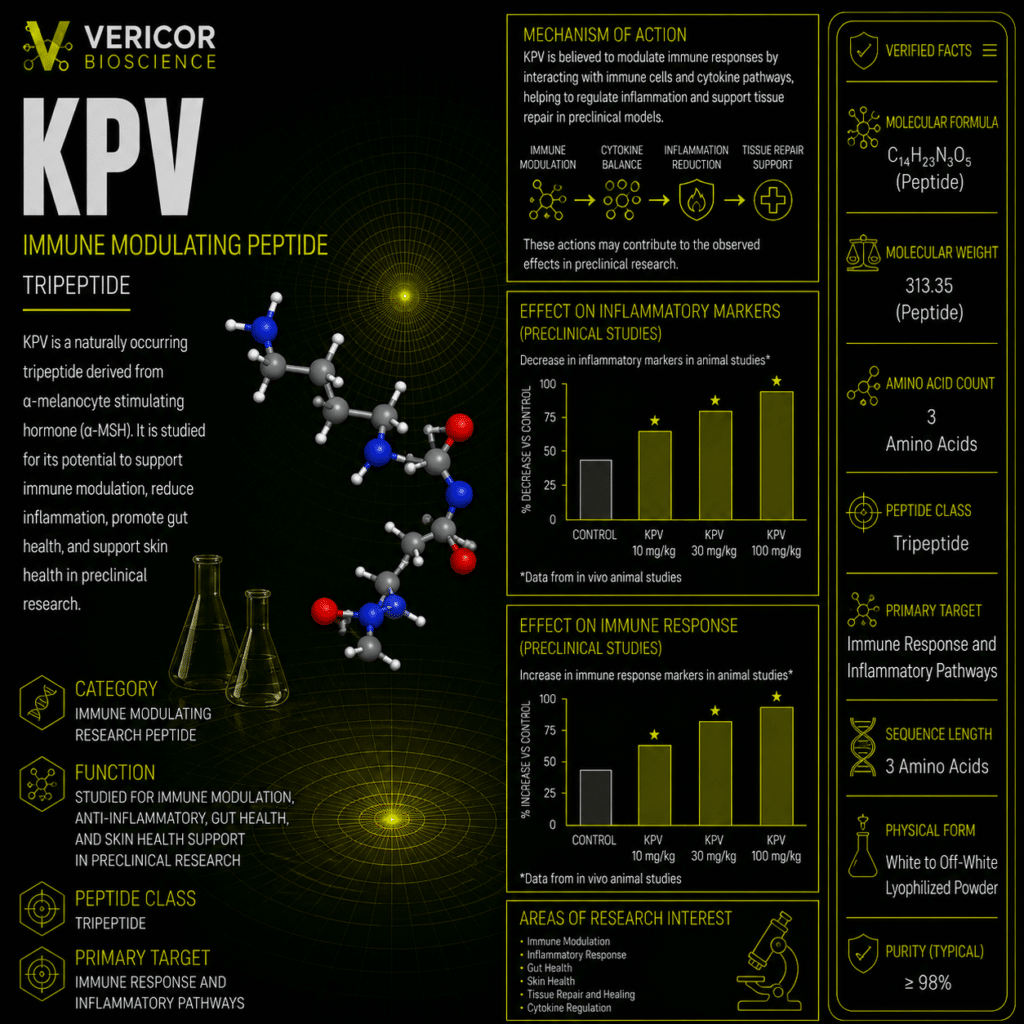
KPV is a short peptide that has attracted interest in the United States because laboratory and animal studies suggest possible anti-inflammatory activity. Online discussions often connect it with intestinal inflammation, skin health, wound healing, and immune regulation. However, the available evidence remains largely preclinical, and KPV is not an FDA-approved treatment for any disease or medical condition.
When reviewing KPV, the most important step is separating early scientific findings from proven human benefits. Laboratory research can identify promising biological effects, but it cannot establish that a substance is safe, effective, or appropriately dosed for patients. Therefore, this article focuses on what researchers have studied, what remains unknown, and how U.S. readers can evaluate peptide-related claims responsibly.
Featured definition: What is KPV?
KPV is a three-amino-acid peptide made of lysine, proline, and valine. It forms the final portion of alpha-melanocyte-stimulating hormone, or alpha-MSH. Laboratory and animal studies suggest anti-inflammatory activity, but KPV is not an FDA-approved medication, and reliable human safety, dosing, and effectiveness data remain limited.
Table of Contents
- What KPV is
- Where the KPV peptide comes from
- How KPV may influence inflammation
- KPV and NF-kappa B signaling
- KPV research involving intestinal inflammation
- KPV research involving skin and wound healing
- Antimicrobial research
- Laboratory evidence versus human evidence
- Current U.S. regulatory status
- KPV products compared
- Evidence-review checklist
- Safety concerns and unanswered questions
- People Also Ask about KPV
- Expert KPV Q&A
- Conclusion
What Is KPV?
KPV is the common name for the tripeptide Lys-Pro-Val. “Tripeptide” means it contains three amino acids linked together:
- Lysine, abbreviated K
- Proline, abbreviated P
- Valine, abbreviated V
These amino acids form the C-terminal sequence of alpha-melanocyte-stimulating hormone, commonly shortened to alpha-MSH. The C-terminal sequence is the end portion of a peptide or protein chain.
Alpha-MSH is part of the melanocortin system, a biological signaling network associated with pigmentation, energy balance, immune activity, inflammation, and other physiological processes. Researchers became interested in KPV after observing that this short fragment appeared to retain some anti-inflammatory properties associated with the larger alpha-MSH molecule.
Importantly, KPV does not appear to produce all the same biological effects as full-length alpha-MSH. For example, published reviews describe KPV as having anti-inflammatory potential without the pigment-producing effect normally associated with alpha-MSH. This distinction is one reason scientists have examined KPV as a possible research candidate for inflammatory conditions.
However, “research candidate” does not mean “approved therapy.” A potential biological mechanism is only the beginning of the drug-development process.
Where Does the KPV Peptide Come From?
KPV is derived conceptually from amino acids 11 through 13 of alpha-MSH. It is not a vitamin, mineral, hormone replacement, or dietary protein.
In scientific studies, researchers may produce KPV through peptide synthesis. Synthetic peptide production involves joining amino acids in a controlled sequence and then purifying and characterizing the resulting substance.
That process sounds straightforward because KPV contains only three amino acids. Nevertheless, the quality of a research peptide depends on several variables, including:
- Correct amino-acid sequence
- Chemical identity
- Purity
- Water content
- Residual solvents
- Counterions or salt form
- Peptide degradation
- Microbial contamination
- Endotoxin levels
- Storage conditions
- Analytical testing methods
A label that says “KPV” does not independently confirm these characteristics. In addition, a certificate of analysis is only meaningful when the methods, laboratory credentials, sample identity, acceptance limits, and test dates can be verified.
For this reason, chemical simplicity should not be confused with clinical safety.
Why Are Researchers Studying KPV?
Most KPV research focuses on inflammation.
Inflammation is a normal defense process that helps the body respond to injury, infection, or harmful stimuli. However, prolonged or poorly regulated inflammation can contribute to tissue damage and chronic disease.
Researchers have examined whether KPV can influence inflammatory signals produced by epithelial cells, immune cells, or damaged tissues. Epithelial cells form protective surfaces in areas such as the skin, respiratory tract, and intestinal lining.
Some experimental findings suggest that KPV may:
- Reduce the production of selected inflammatory mediators
- Influence nuclear factor kappa B signaling
- Affect inflammatory activity in epithelial cells
- Interact with peptide transport systems
- Reduce inflammation in certain animal models
- Support investigation into targeted peptide-delivery systems
Nevertheless, each of these findings must be interpreted within its specific experimental design. A result in cultured cells cannot automatically be applied to an oral, injectable, nasal, or topical product used by a person.
How Might KPV Influence Inflammation?
Inflammation is controlled through complex signaling pathways rather than one simple on-and-off switch.
One pathway frequently discussed in KPV research is nuclear factor kappa B, usually written as NF-kappa B or NF-κB. This group of proteins helps regulate genes involved in inflammation, immune responses, cell survival, and stress signaling.
When inflammatory signals activate a cell, NF-kappa B proteins may move into the cell nucleus. The nucleus contains DNA and controls the expression of many genes. Once active in the nucleus, NF-kappa B can help increase the production of inflammatory molecules such as cytokines and chemokines.
Experimental research suggests KPV may interfere with parts of this signaling process under certain laboratory conditions. In one airway-epithelium study, researchers reported that KPV suppressed NF-kappa B signaling by interfering with the nuclear import of a protein called p65RelA.
This finding is biologically interesting. However, it does not show that KPV improves asthma, chronic obstructive pulmonary disease, inflammatory bowel disease, dermatitis, or another condition in humans.
Why mechanism does not equal treatment
A substance may affect an inflammatory pathway in a laboratory and still fail as a medicine because of:
- Poor absorption
- Rapid breakdown
- Inadequate tissue exposure
- Unexpected toxicity
- Immune reactions
- Off-target activity
- Unstable formulation
- Differences between animal and human biology
- Lack of clinically meaningful benefit
Therefore, mechanism-based claims should be presented as hypotheses supported by experimental evidence, not as proof of therapeutic effectiveness.
KPV and NF-Kappa B Signaling
NF-kappa B appears frequently in marketing claims for anti-inflammatory supplements and peptides. However, reducing one laboratory marker is not the same as treating a disease.
NF-kappa B is involved in normal immune defense as well as harmful inflammation. Completely or indiscriminately suppressing immune signaling could create risks. In addition, scientists must determine whether any observed effect is strong enough, selective enough, and sustained long enough to matter clinically.
For KPV, researchers have proposed several possible mechanisms:
- Interference with NF-kappa B nuclear transport
- Reduction of inflammatory cytokine signaling
- Uptake through the peptide transporter PepT1
- Effects that may not require the melanocortin-1 receptor
- Local activity within epithelial tissues
These mechanisms remain areas of scientific investigation.
Published research has also indicated that KPV’s activity may not depend entirely on the same receptors used by full-length alpha-MSH. That finding matters because a small peptide fragment may behave differently from the parent hormone.
Still, researchers have not established a complete human pharmacology profile for KPV.
KPV Research and Intestinal Inflammation
A significant portion of KPV research relates to the gastrointestinal tract, especially experimental colitis.
Colitis means inflammation of the colon. Human inflammatory bowel diseases include ulcerative colitis and Crohn’s disease. These are serious, chronic conditions that require professional diagnosis and evidence-based treatment.
The role of PepT1
One reason KPV has been investigated in intestinal models involves peptide transporter 1, known as PepT1.
PepT1 normally helps transport small peptides across cell membranes. Research has reported increased PepT1 expression in colonic epithelial cells during chronic intestinal inflammation. Scientists have studied whether this transporter could help deliver KPV into inflamed cells.
In theory, targeted uptake could allow a small peptide to influence inflammatory signaling within intestinal tissue. However, several practical questions remain:
- How much KPV survives digestion?
- Does it reach the intended part of the intestine?
- What concentration enters the cells?
- How long does it remain active?
- Does the delivery system change its safety?
- Are animal results reproducible in humans?
Researchers have explored specialized delivery systems because free peptide solutions may be unstable. For example, a rat study tested a hydrogel designed to improve KPV retention and delivery in experimental colitis. The authors noted that KPV solution alone was unstable when administered rectally, which could limit effectiveness.
This detail is important. It shows why a promising molecule cannot automatically be turned into an effective medicine without formulation research.
What animal studies can tell us
Animal studies can help researchers:
- Identify possible mechanisms
- Compare treated and untreated tissue
- Evaluate inflammation markers
- Explore preliminary toxicity
- Test delivery methods
- Generate hypotheses for later trials
However, animal models do not perfectly reproduce human inflammatory bowel disease.
Mice and rats differ from humans in metabolism, immune responses, microbiomes, body size, and disease development. Furthermore, researchers may chemically induce colitis in animals, while human inflammatory bowel disease involves genetics, immune dysregulation, environmental factors, and other complex influences.
Therefore, KPV should not be described as a proven ulcerative colitis or Crohn’s disease treatment.
Can KPV Treat Ulcerative Colitis?
Current published evidence does not establish KPV as an effective or FDA-approved ulcerative colitis treatment.
Experimental studies have reported anti-inflammatory effects in animal models. However, these findings do not replace controlled human trials comparing KPV with placebo or standard treatment.
A reliable clinical-development program would need to examine:
- Patient eligibility
- Disease severity
- Route of administration
- Product formulation
- Dose selection
- Treatment duration
- Endoscopic findings
- Symptom improvement
- Remission rates
- Laboratory markers
- Adverse events
- Long-term relapse
- Drug interactions
Until those questions are addressed through adequate clinical studies, patients should not replace prescribed inflammatory bowel disease medications with KPV.
Untreated or poorly controlled ulcerative colitis can lead to bleeding, anemia, hospitalization, severe colon inflammation, and other complications. Consequently, treatment changes should be reviewed by a gastroenterologist.
KPV Research and Skin Inflammation
KPV has also been discussed in connection with skin inflammation and wound healing.
The skin is both a physical barrier and an active immune organ. When skin is injured, cells release signals that coordinate inflammation, tissue repair, blood-vessel formation, and remodeling.
Too little inflammation can impair defense against infection. In contrast, excessive or prolonged inflammation may delay healing or contribute to chronic wounds.
Researchers have proposed that alpha-MSH-derived peptides such as KPV could become candidates for future skin and wound studies. A scientific review described KPV and related peptides as promising experimental candidates but emphasized the need for further in vitro, ex vivo, animal, and clinical research.
Areas that require more evidence
Claims involving the following conditions should be approached carefully:
- Eczema
- Psoriasis
- Rosacea
- Acne
- Skin ulcers
- Surgical wounds
- Burns
- Diabetic wounds
- Cosmetic irritation
- Scar reduction
Different conditions have different causes. For example, psoriasis involves immune-mediated skin-cell turnover, while acne involves follicular blockage, oil production, bacteria, and inflammation. A general anti-inflammatory laboratory result does not prove benefit for every inflammatory skin problem.
In addition, topical effectiveness depends on whether a peptide can penetrate the outer skin barrier. Product pH, molecular stability, vehicle, preservatives, concentration, and storage can all influence performance.
Does KPV Promote Wound Healing?
There is not enough reliable human evidence to conclude that KPV accelerates wound healing.
Laboratory findings may justify further investigation, but wound healing is a clinically complex outcome. Researchers must consider wound size, depth, blood supply, infection, diabetes, nutrition, smoking, medication use, and immune function.
A product could reduce one inflammatory marker without improving wound closure. In fact, excessive suppression of inflammation could theoretically interfere with the early stages of normal repair.
Human wound studies would need standardized measurements such as:
- Time to complete closure
- Reduction in wound area
- Infection rate
- Pain
- Tissue quality
- Recurrence
- Scarring
- Adverse reactions
Until well-designed trials are available, claims that KPV “heals wounds” should be treated as unproven.
KPV and Antimicrobial Research
Some laboratory studies have examined KPV and related melanocortin peptides for antimicrobial activity.
Antimicrobial activity means the ability to inhibit or kill microorganisms under specific test conditions. Researchers may test peptides against bacteria or fungi in laboratory cultures.
One study investigated KPV and related peptides against bacterial species. The authors reported antimicrobial observations, although the research did not establish KPV as an approved antibiotic or infection treatment.
Another study examined a modified peptide called (CKPV)2 in laboratory and animal models involving Candida albicans. That compound is structurally different from ordinary KPV, so its findings should not be attributed directly to all KPV products.
Why antimicrobial claims require caution
Laboratory antimicrobial results may not translate into successful treatment because:
- The required concentration may be too high
- The peptide may break down in the body
- Blood proteins may reduce its activity
- It may not reach the infection site
- It may damage human cells
- The organism may respond differently in living tissue
- The formulation may not remain stable
Furthermore, infections require accurate diagnosis. A red or painful skin area could involve bacteria, fungi, viruses, allergy, inflammation, or another cause.
Replacing approved antimicrobial treatment with an unproven peptide could delay care and allow an infection to worsen.
KPV Evidence: Laboratory, Animal, and Human Research Compared
| Evidence level | What it can show | What it cannot prove | Current KPV picture |
|---|---|---|---|
| Chemical analysis | Identity, purity, molecular characteristics | Human safety or clinical benefit | Analytical testing is possible, but product quality may vary |
| Cell-culture studies | Effects on cells and signaling pathways | Whole-body effectiveness | Anti-inflammatory mechanisms have been reported |
| Animal studies | Biological activity in living models | Reliable human outcomes | Experimental colitis and inflammation findings exist |
| Early human studies | Preliminary tolerability or biological effects | Broad safety or established effectiveness | Publicly established evidence is limited |
| Randomized clinical trials | Comparative safety and effectiveness | Every long-term or rare outcome | Robust trials are still needed |
| FDA approval | Agency review of a defined product for a defined use | Suitability for every patient | KPV is not an FDA-approved drug |
The evidence hierarchy matters because stronger health claims require stronger evidence.
A cell-culture result may support wording such as “KPV was associated with reduced inflammatory signaling in a laboratory model.” It does not support wording such as “KPV treats inflammation in humans.”
Is KPV FDA Approved?
No FDA-approved KPV drug has been established for treating inflammation, intestinal disease, wounds, skin disorders, infections, or another medical condition.
In July 2026, the FDA’s Pharmacy Compounding Advisory Committee considered KPV free base and KPV acetate in relation to the federal 503A Bulks List. The reviewed proposed uses involved wound healing and inflammatory conditions.
This review should not be misunderstood as approval of KPV.
The 503A Bulks List process concerns whether specific bulk drug substances may be eligible for use in certain compounded preparations under defined conditions. It is different from FDA approval of a finished drug through a New Drug Application.
An advisory committee also provides recommendations to the FDA. Committee consideration or voting does not independently create an approved medication.
Readers can review the FDA’s July 2026 KPV compounding meeting materials for the latest publicly posted federal context.
What FDA approval normally involves
For a new prescription drug, developers generally must provide evidence covering:
- Product identity and manufacturing
- Formulation
- Stability
- Nonclinical toxicology
- Human pharmacology
- Clinical effectiveness
- Adverse effects
- Dose selection
- Drug interactions
- Labeling
- Quality controls
- Manufacturing inspections
A research peptide sold online has not necessarily passed through this process.
FDA Approval vs. Compounding vs. Research Use
These categories are often confused in peptide discussions.
| Category | FDA-approved finished drug? | Intended status | Main consideration |
| FDA-approved medication | Yes | Used for specific labeled indications | Reviewed for quality, safety, and effectiveness |
| Legally compounded preparation | No | Prepared for qualifying patient-specific needs under applicable law | Not FDA approved and not reviewed like a commercial drug |
| Bulk research peptide | No | Laboratory or analytical research | Not intended as a patient medication |
| “Research use only” product | No | Nonclinical research | Should not be used on or in humans |
| Unverified online product | Unknown | Marketing may be unclear | Identity, purity, sterility, and legality may be uncertain |
Compounding does not convert KPV into an FDA-approved drug.
Moreover, a compounded drug is not a generic version of an approved product unless an approved reference product and the relevant regulatory requirements exist. KPV does not have an FDA-approved drug counterpart that establishes a standard clinical label, dose, or indication.
KPV Free Base and KPV Acetate
KPV may be described as free base or KPV acetate.
These terms refer to different chemical forms. An acetate form includes acetate as a counterion, while the free-base form does not use that same salt association.
The distinction may affect:
- Molecular weight calculations
- Solubility
- pH
- Stability
- Manufacturing specifications
- Analytical results
- Formulation behavior
Therefore, milligram amounts may not always represent the same amount of active peptide across different chemical forms unless calculations and specifications are clear.
The FDA’s 2026 committee materials treated KPV free base and KPV acetate as separate bulk drug substances for voting purposes.
This is another reason consumers should not rely on simplistic comparisons between online products.
Is KPV Safe?
The safety of KPV for routine human use has not been adequately established through large, controlled clinical trials.
Online claims sometimes argue that KPV must be safe because it consists of only three amino acids or is derived from a naturally occurring hormone fragment. That reasoning is incomplete.
Natural origin does not guarantee safety. Biological activity is one of the reasons peptides are studied in the first place.
Potential concerns may include:
- Allergic reactions
- Immune responses
- Local irritation
- Infection from nonsterile products
- Endotoxin exposure
- Incorrect concentration
- Chemical impurities
- Degradation products
- Unexpected interactions
- Effects on normal immune signaling
- Unknown pregnancy risks
- Unknown long-term effects
The risk profile may also change by route of exposure. A topical product, swallowed product, nasal product, and injection cannot be assumed to have the same safety profile.
Injection creates additional risks
Injectable products must meet stringent quality requirements because they bypass many of the body’s external defenses.
Potential injection-related risks include:
- Bacterial contamination
- Fungal contamination
- Endotoxins
- Particles
- Incorrect pH
- Incorrect concentration
- Tissue injury
- Abscesses
- Bloodstream infection
A document labeled “certificate of analysis” does not prove that a finished vial is sterile, appropriately formulated, or safe for injection.
Can KPV Interact With Medications?
Reliable interaction studies for KPV are limited.
The absence of documented interactions does not prove that interactions do not exist. It may simply mean that adequate studies have not been conducted.
Extra caution may be appropriate for people using:
- Immunosuppressive medications
- Biologic drugs
- Corticosteroids
- Anti-inflammatory medicines
- Anticoagulants
- Cancer treatments
- Drugs with narrow therapeutic ranges
- Treatments for inflammatory bowel disease
- Medications affecting wound healing
A clinician or pharmacist should review the complete medication list, including supplements and nonprescription products.
Patients should not stop an approved treatment in order to try KPV. Sudden withdrawal of steroids, immunosuppressants, or other prescription medications can be dangerous.
Who Should Avoid Self-Experimentation With KPV?
Because reliable human safety data are limited, self-experimentation is especially concerning for:
- Pregnant people
- People trying to become pregnant
- Breastfeeding individuals
- Children and adolescents
- People with autoimmune disease
- Organ-transplant recipients
- People receiving cancer treatment
- Individuals with severe allergies
- People with active infections
- Patients awaiting surgery
- People with liver or kidney disease
- Anyone using multiple prescription drugs
This list is not exhaustive. Furthermore, uncertainty is higher when product identity and manufacturing conditions cannot be independently verified.
How to Evaluate a KPV Research Claim
Use this numbered checklist before accepting a KPV claim online.
- Identify the evidence type.
Determine whether the claim comes from a chemical test, cell study, animal study, case report, or controlled human trial. - Check the actual substance.
Confirm whether researchers studied KPV, KPV acetate, a modified peptide, or a delivery system containing KPV. - Review the route of administration.
Oral, topical, rectal, nasal, and injectable routes cannot be treated as equivalent. - Look for a human comparison group.
Testimonials and uncontrolled observations cannot reliably separate treatment effects from natural changes or placebo effects. - Check the outcome measured.
A change in one inflammatory marker does not necessarily improve symptoms, healing, disease activity, or quality of life. - Review study size and duration.
Small or short studies may miss uncommon and long-term risks. - Search for replication.
One positive study is less convincing than repeated findings from independent research teams. - Check for FDA approval.
Compounding discussion, patent applications, and research availability are not FDA approval. - Watch for guaranteed language.
Claims such as “cures inflammation,” “heals the gut,” or “works without side effects” are not supported. - Discuss the claim with a qualified professional.
A physician, pharmacist, or relevant specialist can help place early evidence in the context of established care.
Common Warning Signs in KPV Marketing
Be cautious when a website:
- Presents animal research as proven human treatment
- Claims KPV cures multiple unrelated diseases
- Provides universal dosing instructions
- Encourages injection without medical supervision
- Calls a product FDA approved without an approved drug record
- Uses testimonials as primary evidence
- Hides the manufacturer or testing laboratory
- Does not clarify whether the material is for research
- Guarantees results
- Claims “no side effects”
- Encourages stopping prescription treatment
- Uses the term “clinical grade” without defining a recognized standard
Trustworthy educational content should acknowledge uncertainty and explain evidence limits.
What Do Published KPV Studies Actually Support?
Published studies support the conclusion that KPV is scientifically interesting.
Researchers have reported:
- Anti-inflammatory effects in selected laboratory systems
- Reduced inflammatory signaling in airway epithelial research
- Activity in animal colitis models
- Possible uptake through PepT1
- Interest in targeted intestinal delivery
- Potential investigation in skin and wound models
- Preliminary antimicrobial observations
Readers can examine a PubMed-indexed study on KPV and airway inflammatory signaling and a PubMed-indexed overview of experimental KPV-related wound research to see how scientists frame these findings.
However, the literature does not justify claiming that KPV:
- Cures inflammatory bowel disease
- Replaces approved ulcerative colitis drugs
- Treats eczema or psoriasis
- Reliably accelerates wound closure
- Eliminates infections
- Is safe for injection
- Has a proven human dosage
- Produces guaranteed anti-inflammatory effects
That distinction is central to responsible KPV content.
People Also Ask About KPV
KPV represents the amino acids lysine, proline, and valine. It is a three-amino-acid fragment located at the end of the naturally occurring peptide alpha-MSH.
No. KPV is not an FDA-approved medication for inflammation, gut disorders, wound healing, skin disease, infection, or another medical condition. FDA discussion of KPV in a compounding context does not equal drug approval.
Researchers have studied KPV in laboratory and animal models involving inflammatory signaling, experimental colitis, airway epithelial inflammation, skin biology, wound healing, and antimicrobial activity. Human clinical evidence remains limited.
No. KPV is a three-amino-acid fragment from the C-terminal end of alpha-MSH. It may retain selected biological properties, but it is not the complete alpha-MSH hormone.
Animal and cell studies have explored KPV in intestinal inflammation. However, there is not enough reliable human evidence to recommend it as a treatment for ulcerative colitis, Crohn’s disease, or nonspecific digestive symptoms.
Expert KPV Q&A
1. Why is a three-amino-acid peptide still biologically active?
Small peptides can interact with transport proteins, receptors, enzymes, or cellular signaling machinery. Their small size does not prevent biological activity, although it may affect stability, absorption, and duration of action.
2. Why do KPV studies use specialized delivery systems?
Peptides may break down quickly or fail to reach the intended tissue. Researchers study hydrogels, nanoparticles, and other systems to protect KPV, increase local retention, or improve cellular delivery.
3. Does a high-purity test prove a KPV product is safe?
No. Purity is only one quality attribute. Safety may also depend on identity, potency, sterility, endotoxins, residual solvents, particles, degradation, formulation, packaging, storage, and the intended route of exposure.
4. Why are human clinical trials necessary when animal results look positive?
Human trials determine whether the biological effect translates into meaningful patient benefit. They also help identify appropriate doses, common adverse effects, drug interactions, rare risks, and whether the treatment performs better than placebo or standard care.
5. What should someone do after finding KPV health claims online?
First, identify whether the claim is based on human clinical evidence. Then check the FDA status and discuss the proposed use with a licensed healthcare professional who understands the person’s diagnosis, medications, and current treatment plan.
KPV and BPC-157 in Gut-Inflammation Research
KPV and BPC-157 both appear in preclinical research on intestinal inflammation, though they’ve been studied through different mechanisms. KPV, a tripeptide fragment of alpha-melanocyte-stimulating hormone, has been researched for its potential to inhibit NF-κB signaling, a pathway central to inflammatory response, in animal models of colitis. BPC-157, studied separately for its cytoprotective and angiogenic properties, has its own body of preclinical evidence in gastrointestinal injury and repair models.
Because both peptides show up in ulcerative-colitis-adjacent animal research despite acting on different pathways, some researchers studying gut inflammation reference both bodies of literature side by side. This remains early-stage, animal-model research; neither peptide has been evaluated by the FDA or shown to treat any condition in humans. Read more about BPC-157’s studied role in gastrointestinal research in our full BPC-157 research guide.
Conclusion
KPV is a three-amino-acid fragment of alpha-MSH that has shown anti-inflammatory activity in selected laboratory and animal studies. Researchers have investigated its effects on NF-kappa B signaling, intestinal inflammation, epithelial cells, skin biology, wound models, and microorganisms.
Nevertheless, early research should not be presented as established clinical treatment. KPV is not an FDA-approved drug, standardized human dosing has not been established, and long-term safety information remains limited. In addition, free peptide, acetate forms, modified derivatives, and specialized delivery systems may behave differently.
For U.S. readers, the most responsible approach is to examine the type of evidence, confirm the exact substance studied, distinguish research materials from approved medicines, and avoid claims that promise guaranteed outcomes.
Researchers and qualified professionals seeking product-specific specifications can review the Vericor Bioscience KPV research information. This information should not be used as a substitute for medical diagnosis, treatment, prescribing guidance, or emergency care.